

When you start looking for a violin or piano teacher for your child in Singapore, you will quickly notice two very different styles on offer. Some teachers describe themselves as Suzuki teachers, with group classes, recordings and parents sitting in on every lesson. Others teach the traditional way, starting with reading notes from a book and often working towards graded exams.
Both approaches have produced fine musicians, and neither is “correct”. The question is which fits your child’s age, personality and your family’s routine. This guide compares the Suzuki method vs traditional lessons side by side so you can choose with confidence. If you already know you want an exam-based route, our guide to music lessons and ABRSM exams for children covers how graded exams work.
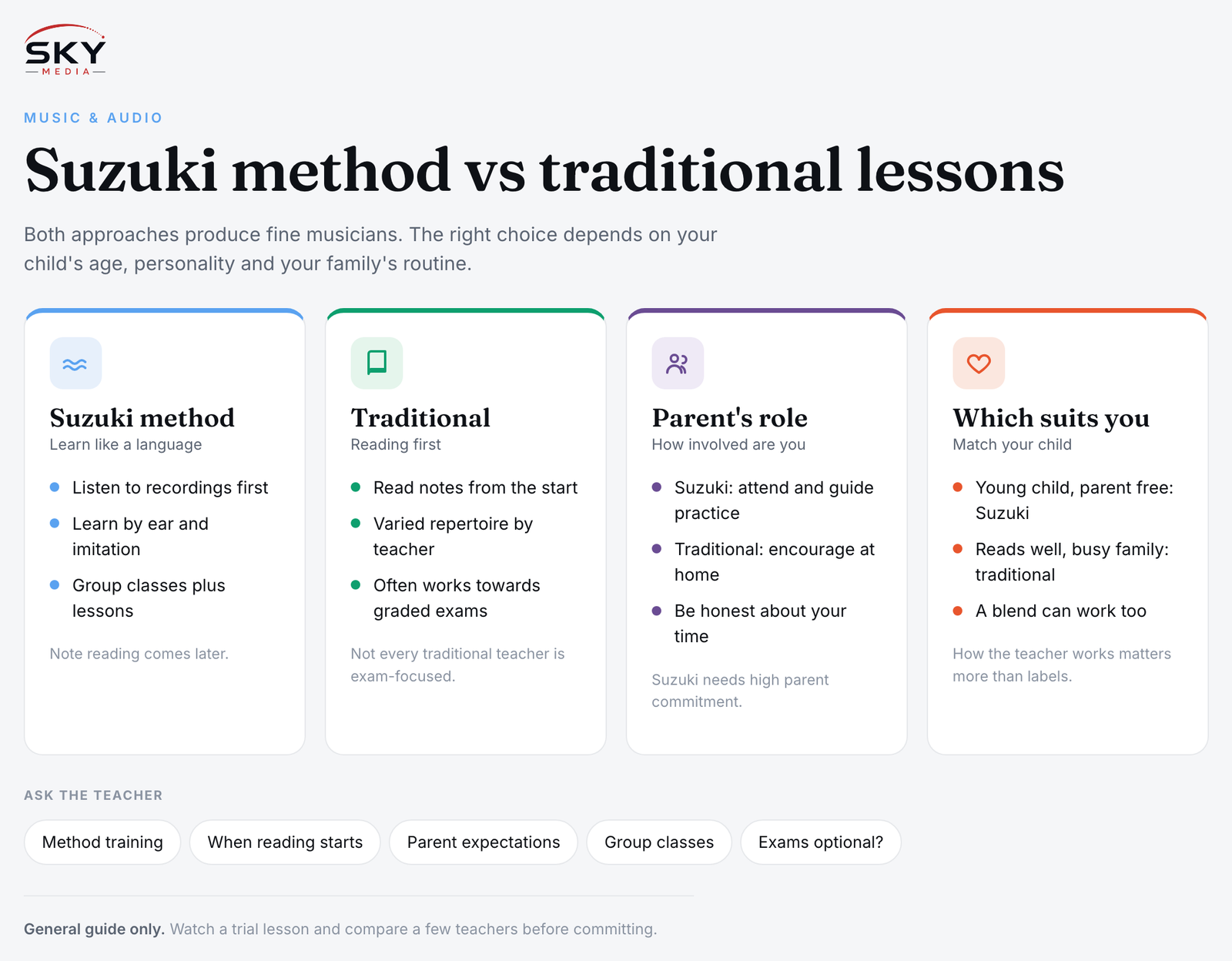
What the Suzuki Method Is
The Suzuki method was developed by Japanese violinist and teacher Shinichi Suzuki in the mid-twentieth century. His central idea was simple: every child learns to speak their mother tongue by listening, imitating and practising daily in a supportive home, long before they learn to read. He believed music could be learned the same way. That is why the approach is sometimes called the “mother tongue” method.
In practice, a Suzuki programme usually involves:
- Listening first. Children listen to recordings of the pieces they will learn, often daily, so the music is familiar before they play it.
- Learning by ear and imitation. Early pieces are taught by watching and copying the teacher rather than reading notation.
- A set repertoire. Students work through a graded series of Suzuki books, so every Suzuki student around the world learns broadly the same pieces in the same order.
- Heavy parent involvement. A parent usually attends lessons, takes notes and acts as the “home teacher” during daily practice.
- Group classes. Alongside individual lessons, children play together in groups, which builds motivation and ensemble skills.
- Early start. Many Suzuki teachers take very young children, sometimes from preschool age.
- Reading introduced later. Note reading is added once playing skills are established, rather than at the very beginning.
The method was first built around the violin but is now widely taught for piano, cello, flute, guitar and other instruments.
What Traditional Lessons Look Like
“Traditional” covers a broad range, but most traditional lessons share a common shape:
- Reading from the start. Children learn to read notes, rhythms and symbols early, often alongside their first pieces.
- Method books and varied repertoire. Teachers choose from many tutor books and pieces to suit each student.
- Individual lessons. Usually one child with one teacher, without regular group classes.
- Lighter parent role. Parents support practice at home but rarely attend lessons.
- Exams as milestones. In Singapore, many traditional teachers prepare students for graded exams from boards such as ABRSM or Trinity College London, which add theory, scales and aural tests to the learning plan.
Not every traditional teacher is exam-focused, so ask. Some teach reading-first without any exams, while others build every year around the next grade.
Suzuki Method vs Traditional: Side by Side
| Factor | Suzuki method | Traditional lessons |
|---|---|---|
| How a child first learns a piece | By listening and imitating | By reading the notes on the page |
| When reading starts | After playing basics are secure | From the first lessons |
| Parent’s role | Attends lessons and guides daily practice | Encourages practice, rarely attends |
| Lesson format | Individual lessons plus group classes | Mostly individual lessons |
| Repertoire | Fixed sequence of Suzuki books | Varied, chosen by teacher |
| Typical starting age | Often very young, including preschoolers | Often once a child can read words comfortably |
| Exams | Not built in, though some families add them later | Often central, especially in Singapore |
Strengths and Common Concerns of Each Approach
Where Suzuki shines
- Ear and tone. Constant listening tends to build a good ear, musical phrasing and confidence playing from memory.
- Early starters. Very young children who cannot read yet can still make real progress.
- Motivation through community. Group classes and shared repertoire give children friends who are learning the same pieces.
- Parent and child bonding. Practising together daily can become a warm routine.
Concerns parents raise about Suzuki
- Reading can lag. If reading is delayed too long, some children find it frustrating to switch to sight-reading later. Good Suzuki teachers plan for this, so ask how and when they introduce notation.
- High parent commitment. You need time to attend lessons and lead home practice. This can be hard for families with two working parents or several children.
- Less flexible repertoire. The fixed sequence suits many children, but some prefer variety.
Where traditional lessons shine
- Strong reading skills. Reading early gives independence to learn new pieces and join school bands or orchestras.
- Clear milestones. Graded exams give structure and certificates that some families value.
- Flexibility. Teachers can tailor repertoire to a child’s taste, including pop, film or Chinese music.
Concerns parents raise about traditional lessons
- Exam pressure. When lessons revolve only around exam pieces, some children lose interest. Watch for signs that music has become a chore.
- Weaker ear training. Playing only from the page can leave aural skills underdeveloped unless the teacher works on them.
- Harder for very young children. Reading notation before a child reads well can be slow going.
Choosing for Your Child and Your Family
Rather than asking which method is better, ask which fits your situation.
Suzuki may suit you if:
– Your child is young, perhaps preschool or early primary.
– A parent can attend lessons and practise with them most days.
– Your child learns well by listening and copying.
– You value the social side of group classes.
Traditional lessons may suit you if:
– Your child already reads comfortably and enjoys working things out from a page.
– Your schedule makes regular parent attendance hard.
– Your child wants to join a school band, choir or orchestra soon.
– You would like graded exams as clear goals.
Many children also do well with a blend. Some Suzuki teachers introduce reading and theory earlier, and some traditional teachers use recordings and ear training. Labels matter less than how a particular teacher works.
Questions to Ask Before You Sign Up
Whatever approach interests you, meet the teacher and, if possible, watch a trial lesson. Useful questions include:
- What training do you have in this method? Suzuki teachers often complete specific teacher training through a recognised Suzuki association.
- How and when do you introduce note reading?
- What do you expect from parents during lessons and at home?
- Are there group classes, recitals or performance opportunities?
- Do you prepare students for exams, and is that optional?
- What is your policy on missed lessons, holidays and notice periods?
Fees and lesson formats vary widely between teachers and schools, so compare a few before committing.
Keeping Music Enjoyable at Home
Whichever path you choose, a few habits help:
- Short, regular practice beats long, irregular sessions, especially for young children.
- Play recordings at home for fun, not only the set pieces.
- Celebrate small wins, like a tricky bar finally clicking.
- Talk to the teacher early if your child seems unhappy or stuck. Switching approach or teacher is sometimes the right answer.
The goal is a child who keeps playing because they love it. If your family enjoys exploring other instruments too, our guide to erhu lessons in Singapore for adults and children is a good starting point, and if you play yourself, see how to teach music lessons.
Further reading: The Music Elective Programme (MEP) in Singapore Schools · Music Classes for Babies and Toddlers in Singapore · ABRSM vs Trinity College London Music Exams: Which to Choose