
Allantoin is one of those ingredients that sits low on a label and rarely gets top billing, yet it quietly appears in a huge number of moisturisers, toners and soothing creams. If you have been curious about allantoin skincare in Singapore, the short version is this: it is a gentle, well-tolerated ingredient known for helping skin feel softer and calmer. It will not transform your face overnight, but it is a dependable supporting player, especially for skin that gets easily irritated by our heat, sweat and frequent cleansing.
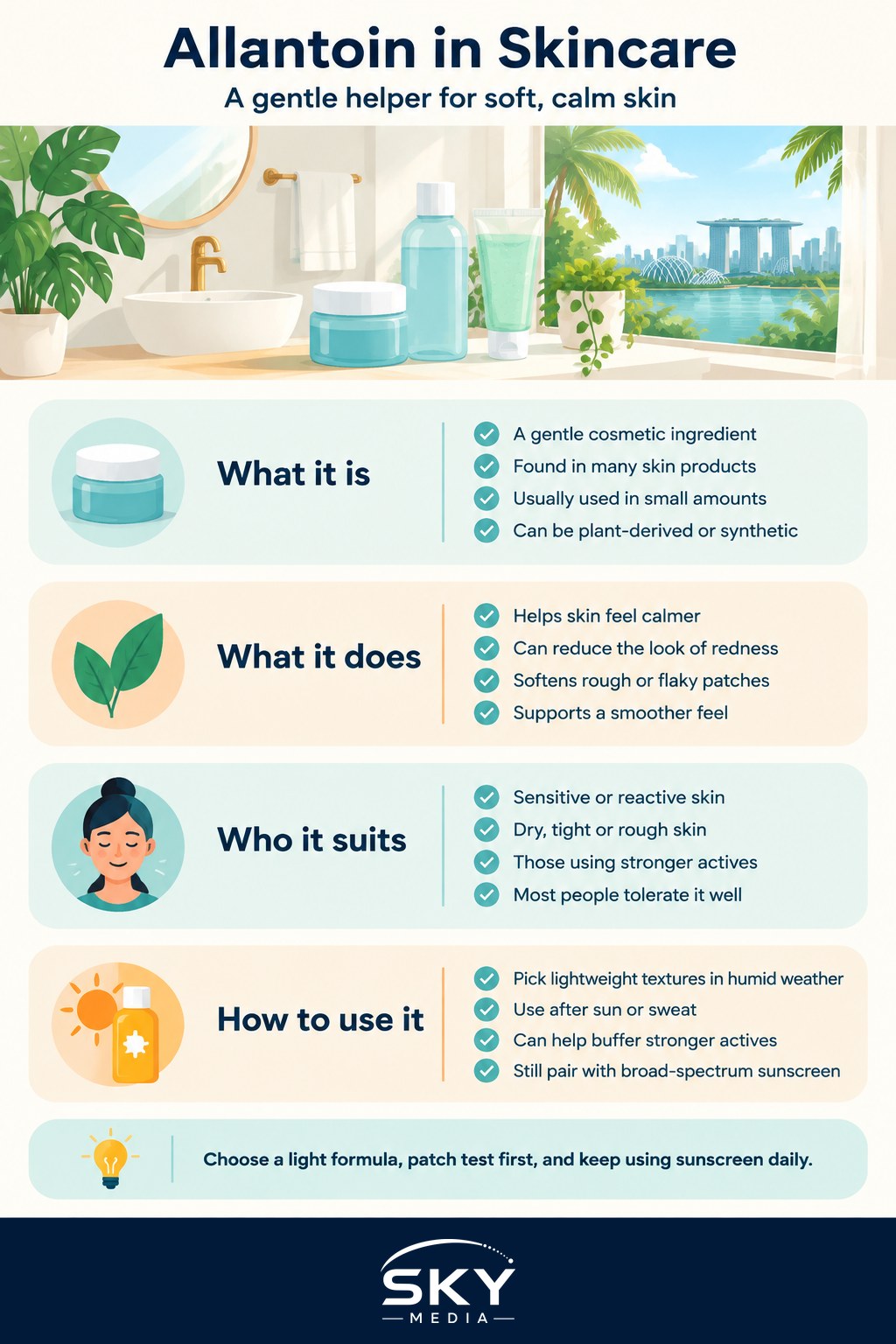
What allantoin is
Allantoin is a compound that can be derived from plants such as comfrey or made synthetically for cosmetic use. The synthetic version is common because it is consistent and pure. On an ingredient list it is simply written as “allantoin,” and it is usually present at a low percentage because a little goes a long way.
It is water-soluble and easy to formulate with, which is why you find it across so many product types: hydrating toners, sheet masks, gentle moisturisers, after-sun gels and products aimed at sensitive skin. Because it is not an active in the way an acid or a retinoid is, it does not come with the usual cautions around sun sensitivity or strict introduction rules. If you want to understand how ingredients like this fit into a wider formula, our guide to understanding skincare ingredients in Singapore gives helpful context.
What allantoin does for your skin
Allantoin is best known for two everyday roles, and it is worth being honest about what those mean in practice.
- Soothing and calming. It is widely used in products designed to make skin feel more comfortable and to reduce the look of redness and irritation. This is why it turns up so often alongside other calming ingredients.
- Softening and smoothing. Allantoin is described as a skin conditioner and a mild keratolytic, which in plain terms means it can help soften the look and feel of rough, flaky or dry patches, leaving skin feeling smoother.
These are cosmetic effects, not medical ones. Allantoin can make skin feel better and look more even in tone, but it is not a treatment for eczema, dermatitis, wounds or any skin condition. If you are dealing with persistent flaking, cracking, or irritation that does not settle, that is a reason to see a doctor or dermatologist rather than to reach for another soothing cream.
Allantoin pairs naturally with other calming ingredients. If you like this gentle approach, our piece on centella and cica for calming skin covers a popular partner ingredient, and repairing your skin barrier explains why a comfortable barrier matters so much.
Who it suits
Part of allantoin’s charm is how broadly tolerated it is. It generally suits:
- Sensitive and reactive skin, where gentler formulas are safer. Our sensitive skin care guide for Singapore is a useful companion.
- Skin that feels dry, tight or rough and needs softening.
- Anyone using stronger actives who wants a soothing product to keep things comfortable.
Even so, “gentle” is never a guarantee for everyone. Fragrance, preservatives or other ingredients in the same product could still cause a reaction. Patch test any new product, ideally following our steps for how to patch test new skincare in Singapore, and introduce one new product at a time so you can tell what your skin likes.
How to use it in Singapore’s climate
Allantoin is easy to work into a humid-weather routine because it is light and unfussy.
- Reach for lightweight textures. In our humidity, a soothing gel, essence or light lotion with allantoin usually feels more pleasant than a heavy balm.
- Use it after sun or sweat. Skin that feels hot, tight or slightly irritated after time outdoors often welcomes a calming allantoin product once you have cleansed.
- Let it buffer your actives. If exfoliating acids or a retinoid leave your skin feeling sensitive, a moisturiser containing allantoin can help keep the routine comfortable.
- Keep sunscreen in the picture. Allantoin does nothing for UV protection, so broad-spectrum sunscreen still needs to be your daily habit.
The honest limits
Allantoin has a long, unremarkable safety record in cosmetics and a reputation for being gentle and soothing. What it cannot do is match the bold “repair” and “regenerate” language that sometimes surrounds it. Any visible benefit depends on the whole formula and your individual skin, and cosmetic products are not medicines. Think of allantoin as a comfort ingredient that helps skin feel soft and calm, not as a fix for a diagnosed condition.
In short, allantoin is a quiet, reliable soother and softener that plays nicely with almost everything. Choose a light formula for our weather, patch test before you commit, keep up your sunscreen, and see a professional for anything that lingers or gets worse.
Frequently Asked Questions
Should I choose allantoin or panthenol for sensitive skin? Both are gentle supporting ingredients, and many moisturisers contain both. Panthenol is mostly valued for hydration and barrier support, while allantoin is known for softening and calming. If your skin reacts, the rest of the formula, such as fragrance, often matters more than choosing between them.
Can I use allantoin morning and night? Yes, it has no special introduction rules, unlike acids or retinoids, so a product containing it can usually be used both morning and night. Patch test a new product first and add one thing at a time. Keep sunscreen in your daytime routine, since allantoin gives no UV protection.
Will allantoin clog pores or cause breakouts? Allantoin itself is not typically described as pore-clogging, but breakouts can come from other things in a product, such as heavy oils or fragrance. If you are acne-prone, look for lightweight textures and patch test first. Persistent breakouts are worth showing to a doctor or dermatologist.
Is allantoin from comfrey, or is it made in a lab? It can be either. The compound can be derived from plants such as comfrey or made synthetically, and the synthetic version is common because it is consistent and pure. The label simply says allantoin, so it will not tell you the source; check with the brand if it matters to you.
Is allantoin safe to use while pregnant? It has a long, uneventful safety record in cosmetics, but this is not personal medical advice. If you are pregnant or breastfeeding, ask your doctor or pharmacist about your whole routine, since the other ingredients in a product, not just allantoin, will matter.