

Ancestral worship is one of the oldest and most enduring practices in Chinese culture, and it remains a living, meaningful part of many homes in Singapore today. At its heart lies a simple, tender idea: that those who have passed on are still remembered, honoured and cared for by their descendants. Far from a relic, it is a heartfelt expression of filial piety, the deep respect for parents and elders that runs through Chinese family life. This is a gentle, respectful introduction for newcomers, not a statement of doctrine. Beliefs and practices vary greatly between families, dialect groups and faiths, and questions of meaning are best left to families and their own religious communities.
Remembering Those Who Came Before
Ancestral worship, sometimes called ancestor veneration, centres on honouring deceased parents, grandparents and forebears. For many families it grows from the Confucian value of filial piety, or xiao (孝), extended beyond a parent’s lifetime into ongoing remembrance and care. Alongside this, Taoist and folk-religious ideas about the continuing bond between the living and the departed shape how different households understand the practice.
It is important to say plainly that not all Chinese Singaporeans observe ancestral worship. Some hold it as a religious practice, some as a cultural or family tradition, and others, including many Christian and non-religious families, do not practise it at all, while still honouring their forebears in their own ways. What it means to each family is theirs to define, and this guide describes the customs respectfully rather than speaking for anyone’s beliefs.
The Family Altar and Its Elements
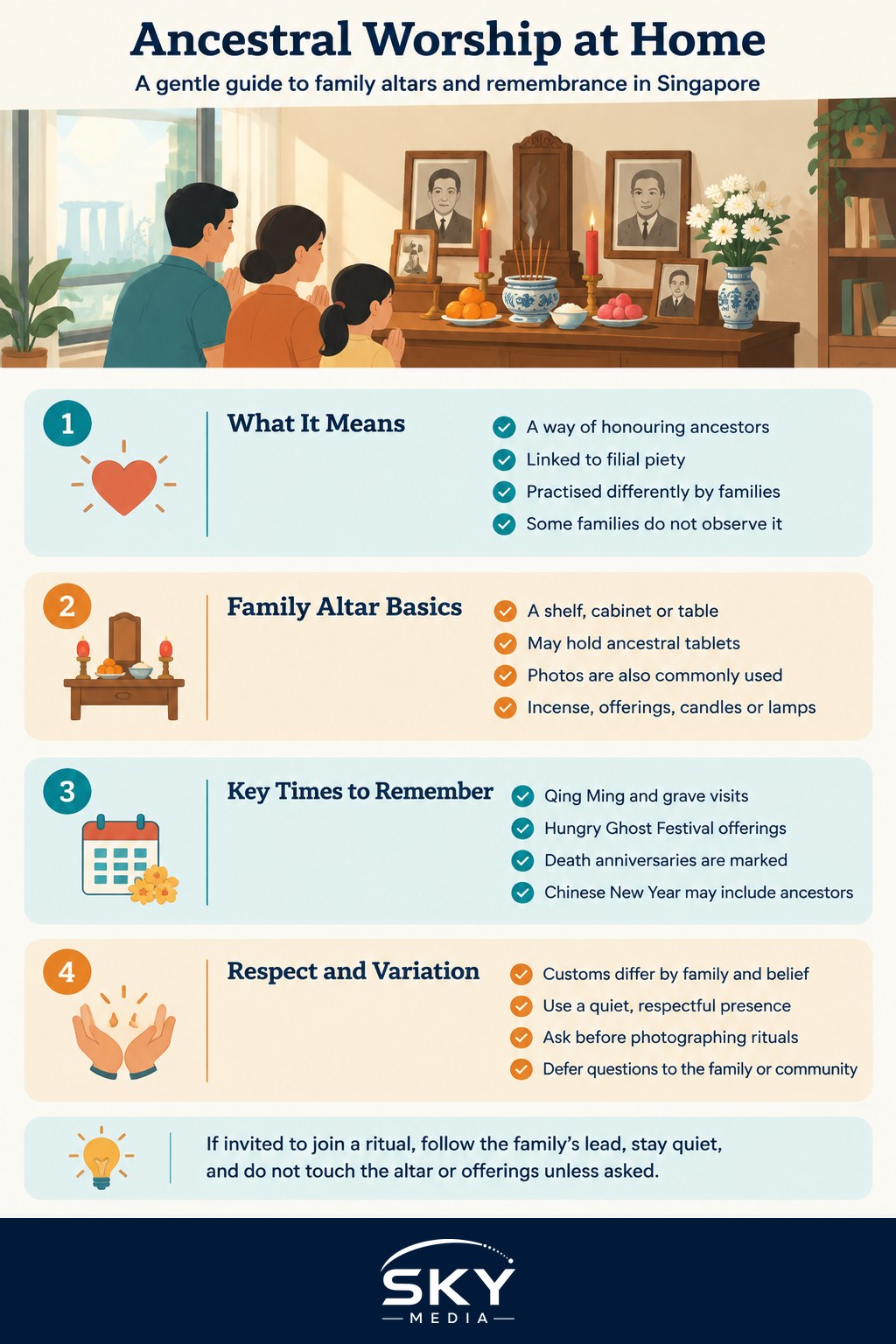
In homes that keep the tradition, a family altar is often the focal point. This may be a dedicated shelf, cabinet or table, frequently set at a height and place chosen with care. Its elements vary, but several appear commonly:
- An ancestral tablet, or shen zhu pai (神主牌), a small plaque bearing the names of ancestors, standing as a focus for remembrance.
- Photographs of departed loved ones, especially in more modern homes.
- An incense holder for joss sticks, whose rising smoke is often understood as carrying respect and prayers.
- Offerings such as fruit, tea, rice or cooked food, and cups of wine or tea, refreshed regularly.
- Candles or lamps, and sometimes statues of deities, since many homes honour both deities and ancestors, though the two are distinct.
Daily or regular observance can be as simple as lighting joss sticks and offering a quiet greeting, a gentle way of keeping the departed present in the rhythm of family life. The exact arrangement, and how often it is tended, differs widely from home to home.
Times of Remembrance Through the Year
Beyond everyday care of the altar, certain times draw families together for fuller remembrance. The best known is Qing Ming (清明), often called the Tomb-Sweeping Festival, when families visit graves or columbarium niches to clean them, offer food and flowers, and pay respects. In Singapore, where many ancestors rest in columbaria, Qing Ming remains a widely observed occasion each spring.
Other moments include:
- The Hungry Ghost Festival in the seventh lunar month, when many families make offerings; practices here vary a great deal by belief.
- Death anniversaries of particular ancestors, marked quietly at the altar or with a family meal.
- Chinese New Year and other festivals, when families may inform ancestors of the season and include them in the celebration.
At several of these times, families may burn joss paper, sometimes folded into symbolic forms, as an offering to the departed. As with everything here, whether and how a family observes these occasions depends on its own beliefs and customs.
How Practices Vary, and How to Show Respect
There is no single, uniform way that ancestral worship is practised, and it would be wrong to suggest otherwise. Customs differ across Hokkien, Teochew, Cantonese, Hakka, Hainanese and other communities, across Taoist, Buddhist, folk and secular outlooks, and from one family to the next. The table below contrasts a few elements to show how differently they can be approached. It is an illustration of variety, not a set of instructions.
| Element | How it may be approached |
|---|---|
| Family altar | A dedicated home shrine, a simple shelf, or none at all |
| Ancestral tablet | A traditional named plaque, replaced or joined by photographs |
| Daily observance | Regular incense and greetings, or attention mainly on key dates |
| Qing Ming | A visit to clean and honour graves or columbarium niches |
| Offerings | Food, tea and joss paper, varying by family and belief |
| Whether it is practised | Central for some families, not observed by others |
If you are welcomed into a home or to a graveside observance, a respectful and quiet presence is the kindest response. Follow the family’s lead, do not touch the altar or offerings unless invited, ask before photographing a private ritual, and treat the tablets, incense and offerings with the same care you would show at any place of remembrance. Marrying into a family that practises ancestral worship, or living in a shared home where an altar is kept, simply calls for the same courtesy you would extend to any sincerely held tradition.
A Living Bond Between Generations
For newcomers, the most helpful way to understand ancestral worship is to see it not as superstition to be judged but as a form of love and memory, one culture’s way of keeping the departed close and honouring the debt each generation owes to the one before. That impulse to remember our elders is something almost every culture shares, even where the customs look very different.
Because it touches faith, family and grief all at once, ancestral worship deserves to be approached with humility. Where questions of meaning or doctrine arise, the wisest course is to defer to each family and to their own temple, clan association or religious community, who can speak to their practice far better than any guide can.
Explore more
Respect for elders in life carries through to the practices here; see how it shapes celebrations in Chinese Birthday and Longevity Customs in Singapore. For how family identity is passed down the generations, read Chinese Naming and Generation Names in Singapore, and for where the family story begins, The Chinese Baby First-Month Celebration in Singapore.
Frequently Asked Questions
Can I set up a family altar at home if I am renting or living in a flat? Many families do keep a small altar in a flat, but be mindful of neighbours, fire safety and any rules from your landlord or town council. Keep incense modest and ventilated, never leave it unattended and ask elders or a temple how to place it respectfully.
Is it acceptable to burn incense in an HDB flat? Many families do, but smoke and ash can disturb neighbours and trigger smoke detectors. Use a stable holder, burn only what you need, keep the area clear of flammable items and open a window. Check HDB, town council or landlord guidelines if you are unsure.
What happens to the ancestral altar when a family moves house? Families usually handle this with care, often seeking guidance from elders, a temple or a religious teacher on when and how to move the tablets or photographs. Practices differ, so there is no single method. Arrange a calm, respectful move rather than rushing.
Can a Christian or non-religious family member take part in Qing Ming? Yes, many attend simply to be with family and show respect, even if they do not make offerings or burn incense. Everyone decides what they are comfortable with, and a quiet presence at the graveside or columbarium is a respectful way to join in.
What should I prepare for Qing Ming at a columbarium? Check the operator’s current visiting arrangements, such as hours, crowd control and any booking, before you go. Bring cloths and flowers, wear comfortable shoes and follow the family’s plan. Official rules on offerings and burning vary, so check with the columbarium management or the National Environment Agency.
Further reading: Remembering Ancestors at Qing Ming as a Christian Family · Chung Yeung Festival in Singapore: Customs and Ancestral Rites · Datuk Kong and Malay-Chinese Folk Worship in Singapore