

Walk through certain older neighbourhoods of Singapore, or past a large tree or a quiet corner of an industrial estate, and you may come across a small shrine painted in bright colours, often yellow and green, with offerings placed carefully before it. This is a shrine to Datuk Kong, a guardian spirit venerated in a fascinating tradition that blends Malay and Chinese folk belief. The worship of Datuk Kong Singapore is one of the region’s most distinctive examples of religious syncretism, and it offers a gentle, respectful lesson in how communities living side by side can weave their beliefs together over time.
Datuk Kong worship is a folk tradition rather than an organised religion, and it varies from place to place and from devotee to devotee. This guide aims to explain the practice sensitively and accurately, without reducing it to caricature. It is a living form of devotion held sincerely by many, and it deserves to be understood on its own terms as part of Singapore’s rich spiritual heritage.
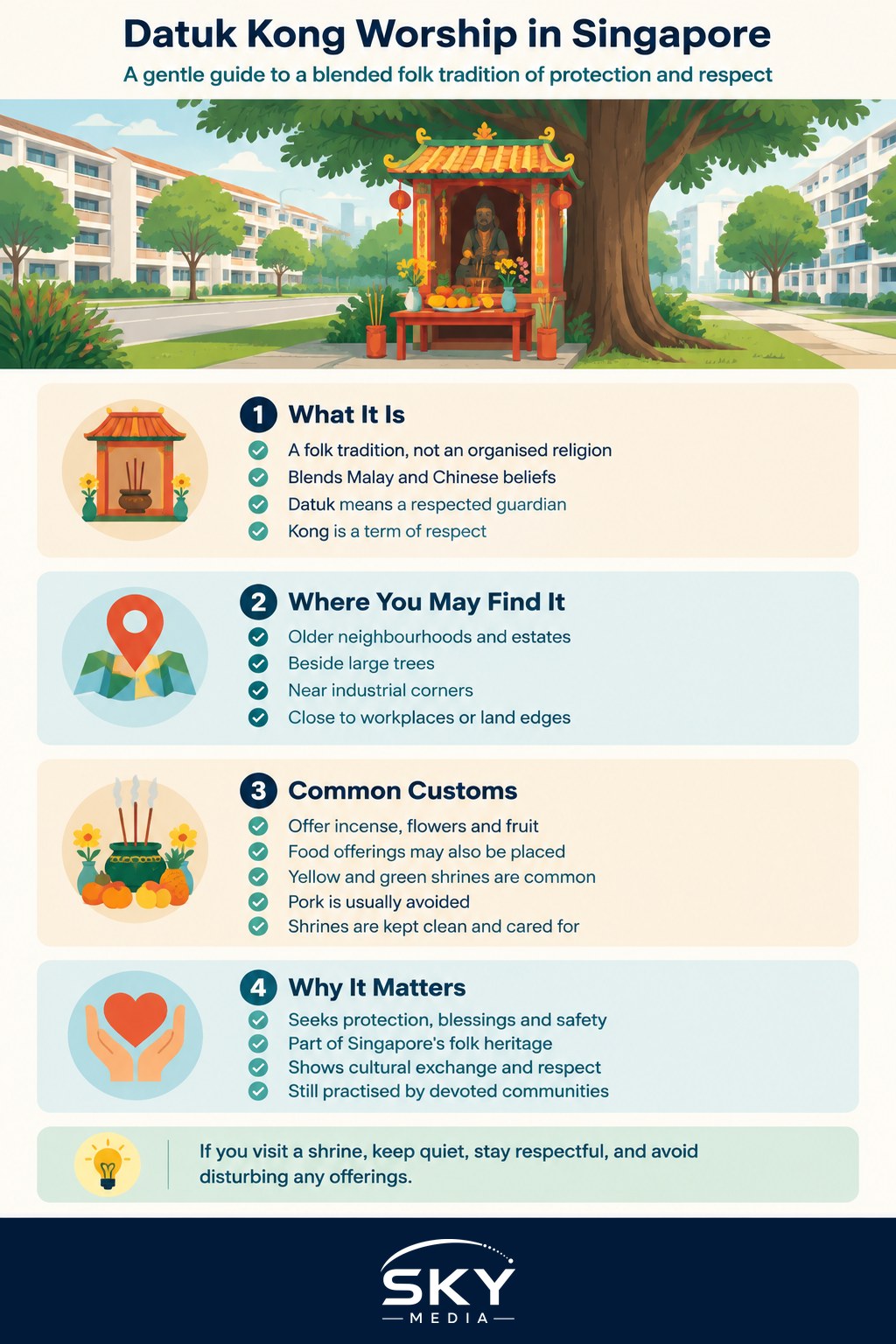
What Datuk Kong Worship Is
The name Datuk Kong brings together two strands of meaning. Datuk, or Dato, is a Malay term of respect, often used for an elder, a chief or a revered figure, and here it points to a local guardian spirit believed to watch over a particular place. Kong is a Chinese term of respect for an elder or ancestor, roughly meaning grandfather or venerable one. Put together, the name reflects the very heart of the tradition, a Malay guardian spirit honoured through customs drawn largely from Chinese folk religion.
The tradition is understood to have grown among Chinese communities in the Malay world, who came to venerate local guardian spirits believed to inhabit and protect the land. Rather than replacing their own customs, they honoured these local spirits using familiar Chinese forms of worship, such as offering incense, food and prayers at a shrine. In this way a genuinely blended, or syncretic, practice took shape, in which a spirit understood in Malay terms is worshipped in a largely Chinese manner. It is a striking illustration of cultural exchange and mutual respect between communities.
Devotees turn to Datuk Kong as a guardian and a source of protection, seeking blessings, safety and good fortune, and sometimes guidance in daily life. Because the Datuk is understood as a local guardian of a specific place, shrines are often found where people feel his presence is strong, such as beside an old tree, at the edge of a plot of land or near a workplace.
Customs and Offerings
The customs surrounding Datuk Kong worship reflect its blended origins, and they are practised with care and sensitivity to the Datuk’s understood character. Devotees typically offer incense, flowers, fruit and other food at the shrine, and they may say prayers asking for protection or blessing. Shrines are frequently painted in yellow, a colour associated with respect and reverence, and green, a colour linked to the Malay and Islamic heritage from which the figure of the Datuk draws.
A particularly notable feature of the tradition is the attention paid to what is considered appropriate to offer. Because the Datuk is understood within a Malay frame of reference, many devotees are careful to avoid offerings that would be considered unsuitable in that context, most importantly pork. Instead, offerings often include items that are acceptable within that understanding, and some devotees present foods and other items thought to please the guardian spirit. This thoughtful adaptation shows a real sensitivity to the Malay elements of the tradition, and it is one of the clearest signs of its genuinely syncretic nature.
Devotees generally approach the shrine with quiet respect, keeping the area clean and tending to it with care. As with all sincere religious practice, these customs are carried out with devotion and should be observed by onlookers courteously and without mockery.
A Living Part of Singapore’s Folk Heritage
Datuk Kong shrines can still be found in various parts of Singapore, often in older estates, near mature trees or in corners of industrial and commercial areas. They may be modest structures, yet they are cared for by devotees who continue a tradition passed down over generations. The persistence of these shrines speaks to the enduring appeal of folk worship and to the way local spiritual practices adapt and survive amid rapid modernisation.
The worship of Datuk Kong sits within a wider world of Chinese folk religion in Singapore, which includes the veneration of many deities and guardian figures. Readers interested in this broader landscape may enjoy learning about Taoist deities and their festivals and the lively deity birthdays and temple processions that punctuate the local calendar. The syncretic character of Datuk Kong worship also connects to the seasonal rhythms of Lunar New Year in Singapore, when many folk shrines see an increase in devotees seeking blessings for the year ahead.
More than anything, Datuk Kong worship stands as a gentle testament to Singapore’s long history of cultural mingling. It shows how communities of different backgrounds, living together over generations, can arrive at shared expressions of reverence that honour more than one heritage at once. As part of the nation’s tradition of religious harmony and festivals, the humble roadside shrine of Datuk Kong offers a quiet but powerful reminder of the respect and understanding that can grow between neighbours.