
Each autumn, on the ninth day of the ninth lunar month, some Chinese families in Singapore make a quiet trip to a columbarium or cemetery. They bring flowers, food offerings, joss sticks and a little cleaning kit. This is the Chung Yeung Festival, known in Mandarin as Chongyang (重阳节) and in English as the Double Ninth Festival.
Many people know Qing Ming as the main tomb-sweeping festival. Chung Yeung is its autumn counterpart, and in some families, especially Cantonese and Hakka households, it carries similar weight. This guide explains what the festival means, how families in Singapore observe it, and what to expect if you visit a columbarium during this period.
What the Double Ninth Means
In traditional Chinese thought, nine is a yang number, linked with brightness and strength. Having two nines on the ninth day of the ninth month gives the festival its name. Over the centuries, this “double yang” date became associated with both caution and longevity.
A well-known legend tells of a man who was warned to take his family to high ground on that day to escape a disaster. When they returned home, they found their animals dead in their place. From this story came the custom of climbing hills, carrying dogwood (zhuyu) and drinking chrysanthemum wine for protection.
Over time, the festival picked up several layers of meaning:
- Honouring ancestors through tomb visits and offerings
- Respecting elders, since the word for nine sounds like the word for “long-lasting”
- Autumn outings, including hill climbing and admiring chrysanthemums
In mainland China, the day is also observed as a day for respecting seniors. In Singapore, the ancestral rites tend to be the most visible part.
Chung Yeung Compared With Qing Ming
Both festivals involve visiting and caring for the resting places of ancestors, but they differ in timing and feel.
| Aspect | Qing Ming | Chung Yeung |
|---|---|---|
| Timing | Spring, around early April on the solar calendar | Autumn, ninth day of the ninth lunar month, usually October |
| Main focus | Tomb sweeping and ancestor remembrance | Ancestor remembrance, plus respect for elders and longevity |
| Crowds in Singapore | Typically very busy at columbaria, often spread across several weekends | Usually quieter, though some columbaria still see a weekend rush |
| Who observes it most | Widely observed across Chinese dialect groups | Observed more strongly by some families, notably many Cantonese and Hakka households |
Some families visit at both festivals. Others choose one, depending on family tradition, work schedules or what their elders practised. There is no single correct approach.
How Families Observe It in Singapore
Most ancestors in Singapore today are housed in columbaria rather than in-ground graves, because land is limited and burial plots are exhumed after a set period under government policy. As a result, Chung Yeung visits in Singapore usually mean a trip to a government or private columbarium, or to a temple with niches for urns.
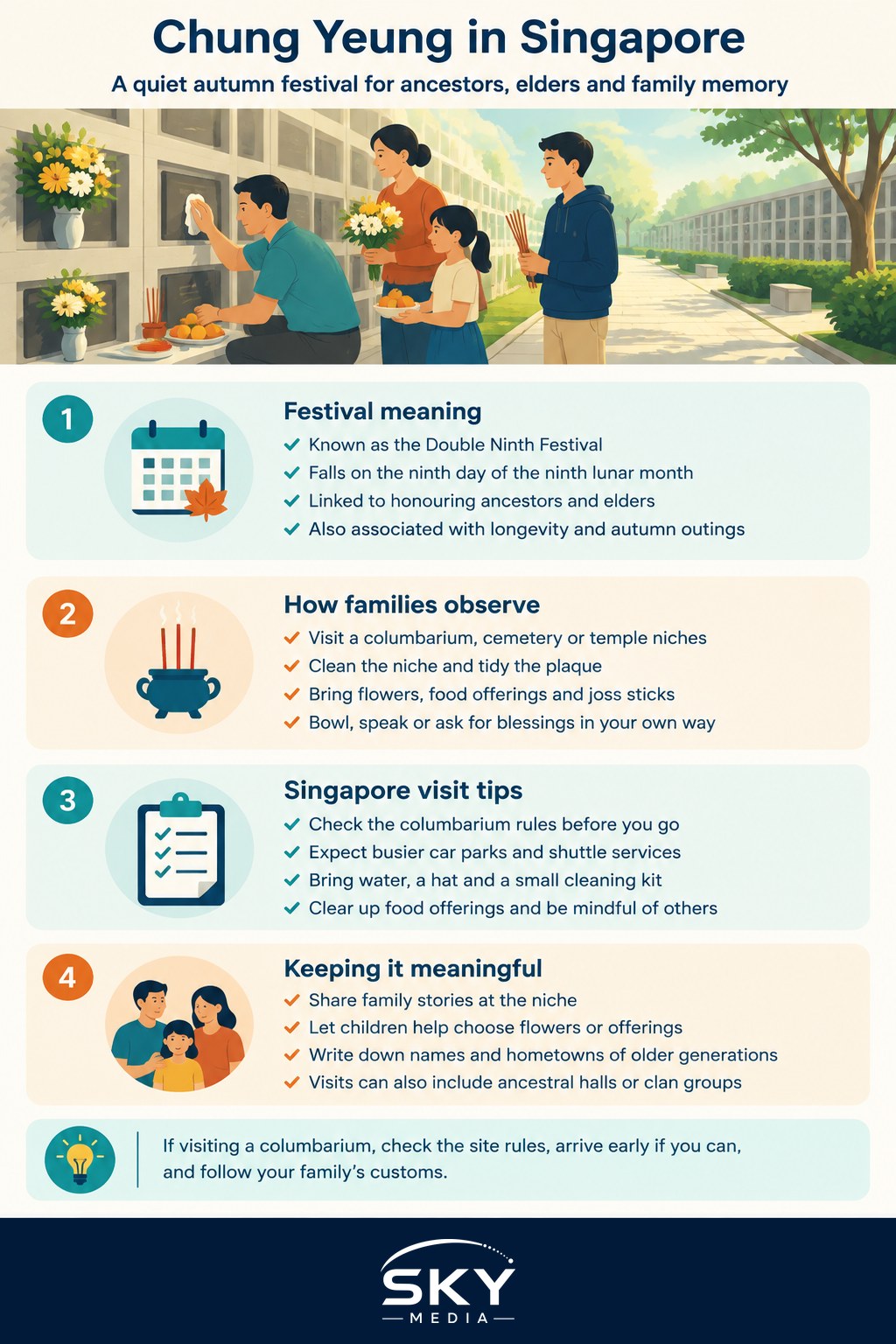
A typical family visit might include:
- Cleaning the niche with a damp cloth and tidying the plaque
- Offering flowers, often chrysanthemums, which are tied to the season and to remembrance
- Placing food, such as fruit, roasted meats, cakes or the ancestor’s favourite dishes
- Lighting joss sticks and candles in designated areas
- Burning joss paper in provided burners, where allowed
- Bowing and speaking to the ancestor, sharing family news or asking for blessings
Families usually observe Chung Yeung within a window around the actual date, not only on the day itself. Many columbaria see visits over the weekends before and after, which helps working families attend.
Practices vary a lot from family to family. Buddhist families might chant or bring vegetarian offerings, Taoist families might follow a particular order of rites, and many families simply follow what their parents and grandparents did. Some Christian or freethinking relatives join visits to pay respect without taking part in the rituals.
Columbarium Etiquette and Practical Tips
If you are visiting a columbarium during Chung Yeung, especially for the first time, a few practical points help.
- Check the rules before you go. Many columbaria have designated areas for joss sticks and burning, and some restrict burning or certain offerings. Each site sets its own rules, so check with the columbarium operator. For government columbaria, the National Environment Agency (NEA) publishes visitor information.
- Plan for crowds and traffic. Expect busier car parks and shuttle services around the festival weekends. Public transport or going early in the morning can help.
- Bring a small kit. A cloth, a small bag for rubbish, a lighter and a foldable stool for elderly relatives are useful.
- Clear up afterwards. Take food offerings home or dispose of them as the columbarium instructs, so they do not attract pests.
- Mind the heat. Bring water, a hat or umbrella, and keep elderly family members out of the sun for long periods.
- Be patient and respectful. Other families are remembering their loved ones too. Keep voices low and give people space.
Sharing the Meaning With Younger Generations
For many families in Singapore, Chung Yeung is a chance to pass down family history. A visit becomes a natural moment to explain who an ancestor was, where they came from and how the family came to Singapore.
Ways families keep the tradition meaningful:
- Telling a story about the ancestor at the niche
- Letting children help choose flowers or arrange offerings
- Visiting the family’s ancestral hall or clan association, if they have one
- Writing down the names and hometowns of older generations
Our guides to ancestral worship and family altars in Singapore and Chinese ancestral halls and lineage explain the wider practices that Chung Yeung connects to.
For Newcomers and Non-Chinese Friends
If you are new to Singapore, including newcomers from mainland China where Chongyang often focuses more on elders and outings, you may notice the stronger emphasis on columbarium visits here. Both are part of the same tradition, simply weighted differently.
If a friend or colleague invites you along, it is a sign of trust. Dress modestly in subdued colours, follow their lead on bowing or offering joss sticks, and feel free to stand respectfully if you prefer not to take part. Asking quietly about the ancestor is usually welcome.
For more on the seasonal festivals that shape the Chinese calendar in Singapore, see traditional Chinese customs in Singapore and our guide to Hungry Ghost Festival customs and taboos for newcomers.
Chung Yeung is a quiet festival, without the noise of Chinese New Year or the lanterns of Mid-Autumn. But for the families who keep it, the simple act of tidying a niche and offering flowers is a way of keeping their ancestors close.