

For art students, the hardest part of making work is often not the idea but the space. Canvases do not fit in a shared HDB bedroom, turpentine fumes are unwelcome at the dining table, and a school studio is not always available once term ends or you graduate. Art studio rental in Singapore can feel out of reach, but there are more routes than most students realise, from hourly bookings to shared studios split among friends.
This guide is about the practical side: finding space, sharing it, checking the paperwork and keeping costs and relationships manageable. It does not cover art classes or open studio events, but the hands-on business of getting a room to work in.
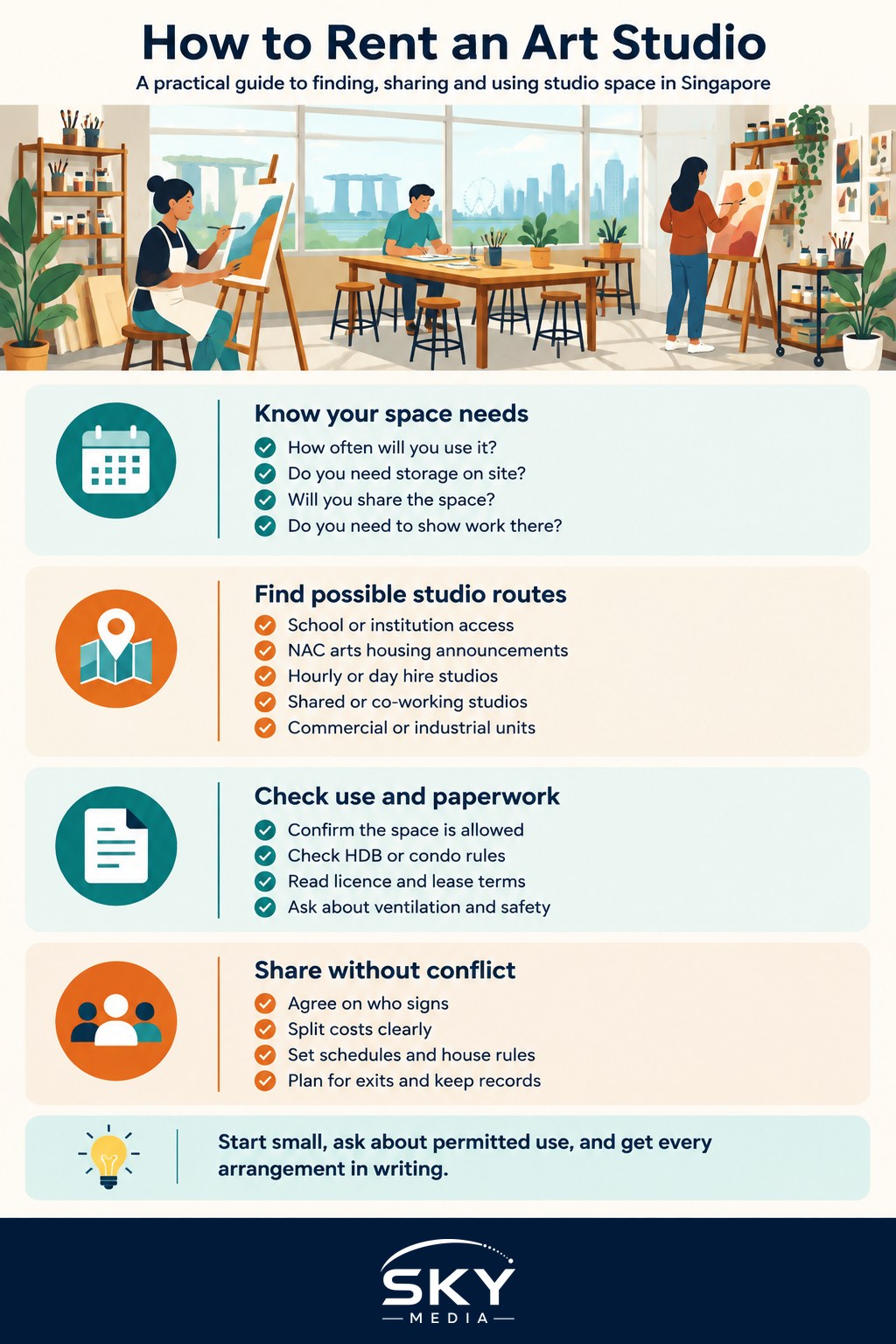
Know What Kind of Space You Actually Need
Before searching, be clear about how you work. A painter working on small canvases has very different needs from a sculptor using power tools or a printmaker with inks and a press.
Ask yourself:
- How often do you need it? A few hours a week, several full days, or round the clock?
- What does your practice involve? Wet media, solvents, dust, noise, kilns or heavy materials narrow your options considerably.
- Do you need storage? Leaving works in progress and materials on site is a big advantage.
- Do you need to show work there? Some artists want a space that can double as a small viewing room for tutors or buyers.
- Will you share? Splitting a space is often the only affordable way for students, but it brings its own rules.
Being honest about these needs saves you from paying for a large room you rarely use, or renting somewhere that turns out to ban the very materials you work with.
Where Students Find Studio Space
There is no single marketplace for artist studios in Singapore, so most people combine several routes.
Your school or institution. Many arts institutions and universities offer studio access to current students, and some have schemes or alumni arrangements for recent graduates. Ask your department office or programme leader what is available, including during holidays.
Arts housing and subsidised spaces. The National Arts Council (NAC) has supported arts spaces under its arts housing schemes, which usually go to established groups and practitioners through an application process. Students may not qualify directly, but tenants in these buildings sometimes sublet desks or share space, so it is worth keeping an eye on their announcements. Check NAC’s website for current schemes and eligibility.
Hourly or day hire studios. Some creative spaces, community art studios and makerspaces rent out rooms or workbenches by the hour or day. This suits students with irregular schedules or one-off large projects.
Shared and co-working studios. Groups of artists sometimes lease a unit and rent out individual desks or wall space to others. These are often advertised through word of mouth, art school networks and social media groups.
Commercial and industrial units. Some artists lease small light industrial or commercial units. These can offer more room and fewer neighbours to disturb, but leases are more formal and permitted uses are tightly controlled, as explained below.
Community and craft studios. If your medium is ceramics or crafts, existing studios sometimes offer membership or open-access time. Our guide to pottery and craft studios in Singapore gives a sense of what these spaces look like.
Comparing Your Studio Options
| Option | Who it suits | Typical commitment | Key things to check |
|---|---|---|---|
| School studio access | Current students and some recent graduates | Term or programme based | Booking rules, access hours, what happens after graduation |
| Hourly or day hire | Irregular schedules, one-off projects | Per session | Material restrictions, clean-up rules, cancellation terms |
| Shared desk in a group studio | Students wanting a community and lower cost | Monthly or rolling | Written agreement, storage, house rules, notice period |
| Leasing a whole unit with friends | Committed groups with steady practice | Fixed-term lease | Permitted use, landlord consent, who signs, how costs are split |
| Craft studio membership | Ceramics, textiles, printmaking | Membership period | Equipment access, firing or press fees, safety induction |
Checking Permitted Use and Paperwork
This is where many first-time renters get caught out. A space being available does not mean it can legally be used as an art studio.
- Permitted use. Commercial and industrial properties have approved uses. Ask the landlord or agent to confirm that the unit can be used for your type of creative work. For questions about property use, the Urban Redevelopment Authority (URA) and, for industrial estates, JTC Corporation are the relevant bodies, and their websites explain how use is regulated.
- Residential property. Running a studio that brings in visitors, noise or hazardous materials in a flat or condo can breach HDB rules or the condo’s by-laws. Check with HDB or your MCST (the management corporation of a condo) before using a home as a working studio.
- Licence vs lease. Many shared studios offer a licence to use a desk rather than a formal lease. Read what you are signing, including notice periods, deposits and what happens if the main tenant leaves.
- Safety. If you use solvents, kilns, spray paints or power tools, ask about ventilation, fire safety and whether the landlord permits them. Do not assume.
General information only: for anything contractual, read the agreement carefully and consider getting advice before signing. Our guide to spotting rental scams is written for homes, but its warning signs, such as pressure to pay before viewing, apply to studio listings too.
How to Share a Studio Without Falling Out
Shared studios are the most realistic option for many students, and the friendships they create are part of the appeal. Problems usually come from unspoken expectations, so write things down early.
- Agree on who signs. If one person signs the lease, the others depend on them. Discuss whether everyone signs, or put a simple written agreement in place among yourselves.
- Split costs transparently. Decide whether rent is split equally or by space used, and agree on how utilities, internet, cleaning supplies and repairs are shared.
- Set a schedule if space is tight. A shared online calendar avoids clashes for large tables, walls or equipment.
- Define house rules. Cover noise, guests, music, cleaning up wet media, food, and overnight work.
- Plan for exits. Agree how much notice someone gives before leaving and how their share is covered until a replacement is found.
- Keep records. Note who paid what and when, so there are no disputes at the end of the term.
Making Your Budget Go Further
Studio space is a real expense for students, so think about value rather than size.
- Start small. A shared desk or hourly booking lets you test whether you actually use the space before committing to a lease.
- Look for off-peak times. Some hire spaces have quieter periods that may be easier to book.
- Pool equipment. Sharing large items such as easels, a press or drying racks reduces individual costs.
- Ask about grants. NAC and some institutions run grant schemes that may support creative projects; check their current terms rather than relying on assumptions.
For a lighter, social way to paint without committing to a space at all, our guide to art jamming and paint studios covers drop-in options.
Getting Started This Month
Write down your needs, ask your school about access, and message classmates to see who else is looking. Visit at least two spaces before deciding, ask direct questions about use and rules, and get every arrangement in writing. A modest, well-run shared studio will serve your practice far better than an ambitious space you cannot sustain.