

If you want to study music, dance, theatre, fine art, design or film, Singapore has more routes than many students realise. You can start with a diploma at a specialist arts school or a polytechnic, go straight into an arts degree, or combine the two. Choosing an arts degree Singapore pathway is less about picking the “best” school and more about matching the course style, entry route and end goal to the kind of creative work you want to do.
This guide maps the main types of institutions and the pathways between them. Programme names and entry rules change, so always check each school’s official website for the current details.
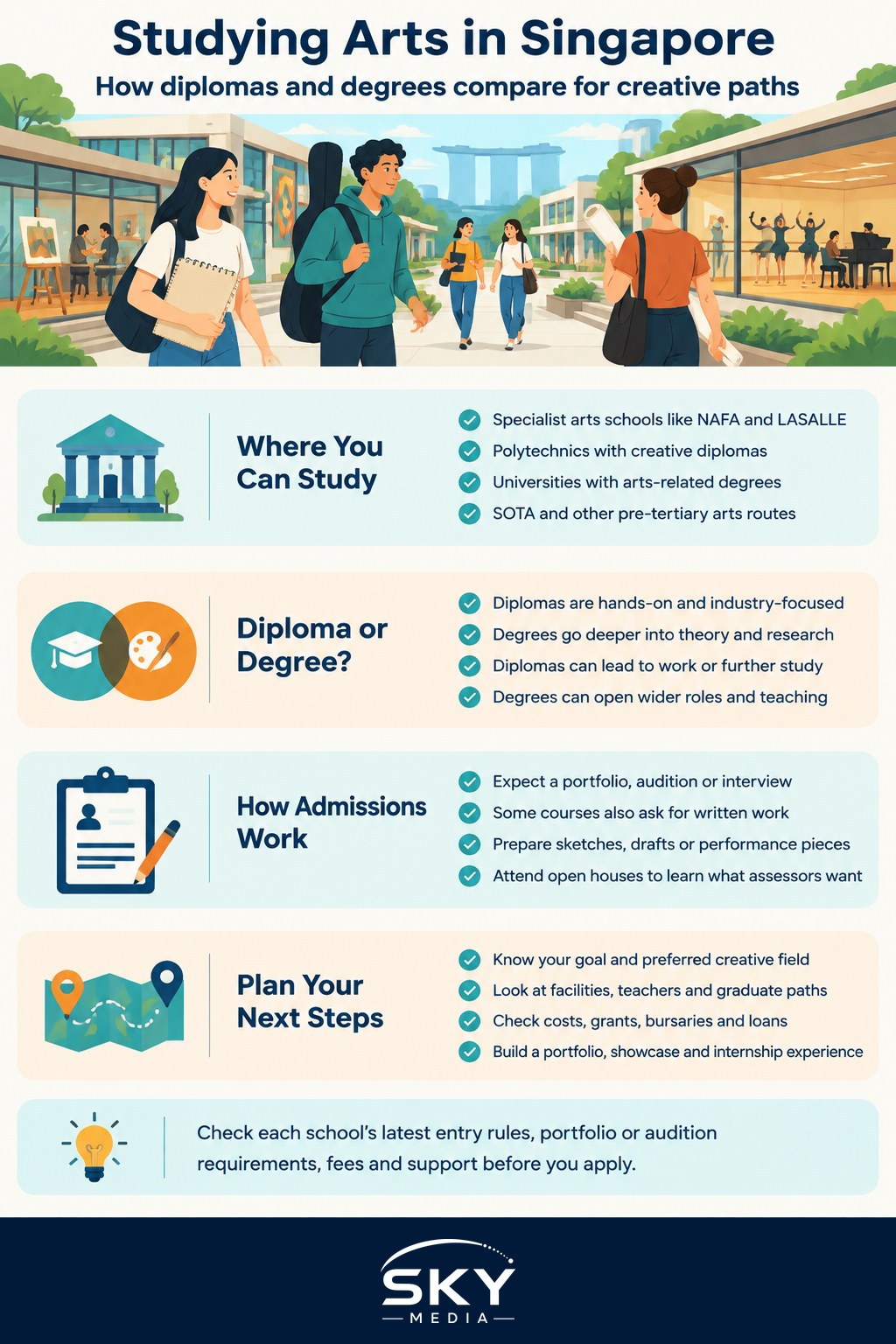
The Main Places to Study the Arts
Specialist arts institutions
Singapore has two long-standing specialist arts schools: the Nanyang Academy of Fine Arts (NAFA) and LASALLE College of the Arts. Both offer diplomas and degrees across visual arts, design, performing arts, music and media. They now come together under the University of the Arts Singapore (UAS), an alliance set up to award degrees in the arts. Students typically still apply to and study at NAFA or LASALLE, with degree programmes awarded through UAS. Check the UAS, NAFA and LASALLE websites for how this works for your intake year.
These schools focus on studio and practice-based learning. Expect a lot of time in rehearsal rooms, studios and workshops, plus portfolio reviews and performances.
Polytechnics
Several polytechnics run creative diplomas in areas such as design, media, animation, film, games, music and arts management. Courses tend to be applied and industry-facing, with internships built in. A polytechnic diploma can lead straight to work or to further study at university.
Autonomous universities
Some local universities offer arts-related degrees within a broader university setting. Examples include a dedicated music conservatory at the National University of Singapore and an art, design and media school at Nanyang Technological University. Some universities also offer design, architecture or arts and culture management degrees. Entry is usually through the standard university admissions route, often with an audition, portfolio or interview.
Pre-tertiary arts schools
The School of the Arts (SOTA) is an independent arts school for secondary and pre-university students, with its own pre-tertiary qualification. If you are younger, this may shape your later options. Many secondary schools and junior colleges also run arts electives or programmes.
Diploma or Degree: How the Paths Compare
For a broader look at this choice across all fields, see our guide to choosing between a diploma and a degree. For the arts specifically, the main differences look like this:
| Factor | Arts diploma (specialist school or poly) | Arts degree (UAS or university) |
|---|---|---|
| Typical focus | Hands-on skills and industry practice | Deeper practice plus theory, research and critical thinking |
| Common entry | O-Level, N-Level progression, ITE, or equivalent, often with portfolio or audition | A-Level, IB, poly diploma or equivalent, plus portfolio, audition or interview |
| Outcome | Entry-level creative roles or progression to a degree | Wider range of roles, teaching pathways, postgraduate study |
| Learning style | Studio projects, internships, industry briefs | Studio work plus essays, dissertations and independent projects |
| Time commitment | Usually shorter | Usually longer, with options to enter later years from a diploma |
Treat this table as a general guide. Some diplomas include substantial theory, and some degrees are intensely practical.
Common Pathways Students Take
There is no single correct route into a creative career. Some common patterns:
- Diploma straight to work. Many designers, animators and media professionals start working after a polytechnic or specialist diploma, building a portfolio on the job.
- Diploma then degree. A diploma graduate may apply for a degree, sometimes with advanced standing, meaning they can skip part of the course. Ask each school whether your diploma qualifies and which year you would enter. Our guide to top-up degrees in Singapore explains how these shorter degree routes work in general.
- A-Levels or IB to degree. Students from junior colleges or IB schools often apply straight to a degree, with an audition or portfolio alongside academic results.
- Working adults returning to study. Some institutions run part-time or evening courses for working adults who want a formal qualification. See our guide to part-time and flexible degrees for how these generally work.
- Overseas study after a local diploma. Some students move overseas for a degree. If you plan this, check how the overseas university views your diploma before you enrol.
Auditions, Portfolios and Interviews
Arts admissions rarely rely on grades alone. Expect at least one of the following:
- Portfolio. For visual arts, design, film and animation. Schools usually want to see your process, such as sketches and drafts, not just finished pieces. Read each school’s portfolio brief closely, because requirements differ.
- Audition. For music, dance and theatre. You may need prepared pieces, sight-reading or movement tests, depending on the discipline.
- Interview. Many programmes ask why you want to study the course and what you hope to create. Be ready to talk honestly about your influences and goals.
- Written work. Some degree courses ask for a short essay or statement.
Start preparing months before applications open. Attend open houses, where you can see student work, talk to lecturers and ask what assessors look for.
How to Choose the Right Course
Before you decide, work through these questions:
- What do you want to make or do? A performer, a graphic designer and an arts administrator need very different training.
- How do you learn best? If you thrive on making things, a studio-heavy course may suit you. If you also enjoy reading and debate, a degree with more theory may be better.
- What facilities will you use? Visit studios, theatres, recording rooms and workshops. Ask how much access students have outside class hours.
- Who teaches? Look at the practising artists and industry professionals on staff.
- Where do graduates go? Ask schools about graduate outcomes and the companies that take interns.
- What does it cost? Fees differ by school, course and citizenship status, and some programmes may have tuition grants or subsidies for eligible students. Check fees and any financial assistance with the school and the Ministry of Education (MOE).
Funding and Practical Considerations
Arts courses can involve costs beyond tuition, such as materials, instruments, software and equipment. Ask for an estimate of these at the open house. Students may be eligible for bursaries, scholarships or loans, and some arts organisations offer scholarships too. The National Arts Council is a useful starting point for understanding the wider arts scene and support available, while the schools themselves can explain their own scholarships.
International students should check with the institution about student pass requirements through the Immigration & Checkpoints Authority (ICA), and with the school about fees for non-citizens.
Building Your Creative Career Alongside Study
Whichever path you choose, your work matters as much as your certificate. Use your study years to:
- Build a portfolio or showreel you can share.
- Take part in student showcases, festivals and competitions.
- Collaborate with students from other disciplines, such as a designer working with a theatre group.
- Do internships, even short ones, to understand how the industry works.
An arts degree in Singapore or a strong diploma can both open doors. The right choice is the one that fits your discipline, your learning style and the career you are aiming for.
Further reading: Fashion Design Courses in Singapore: How to Choose