

Avoiding scams in Singapore has become an everyday skill rather than an occasional worry, because fraudsters now reach people through calls, texts, messaging apps, social media and fake websites. The good news is that almost every scam relies on the same handful of tricks, and once you recognise the pattern you can shut it down quickly. This guide sets out the common schemes and the firm habits that keep your money and identity safe.
The one rule that stops most scams
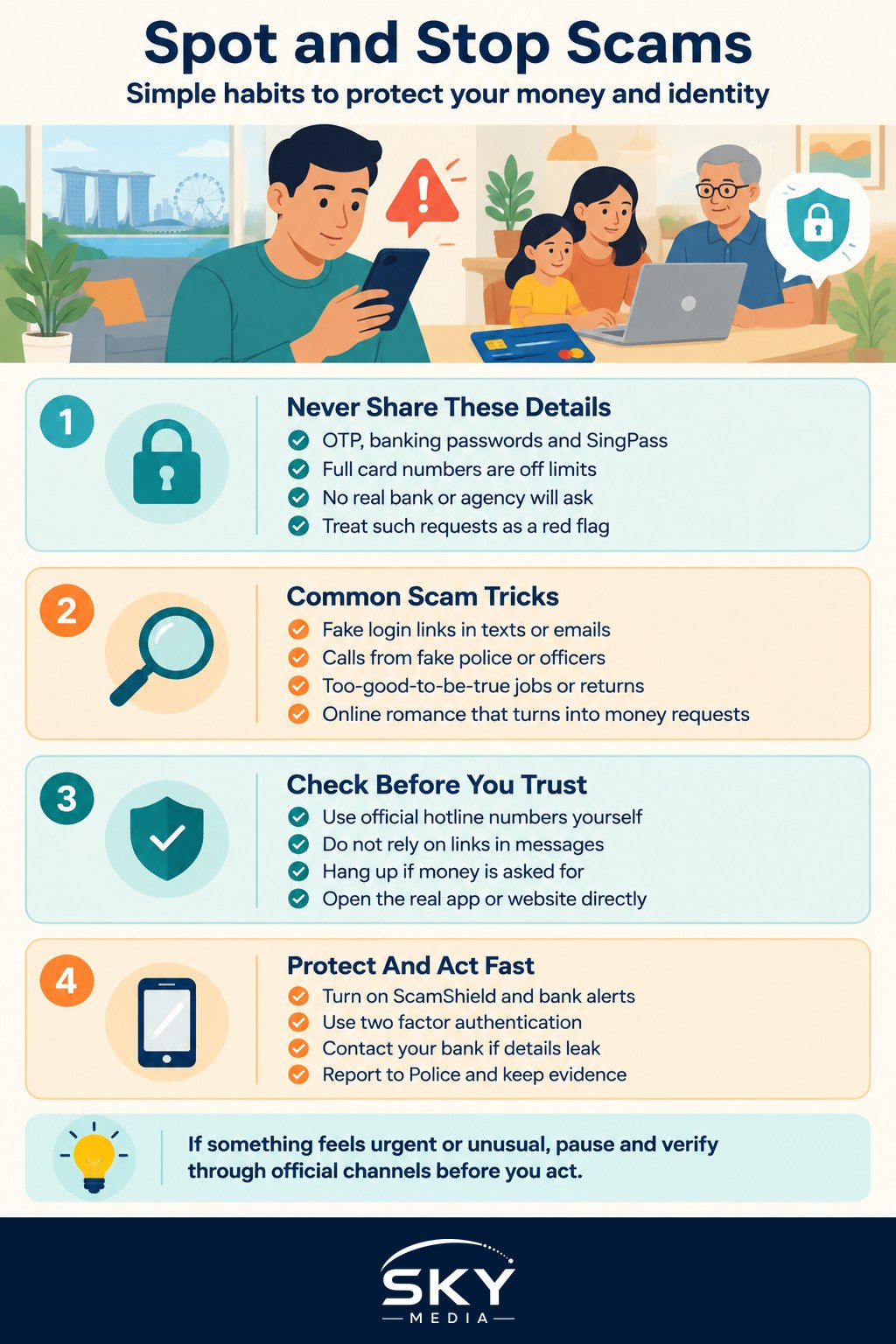
If you remember nothing else, remember this: never share your one time password (OTP), banking passwords, SingPass details or full card numbers with anyone who contacts you. No legitimate bank, government agency or company will ever ask you to reveal these. An OTP is the final key to your account, and a scammer who obtains it can drain your funds in seconds. Treat any request for it as a red flag, full stop.
How to spot the common schemes
Scams change their costume but keep the same script. Being able to name them helps you stay calm when one lands.
Phishing messages
You receive a text or email that looks like it comes from a bank, a courier, a telco or a government body. It contains a link and a sense of urgency, such as a blocked account or an unpaid fee. The link leads to a fake login page designed to steal your credentials. Genuine organisations do not ask you to log in through a link sent by message.
Government and authority impersonation
A caller claims to be from the police, a ministry, the tax authority or a foreign embassy, and says you are involved in a crime or owe money. They may sound official and even quote a fake case number. Remember that government agencies in Singapore will not demand payment over the phone, will not ask you to transfer money to a personal account, and will never accept payment in gift cards or cryptocurrency.
Investment and job scams
You are offered guaranteed high returns, or a simple work from home task that pays well after you make an upfront deposit or complete rounds of paid tasks. Early small payouts build trust before a large deposit disappears. If returns sound too good to be true, they are.
Love and friendship scams
A stranger builds a warm online relationship over weeks, then a crisis appears and they need money. Genuine affection does not require a bank transfer to someone you have never met in person.
A quick comparison of red flags and safe responses
| Warning sign in the message or call | The safe response |
|---|---|
| Urgent threat to act now or lose access | Slow down and verify through official channels |
| Request for your OTP, password or SingPass | Refuse; no genuine party asks for these |
| Demand for gift cards, crypto or a personal account transfer | Hang up; this is never how agencies collect money |
| Guaranteed high returns or easy paid tasks | Treat as a scam and do not deposit |
| A link to log in or verify details | Do not click; open the official app or site yourself |
Verify before you trust
The single most powerful habit is independent verification. If a message claims to be from your bank, do not use the number or link it provides. Instead, look up the official hotline printed on the back of your card or on the bank’s real website, and call that. If a caller claims to be a government officer, hang up and reach the agency through its published contact details. Scammers rely on you staying inside the conversation they control, so stepping outside it breaks their power.
Tools and settings that protect you
- Install and activate the ScamShield app, which helps filter scam calls and messages and lets you check suspicious content.
- Set transaction limits and alerts on your banking apps so any unusual movement is capped and flagged.
- Enable two factor authentication on important accounts, and never approve a login request you did not start.
- Keep your phone and apps updated so security fixes are in place.
- Be cautious with money mule requests; letting someone route funds through your account can make you liable, so never lend your bank account to others.
What to do if you are targeted or caught out
If you receive a suspicious approach, do not engage, and share a warning with family members who may be less familiar with these tactics. If you think you have already given away details or transferred money, act fast. Contact your bank immediately to freeze the account or card and stop further transfers. Then report the incident to the Police. There is a national anti-scam helpline you can call for advice, and you should look up its current number on the official government or police website rather than trusting a number from an unsolicited message.
Speed matters, because the sooner a bank and the authorities are alerted, the better the chance of holding or recovering funds. Keep any screenshots, transaction records and phone numbers, as they help investigators.
Protecting the people around you
Scammers often target those who are alone or under pressure. A short, regular conversation with older relatives about never sharing OTPs and always calling you before transferring money can prevent painful losses. Normalising the habit of pausing and checking, without shame, makes the whole household harder to deceive.
In summary
Avoiding scams in Singapore comes down to a few unshakeable habits: guard your OTP and passwords, distrust urgency, verify through official channels you look up yourself, and use tools like ScamShield and banking alerts. Government agencies will not threaten you into paying, and no honest opportunity needs your login details. Stay calm, step outside the conversation, and report anything suspicious to the Police so others can be protected too.
Explore more: Recognising and avoiding loanshark harassment in Singapore · Saving on your utility bills in Singapore · Singapore healthcare guide
Frequently Asked Questions
What should I do straight away if I have already transferred money to a scammer? Contact your bank immediately to freeze the account or card and stop further transfers, then report the incident to the Police. The sooner the bank and authorities are alerted, the better the chance of holding or recovering funds. Keep screenshots and records.
Is it okay to let a friend use my bank account for a transfer? No. Letting someone route funds through your account can make you liable as a money mule, so never lend your bank account to others, however plausible the reason sounds.
How do I verify a call or message claiming to be my bank? Do not use the number or link it provides. Look up the official hotline printed on the back of your card or on the bank’s real website, and call that. Stepping outside the conversation breaks the scammer’s hold.
What is ScamShield and does it help? It is an app that helps filter scam calls and messages and lets you check suspicious content. It is one layer of protection alongside transaction limits, alerts on banking apps, and two-factor authentication on important accounts.
How can I protect elderly parents from scams? Have short, regular chats about never sharing OTPs and always calling you before transferring money. Make pausing and checking a normal, shame-free habit, because scammers often target people who are alone or under pressure.
Official sources: ScamShield · Singapore Police Force