

Bedok is one of Singapore’s largest and most populous towns, but long before the high blocks and shopping malls arrived, this eastern stretch was a landscape of coconut groves, fishing kampongs and quiet coastal roads. Understanding Bedok heritage in Singapore means looking past the busy interchange and the neat rows of flats to a much older rhythm of village life shaped by the sea, the sand and the soil.
The name Bedok itself is old, and its exact origin is debated. Some accounts link it to a Malay word, while others tie it to features of the local landscape. What is clearer is that the area was inhabited and farmed for generations, with Malay kampongs, Chinese villages and smallholdings spread across the terrain well before large scale redevelopment.
History and How Bedok Developed
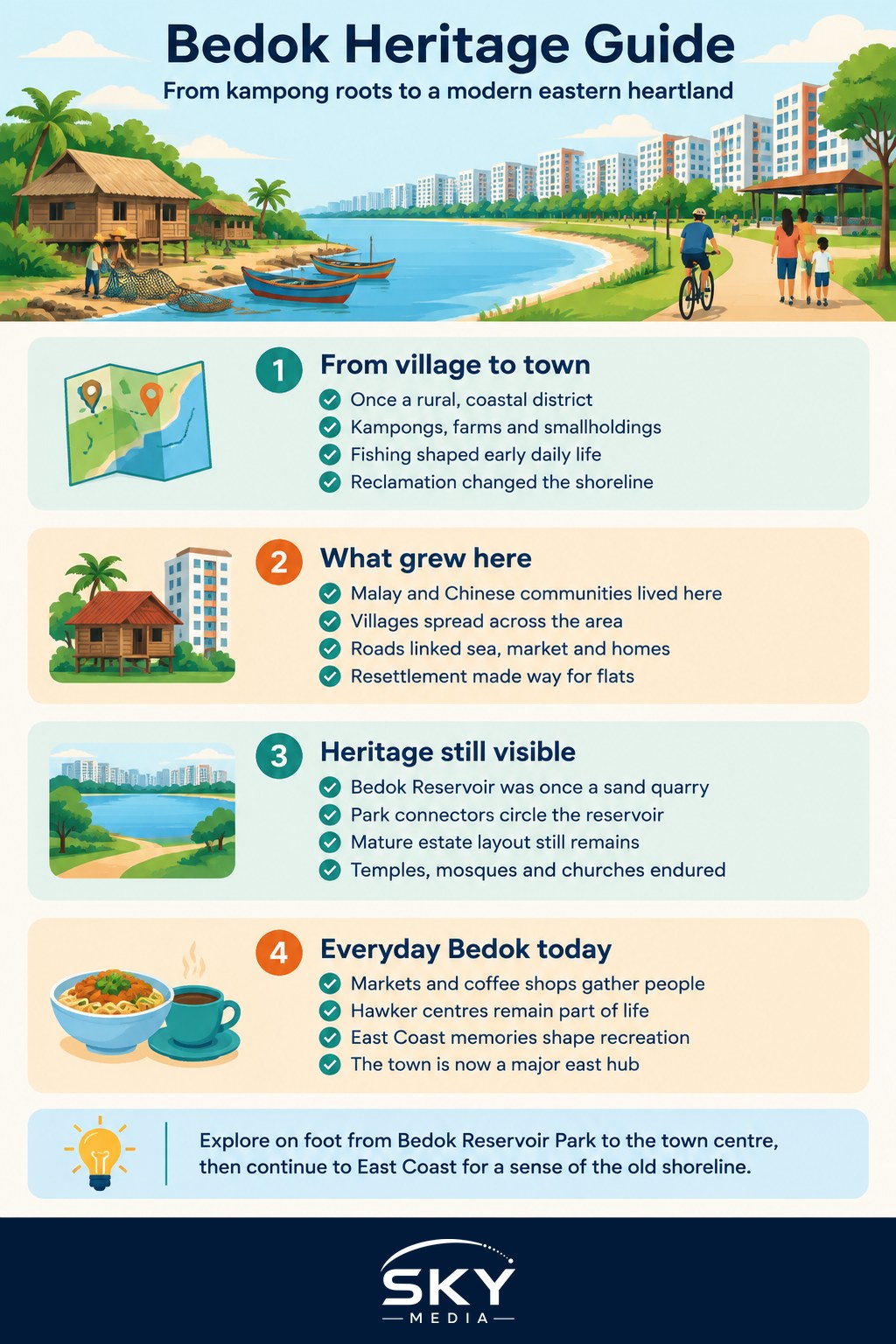
For much of its early history, Bedok was rural and coastal. The eastern coastline once ran much closer to what is now the town centre, and fishing was a way of life for many families. Kampongs such as those in the Bedok and Siglap areas were home to Malay communities, while Chinese settlers farmed vegetables, reared livestock and ran provision shops. Roads like Bedok Road and the older coastal routes carried villagers, hawkers and produce between the sea and the market.
The great transformation came with land reclamation and new town planning. From the late 1960s and into the 1970s, extensive reclamation along the East Coast pushed the shoreline outward, creating the land that would eventually hold East Coast Park and new expressways. As the Housing and Development Board rolled out Bedok New Town, kampong dwellers were resettled into flats, and the old villages were gradually cleared. This was part of the same nationwide shift that reshaped so many districts, a story told across our look at Kampong days in Singapore.
By the time the town matured, Bedok had become a dense residential area organised around neighbourhood centres, schools and transport nodes. The arrival of the MRT and the Bedok bus interchange cemented its role as a key hub for the east.
Heritage Landmarks and Old Estates
A few threads of the older Bedok can still be traced today. Bedok Reservoir, once a sand quarry, was converted into a reservoir and is now ringed by a popular park connector where residents walk, run and row. The reservoir is a reminder of how Singapore repurposed worked out land into public green space.
Bedok is also known for its early public flats and neighbourhood layouts. While the very first Bedok blocks have largely been redeveloped or upgraded over the decades, the general form of the mature estate, with its void decks, wet markets and hawker centres, remains a living example of heartland design. If you are interested in how these communal spaces shaped daily life, our piece on HDB heartland and void deck culture in Singapore gives useful context.
Places of worship also anchor the area’s heritage. Temples, mosques and churches that once served the kampongs were in several cases relocated or rebuilt as the town grew, carrying their congregations and traditions into the new estate. It is worth noting that many original kampong structures no longer stand, having been cleared during resettlement, so much of what survives is the community memory rather than the buildings themselves.
Community and Cultural Roots
Bedok’s identity was built on a mix of communities. Malay fishing and farming families, Chinese market gardeners and traders, and later a broad cross section of Singaporeans all called the area home. This diversity is echoed in the food culture, where the Bedok hawker scene is celebrated for its long standing stalls and late night eateries. The town’s markets and coffee shops remain gathering points where longtime residents still recognise familiar faces.
The eastern coastal character also shaped recreation. Generations of Singaporeans associate the Bedok and East Coast area with weekends by the sea, cycling, kite flying and seafood, a leisure tradition that continues at East Coast Park today.
What Remains and What Has Changed
The honest picture is one of significant change. The original coastline, the fishing kampongs and most village houses are gone, replaced by reclaimed land, expressways and high density housing. What remains is a blend of the practical and the remembered, the reservoir and its park, the mature neighbourhood centres, and the enduring food and community life that gives Bedok its heartland feel.
How to Explore Bedok
A good way to explore Bedok heritage in Singapore is on foot and by park connector. Start at Bedok Reservoir Park and walk the loop, then head toward the town centre to see the hawker centre and market at the heart of daily life. From there, the East Coast is a short journey away for a sense of the reclaimed shoreline that redrew the district. Bedok’s story sits alongside those of other transformed towns, and reading about Toa Payoh heritage or Queenstown, Singapore’s first satellite town helps place Bedok within the larger arc of how the island moved from village to town.
Frequently Asked Questions
How did Bedok Reservoir come about? Bedok Reservoir was once a sand quarry that was converted into a reservoir, and it is now ringed by a popular park connector where residents walk, run and row. It shows how Singapore repurposed worked-out land into public green space.
Did land reclamation change Bedok’s coastline? Yes. From the late 1960s into the 1970s, extensive reclamation along the East Coast pushed the shoreline outward, creating the land that would eventually hold East Coast Park and new expressways. The original coastline ran much closer to today’s town centre.
Are there still kampong houses in Bedok? The honest answer is no, as the original fishing kampongs and most village houses were cleared during resettlement. What survives is mostly community memory, along with the reservoir, mature neighbourhood centres and the food culture.
Where should I start a self-guided Bedok heritage walk? Start at Bedok Reservoir Park and walk the loop, then head to the town centre to see the hawker centre and market at the heart of daily life. From there, East Coast Park is a short journey away for a sense of the reclaimed shoreline.
What was daily life like in old Bedok? Fishing was a way of life for many families, Malay kampongs were home to Malay communities, and Chinese settlers farmed vegetables, reared livestock and ran provision shops. Roads carried villagers, hawkers and produce between the sea and the market.