

Ask any local where they really grew up and the answer is rarely a postcard address. It is the block, the lift lobby, the corner coffee shop and the shaded open space on the ground floor where so much of daily life happens. That ground floor is the void deck, and void deck culture Singapore has quietly built over decades is one of the most honest windows into how ordinary people here actually live. More than eight in ten residents call a Housing and Development Board (HDB) flat home, so the heartland is not a niche. It is the mainstream, and its rhythms shape the whole country.
This guide walks through what the HDB heartland is, why the void deck matters so much, and how to read the small everyday signs that make each estate feel like a village.
What the HDB Heartland Actually Is
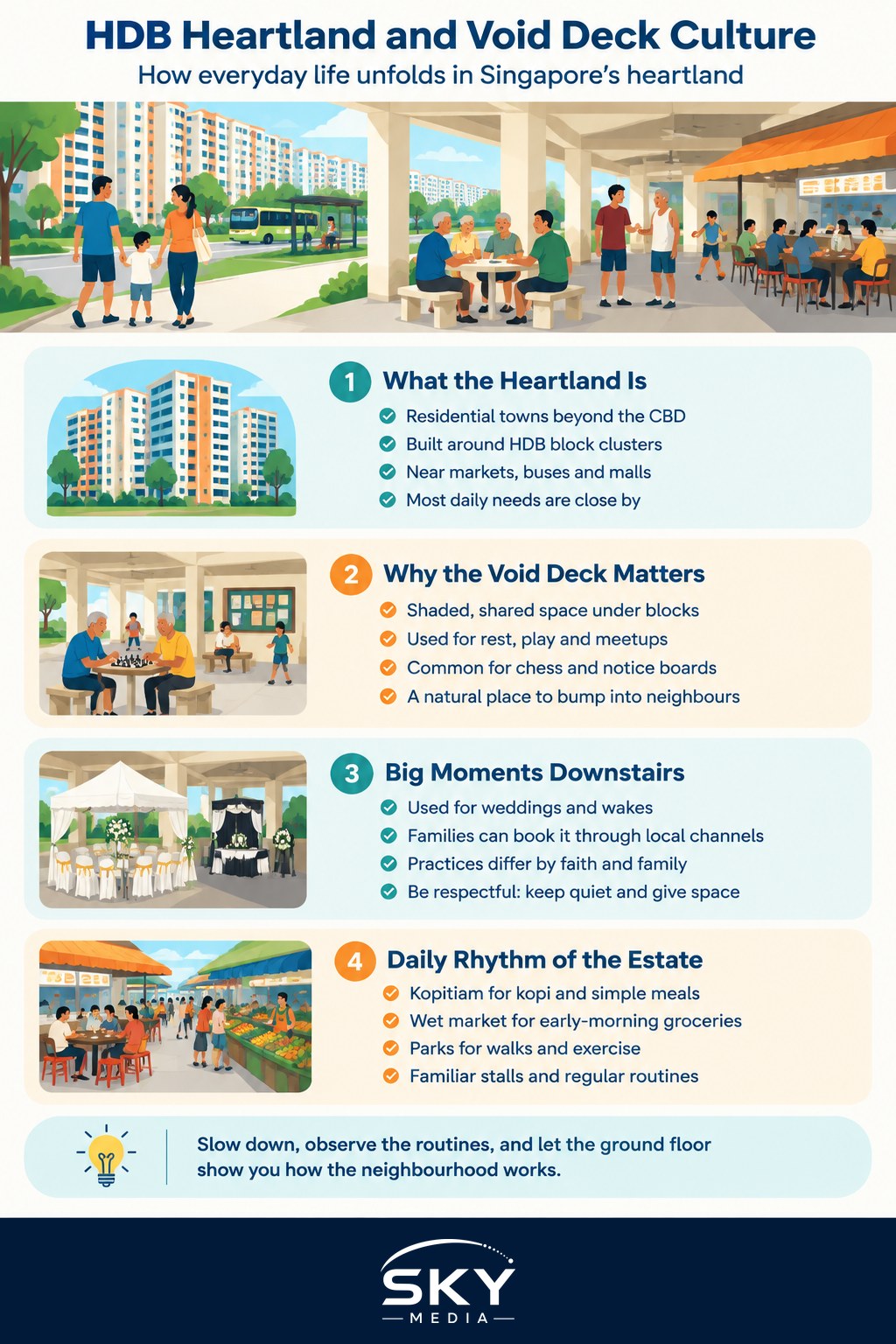
“Heartland” is the affectionate shorthand for the residential towns spread across the island, away from the shiny central business district. Each town is built around a cluster of HDB blocks, a bus interchange, a wet market, a hawker centre and a neighbourhood mall. The idea is that most of what a family needs sits within a short walk or a few bus stops.
A few features define heartland living:
- Blocks and units. Flats are known by block number and unit, and neighbours often know each other by which floor they live on rather than by full name.
- Self-contained towns. Older estates and newer ones alike are planned so that schools, clinics, markets and transport are close by.
- A shared ground floor. Nearly every block sits on stilts, leaving an open, sheltered space beneath. That is the void deck, and it belongs to everyone.
The heartland is where you hear the widest mix of languages, smell dinner cooking from a dozen kitchens at once, and see the full span of ages living side by side. It is Singapore with its shoes off.
Why the Void Deck Is the Heart of the Block
The void deck was designed as empty sheltered space, but residents have never left it empty for long. It is public, free, shaded and central, which makes it the natural stage for the moments that matter most to families.
Walk through enough estates and you will see the same scenes repeat. Toddlers learning to cycle. Uncles reading the papers. Students spreading out books before exams. Aunties resting between market trips. Delivery riders catching their breath. None of it is scheduled, and that is exactly the point. The void deck absorbs whatever the community needs on a given day.
Several fixtures show up again and again:
- Stone or cement tables and stools, often used for chess, checkers or card games.
- A shared notice board carrying grassroots updates, lost-and-found notes and event flyers.
- Bicycle and mobility-aid parking, plus the occasional communal plant corner tended by a green-fingered resident.
- A small provision shop or a laundry point in some older blocks, the last of a fading trade.
Because it is neutral ground, the void deck lets neighbours meet without anyone having to host. That low-pressure mixing is a big reason heartland estates still feel neighbourly in a fast, dense city.
Weddings, Funerals and the Big Moments Downstairs
The most striking feature of void deck culture Singapore families know is that the same space handles both joy and grief. A Malay wedding may fill a void deck with a bright canopy, a decorated dais, rows of chairs and the smell of a communal feast, while friends and relatives stream in and out across a weekend. A few blocks away, another void deck might be set up for a funeral wake, with prayers, incense or hymns depending on the family’s faith, and neighbours quietly paying respects over several evenings.
This sharing is possible because families can book the space through the town council or relevant grassroots channels for a modest cost, keeping big life events affordable and close to home. Practices vary widely between families, religions and communities, so it is best not to assume any single template. If you live nearby and are unsure how to respond to a wake or a celebration downstairs, a respectful nod is always safe, and neighbours will usually welcome a kind word.
A gentle etiquette note. During a wake, keep noise down and avoid staring or taking photos. During a celebration, do not park across the setup or block access. Small courtesies keep the shared space working for everyone.
Kopitiams, Markets and the Everyday Rhythm
Step just beyond the void deck and the heartland’s food and market life takes over. The neighbourhood kopitiam or hawker centre is where mornings begin over kopi and toast, where families gather for cheap, unfussy dinners, and where the same stall aunty may have watched a child grow from primary school to national service. Wet markets bring their own early-morning bustle, with produce, seafood and dry goods sold much as they were a generation ago.
These places run on familiarity. Regulars have “their” stalls, orders are remembered, and a lot of business is done in dialect and Singlish. Because stalls, prices and opening hours change constantly, it is always worth checking current details rather than trusting an old tip, but the underlying pattern is remarkably stable.
Here is a quick way to read the different community spaces in and around a typical block.
| Space | What it is for | Typical crowd | Best time to go |
|---|---|---|---|
| Void deck | Rest, play, community events | Families, elderly, students | Anytime, quieter midday |
| Kopitiam / coffee shop | Cheap meals, kopi, gathering | All ages, regulars | Breakfast and dinner |
| Wet market | Fresh produce and groceries | Home cooks, aunties, uncles | Early morning |
| Neighbourhood park | Exercise, walks, kids’ play | Joggers, families, seniors | Early morning, evening |
Read together, these spaces form a daily loop. Market in the morning, kopi with a neighbour, a rest downstairs in the afternoon heat, and a slow evening walk through the park. That loop is the real texture of heartland life.
How the Heartland Keeps Its Village Feel
Singapore is dense and fast, yet estates still manage a village warmth, and it is worth understanding why. Part of it is design, since shared ground floors and clustered amenities push people into the same spaces. Part of it is habit, since routines built around markets and coffee shops keep the same faces circulating.
You can see the village feel in small signs:
- Slippers and shoes left neatly outside front doors along a corridor.
- Potted plants and festive decorations that shift with the seasons and festivals.
- Neighbours keeping a casual eye on each other’s kids and elderly parents.
- Grassroots events, from festive light-ups to community garden days, that spill out from the void deck into the wider estate.
None of this is guaranteed, and how neighbourly a block feels can vary a lot from one estate to the next. But the ingredients are baked into the heartland’s layout, which is why the culture has proven so durable. To visitors and newcomers, the best advice is simple. Slow down, eat where the locals eat, and let the ground floor teach you how the neighbourhood really works.
Explore more
The heartland connects to almost everything local, from food to festivals. Start with our kopitiam culture guide and hawker centres guide to understand where heartland meals happen, then read kampong days in Singapore to see how village life shaped today’s estates. For the festive scenes that fill void decks through the year, the Singapore festivals guide is a good next stop.
Further reading: Photographing HDB Estates and Void Deck Architecture · Holding a Void Deck Wedding in Singapore