

Walk down the household aisle of any supermarket and you will see biodegradable bin liners sitting next to ordinary rolls, usually in green packaging and usually at a higher price. They feel like the responsible choice. But whether they actually help depends on where your rubbish ends up, and in Singapore that answer is quite different from many other countries. This guide explains how our waste system works, what the labels on bin bags really mean, and when a degradable bag is worth paying for.
Where Singapore’s Rubbish Actually Goes
Most advice about biodegradable bags is written for countries that bury their rubbish in landfills, where a bag that breaks down faster can, in theory, reduce long-term plastic in the ground. Singapore does things differently.
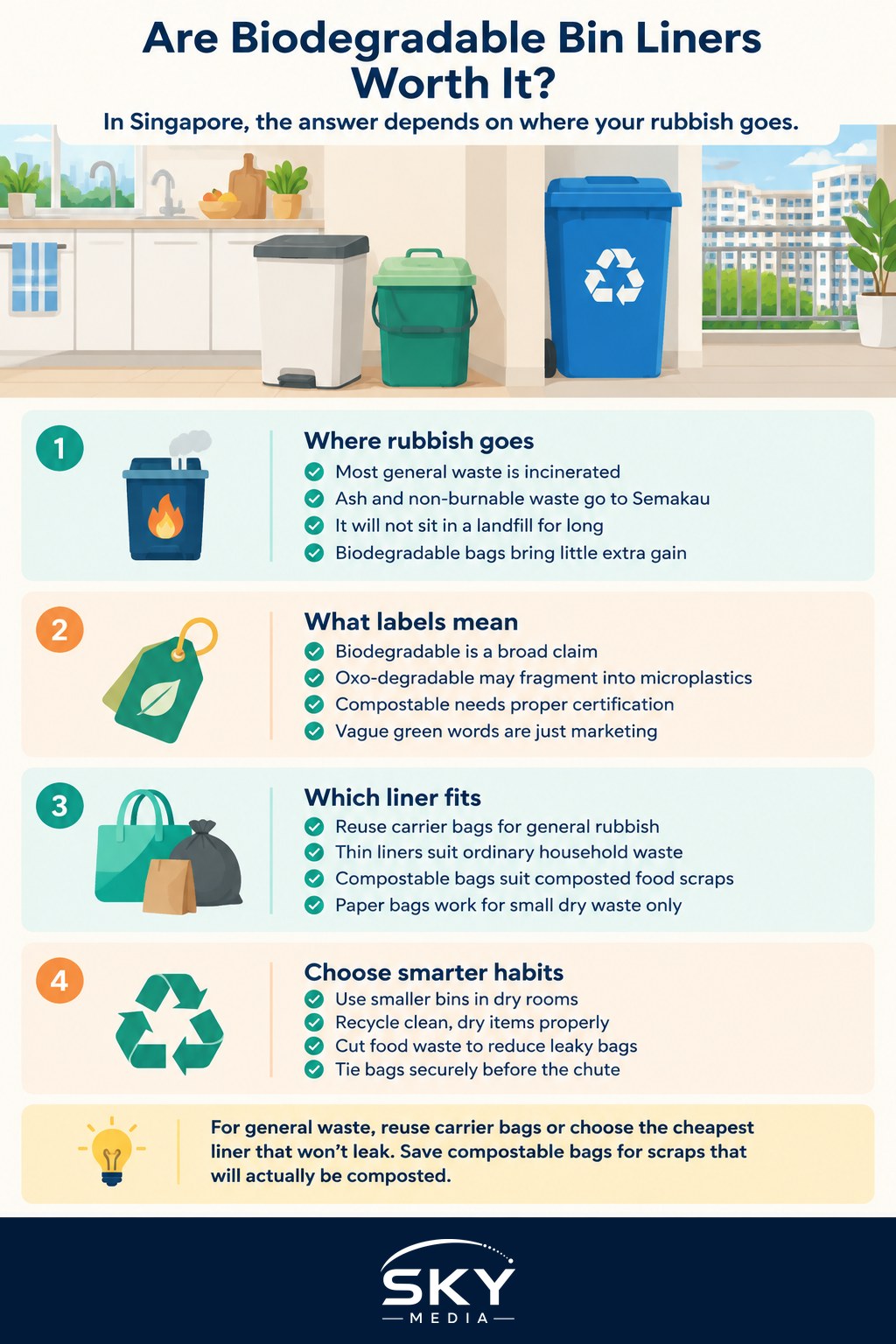
General waste that is not recycled is sent to waste-to-energy incineration plants, where it is burned to generate electricity. The ash left over, together with some waste that cannot be burned, goes to Semakau Landfill, an offshore landfill managed by the National Environment Agency (NEA). Incineration reduces the volume of rubbish dramatically, which matters on an island with very little space.
What this means for your bin liner:
- A bag that goes into your rubbish chute or the bin centre will almost certainly be burned within days. It does not sit in soil long enough for “biodegradable” to mean anything.
- Burning a biodegradable bag and burning a conventional bag lead to the same outcome: both are destroyed in the incinerator.
- The real environmental cost is in making the bag. Materials, manufacturing and transport matter more than what happens after you throw it away.
So in a typical HDB or condo household, a biodegradable bin liner used for general rubbish offers little extra benefit. That does not make all “green” liners pointless, but it does change which ones are worth buying.
What the Labels on Bin Bags Really Mean
Bin bag packaging uses several terms that sound similar but describe very different products. For a deeper look at these terms across all kinds of packaging, see our guide to understanding compostable and biodegradable packaging.
- Biodegradable. A broad word meaning the material can be broken down by microorganisms at some point, under some conditions. On its own, it says nothing about how long that takes or where.
- Oxo-degradable (or “degradable”). Conventional plastic with additives that make it break into smaller pieces when exposed to heat, light and air. Many environmental groups criticise these bags because they can fragment into microplastics rather than truly breaking down. Several jurisdictions have restricted them.
- Compostable. Designed to break down into compost under specific conditions. Look for a recognised certification mark and note whether it says “industrial” or “home” compostable. Industrial compostable bags need the higher temperatures of a commercial composting facility.
- Recycled content. Conventional plastic made partly from recycled material. This does not break down any faster, but it can reduce demand for new plastic.
If a bag only says “eco”, “green” or “earth-friendly” without a specific claim or certification, treat that as marketing rather than information.
Comparing Your Bin Liner Options
The right choice depends on what you put in the bin and where it goes next. Here is how the common options compare for a typical Singapore home.
| Liner option | Where it makes sense | Drawbacks in Singapore |
|---|---|---|
| Reused plastic carrier bags | General rubbish bound for the chute or bin centre | Sizes vary and some bags leak; only works if you already have bags |
| Conventional bin liners (thin) | General rubbish when you have no reusable bags | New plastic each time, though incineration means it is not landfilled as plastic |
| Oxo-degradable or vague “biodegradable” liners | Rarely the best choice | Costs more, may fragment into microplastics, offers no benefit once incinerated |
| Certified home-compostable liners | Food scraps going into your own compost bin or a community compost programme | Higher price, weaker when wet, can start breaking down in a humid cupboard |
| Newspaper or paper bags | Small amounts of dry kitchen waste or compost collection | Tears when wet, not suitable for heavy or liquid rubbish |
| No liner | Dry bins such as a bedroom or study bin you empty into a main bag | You need to wash the bin occasionally |
When Compostable Bags Genuinely Help
The one situation where a degradable bag clearly earns its price is when your food waste is actually composted rather than incinerated.
That could mean:
- You compost at home. Some households keep a small compost bin, a bokashi system or a worm bin on a balcony or in a corridor garden where rules allow. A home-compostable liner lets you carry scraps without plastic contaminating the compost.
- Your community garden accepts food scraps. Some community gardens and residents’ groups run composting efforts. If you garden near your block, our guide to starting a bin centre herb garden shows how compost can feed small growing projects.
- Your building has food waste segregation. NEA has been introducing requirements for certain new developments and premises to separate food waste for treatment. If your building has a separate food waste collection, ask the management (for condos, the MCST, the management corporation) which bags, if any, are accepted. Some systems want no bags at all.
If none of these apply and your food scraps go down the chute with everything else, a compostable bag will simply be burned along with the rest.
Smarter Ways to Cut Bin Bag Waste
If your aim is to reduce your household’s footprint, these habits generally do more than switching to a premium liner:
- Reuse the carrier bags you already have. Large supermarkets in Singapore now charge for disposable carrier bags, so many people bring their own and end up with fewer. Keep the ones you do get for bin duty rather than buying new rolls.
- Use smaller bins in more rooms, unlined. A dry bin in the bedroom or study rarely needs its own bag. Empty it into the kitchen bag.
- Recycle properly. Clean, dry recyclables such as paper, cans and plastic bottles belong in the blue recycling bins. Fewer items in general waste means fewer bags. Check NEA’s guidance on what can and cannot be recycled, because contamination is a common problem.
- Reduce food waste first. Plan meals, store leftovers well and freeze what you will not finish. Less wet waste means fewer leaky bags and fewer smells in a hot, humid flat.
- Choose a liner size that fits. An oversized bag wastes plastic; an undersized one tears and needs double bagging.
- Tie bags securely before the chute. Leaking bags cause hygiene problems for neighbours and cleaners, whatever material the bag is made of.
How to Decide What to Buy
A simple way to decide:
- Where does this bin’s content go? If it goes to the chute or bin centre, it will be incinerated. Choose the cheapest liner that does not leak, or reuse bags.
- Is any of it actually composted? If yes, use a certified compostable liner, or no liner at all, for that stream only.
- Does the claim on the pack mean anything? Look for a specific certification and avoid vague “degradable” wording.
- Is it practical in our climate? Compostable bags can weaken in Singapore’s humidity, so buy smaller packs and store them in a cool, dry place.
The honest conclusion is that biodegradable bin liners are not worth it for most Singapore households sending rubbish to incineration. They are worth it, in certified compostable form, for the specific bin that holds food scraps you or your building will compost. Spend the difference on habits that cut waste at the source, and your bin will do far less harm than any label could promise.
Official sources: National Environment Agency (NEA)