
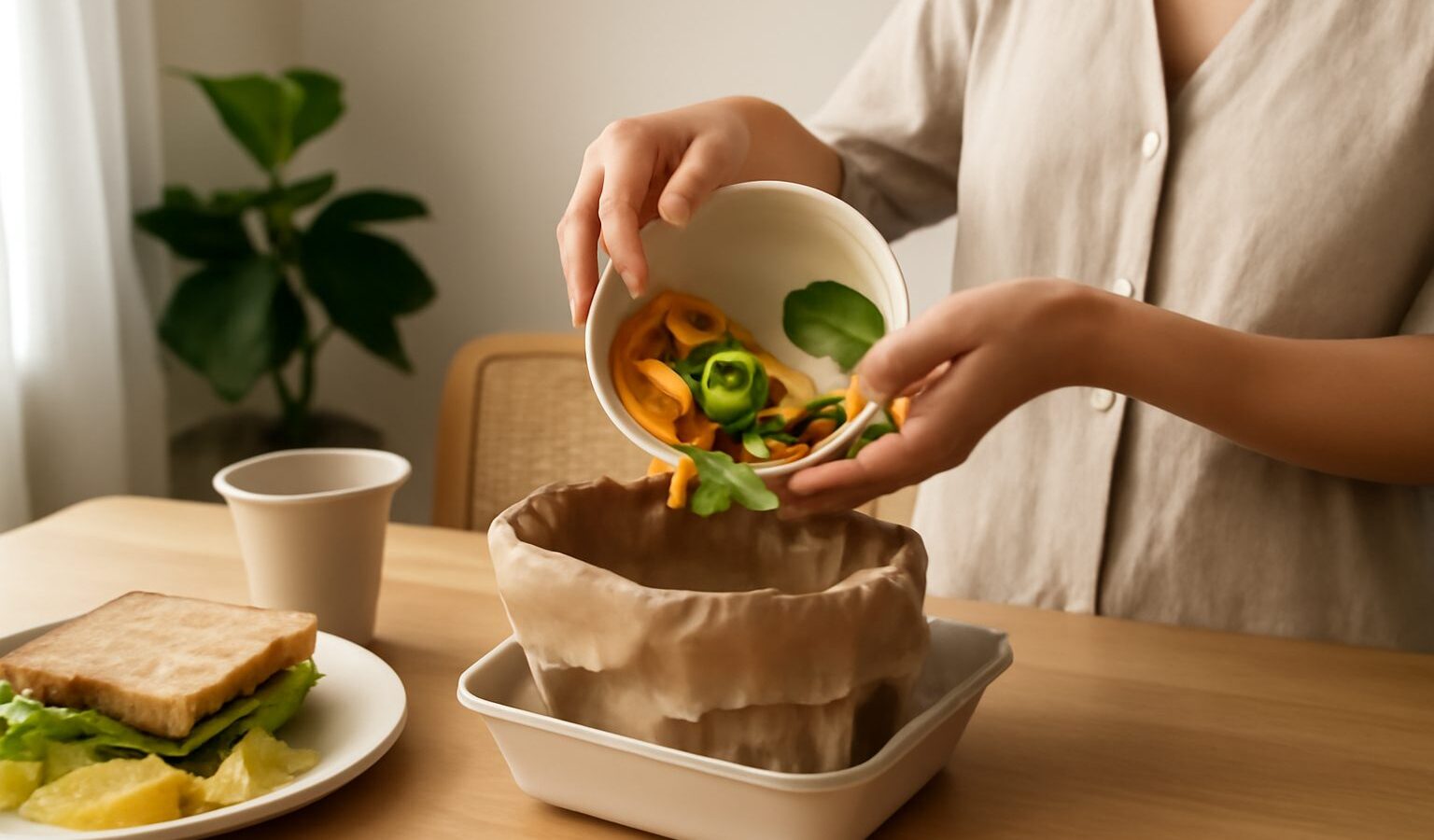
Order a bubble tea or a hawker takeaway and you might notice the cup or cutlery proudly labelled “compostable” or “biodegradable”. It feels like a small win for the planet. But does that fork really turn into soil, and where does it go once you are done with it in Singapore? Compostable packaging is one of the most misunderstood corners of green living, and a little clarity saves you from wishful recycling and needless guilt.
The short version: these materials can be genuinely better in the right system, but they are not a magic fix. Most of them do not break down in a rubbish bin, a recycling bin, or the sea. Understanding the difference between the labels, and what actually happens to your waste locally, helps you make calmer, smarter choices.
Compostable, Biodegradable and Bioplastic: What the Words Mean
These terms get used loosely, which is where confusion starts. Here is the plain-English version.
- Biodegradable simply means something can, in theory, be broken down by microbes. There is no promise of how long it takes or under what conditions. A label saying only “biodegradable”, with no standard or timeframe, tells you very little.
- Compostable is more specific. It means the item is certified to break down into compost within a set time under defined conditions, leaving no harmful residue. Crucially, most compostable packaging is certified for industrial composting, which needs sustained high heat and controlled moisture, not the conditions in your kitchen bin.
- Home compostable is a stricter, less common certification meaning it can break down in a backyard or balcony compost setup at everyday temperatures. Far fewer products qualify.
- Bioplastic means a plastic made partly or wholly from plant material, such as corn starch or sugarcane. Confusingly, “bio-based” does not automatically mean compostable. Some bioplastics behave just like conventional plastic and will not break down at all.
The takeaway is to read past the buzzword. Look for a clear certification and the words “industrial” or “home”, not just a green leaf logo.
The Catch: Singapore Has No Kerbside Composting
Here is the honest local reality. Singapore does not have a household or kerbside composting collection for the general public. There is no green food-and-garden waste bin outside your HDB block, and the blue recycling bins are for clean paper, plastic, metal and glass, not for compostable cutlery.
So what happens to a “compostable” cup you toss in the general rubbish? It goes to the same place as most of our non-recyclable waste. To understand that journey, it helps to know how waste-to-energy works in Singapore: most general waste is incinerated to generate electricity, and the ash goes to Semakau Landfill. A compostable fork sent for incineration is simply burned like anything else. It never becomes compost, and the “compostable” benefit is lost.
Worse, if you drop a compostable bioplastic item into the blue recycling bin hoping it counts as plastic, you can actually cause a problem. It is not the same polymer as ordinary recyclable plastic and can contaminate the batch. Avoiding this is a big theme in avoiding recycling contamination in Singapore: when in doubt, keep it out, and follow the current NEA blue-bin guidance rather than guessing.
Compostable Packaging Versus the Alternatives
So is compostable packaging worthless here? Not quite. It depends on what you are comparing it to and whether it ends up in a suitable system, such as a food business that sends its waste to an industrial composter or a home compost bin for the few items that qualify. This table lays out the honest trade-offs.
| Option | Best case | The catch in Singapore | Practical verdict |
|---|---|---|---|
| Reusable (own cup, container, cutlery) | No new waste at all | Needs washing and remembering to bring it | Genuinely the greenest for daily use |
| Compostable packaging | Breaks down in industrial composting | Usually incinerated here, so benefit is often lost | Fine if a proper composting route exists |
| Conventional recyclable plastic | Can be recycled if clean and sorted | Only if truly clean and accepted | Better than compostable if you will recycle it right |
| “Biodegradable” plastic (uncertified) | Marketing suggests it disappears | Often just fragments into microplastics | Treat with scepticism; avoid |
The pattern is clear. A reusable item you actually reuse beats every disposable, compostable or not. Compostable packaging only delivers its promise when it reaches the right facility, which for households here is rare.
Making Sensible Choices Without the Guilt
You do not need to memorise polymer science to do well. A few simple habits cover most situations.
- Reduce first. The greenest cup is the one you did not use. Bring a reusable bottle, cup and set of cutlery for regular outings. This is the heart of reducing disposables when dining out in Singapore, and it beats debating which disposable is least bad.
- Do not “wish-cycle”. Compostable and bioplastic items generally do not belong in the blue bin. Putting them there to feel better can spoil genuinely recyclable material.
- Read the certification, not the vibe. If a product claims compostable, look for a recognised standard and check whether it is industrial or home compostable. Treat vague “biodegradable” claims, with no standard, as marketing.
- Consider home composting for the right items. If you have a small balcony or corridor setup, food scraps and certified home-compostable items can work, as long as you follow NEA guidance and avoid mosquito breeding by keeping everything covered and free of standing water. Not every “compostable” product qualifies, so check the label.
- Support businesses closing the loop. Some cafes and events pair compostable serviceware with a real composting collection. That is when these products shine. On their own, without that back end, they are mostly a feel-good label.
It is also worth remembering that packaging is only one slice of your footprint. Cutting food waste, choosing loose and ugly produce, and generally buying less often matter more than the exact material of a single takeaway box.
The Bigger Picture on Packaging Waste
Singapore is steadily shifting responsibility for packaging back towards producers. Under the developing framework often described as Extended Producer Responsibility, companies are being nudged to take account of the packaging they put on the market, which over time should mean less wasteful design and clearer disposal routes. Rules and schemes evolve, so check the current NEA sources for the latest on packaging reporting and any beverage or e-waste schemes rather than relying on older summaries.
For now, treat compostable packaging as a useful tool in specific settings rather than a household solution. When a genuine composting route exists, it is a real improvement. When it does not, the honest move is to reduce what you use, recycle correctly what you can, and let go of the idea that a green-looking fork is quietly turning into soil somewhere. Small, realistic steps, repeated daily, add up to far more than any single label ever will.