

You drop your car off for routine servicing, and the bill that comes back is longer than you expected. There are labour lines, part numbers, “sundries”, a recommended item you never asked for, and GST at the bottom. Many drivers simply pay. Learning to read a car service invoice in Singapore takes only a few minutes, and it puts you in a much better position to ask sensible questions, decline unnecessary work and spot genuine errors.
This guide walks through each section of a typical invoice, explains common upsells and shows you how to raise a concern politely and effectively. It does not name or compare specific workshops, and prices vary widely, so treat it as a framework rather than a price list.
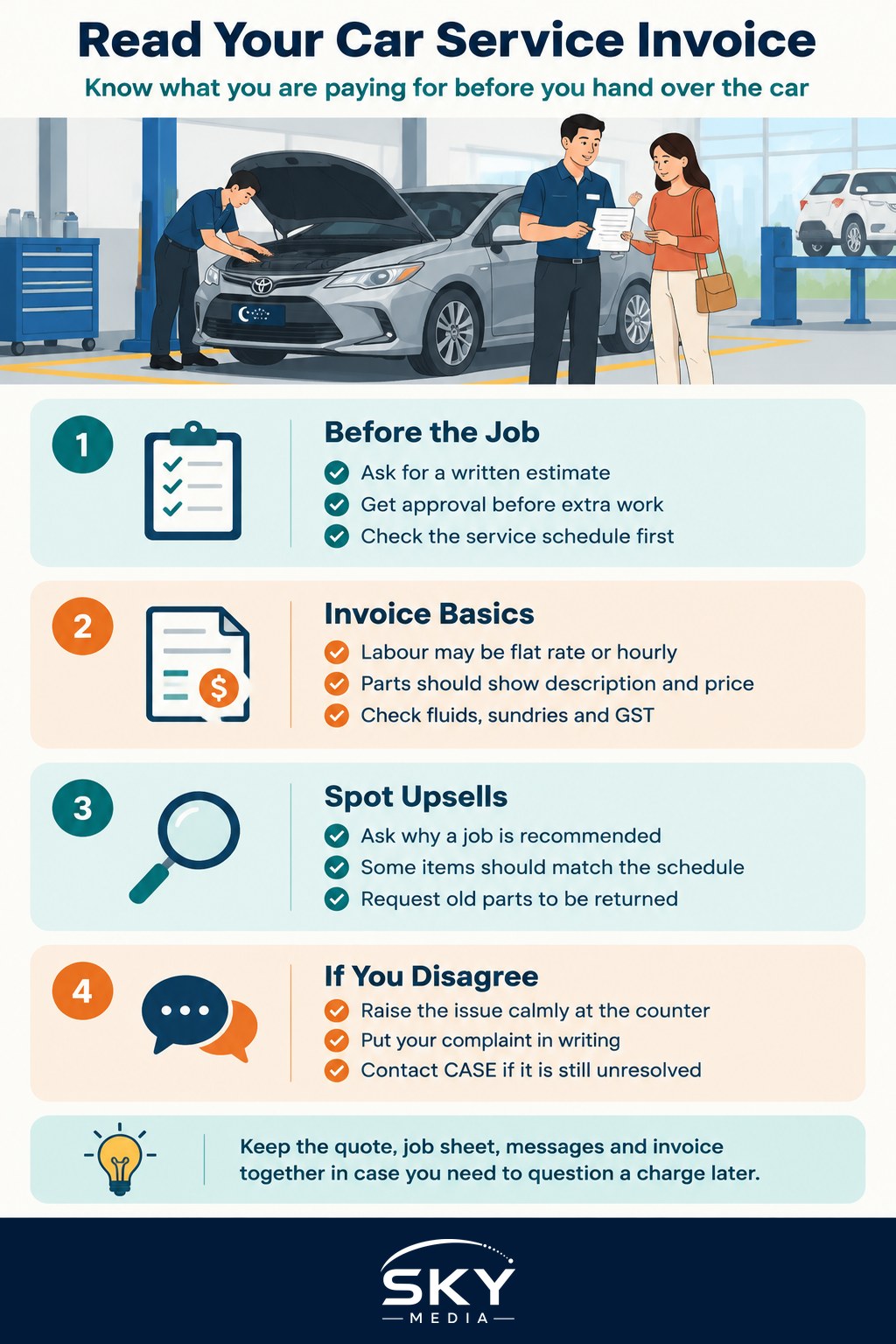
Before the Invoice: The Quote and Job Sheet
The best time to control a bill is before work starts. Most workshops prepare a job sheet or work order when you drop the car off, listing what you have asked for. Ask for an estimate in writing, even a WhatsApp message, and request that the workshop contact you before doing anything not on the list.
Also check your car’s service schedule in the owner’s manual or service booklet. Manufacturers set intervals by mileage or time for items such as engine oil, filters, brake fluid and spark plugs. Knowing what is actually due makes it much easier to judge whether an added item is reasonable.
Reading the Main Sections of the Invoice
Most invoices are split into a few blocks, even if the layout differs.
Labour
Labour is how workshops charge for a mechanic’s time. It is commonly shown in one of two ways:
- Flat or package rate, such as a fixed price for a standard service.
- Hours multiplied by an hourly rate. Some workshops use standard “book times” for each job rather than the actual time spent.
Look for duplicated labour. For example, if two jobs require removing the same part, you should not normally be charged twice for removing it.
Parts
Each part should have a description, a quantity and a unit price. You may see terms like these:
- OEM or genuine parts: made or branded by the car manufacturer, usually the most expensive.
- OE-equivalent or OES parts: made by the same supplier that makes them for the manufacturer, sometimes without the car brand’s logo.
- Aftermarket parts: made by other companies, with quality ranging from excellent to poor.
None of these is automatically wrong, but you should know which you are getting. If your car is under warranty, check the warranty terms on parts and servicing before agreeing to non-genuine parts.
Fluids and Consumables
Engine oil is usually charged per litre, so check the quantity matches your engine’s capacity in the owner’s manual. Coolant, brake fluid, washer fluid and additives may be listed separately.
Sundries or Shop Supplies
This line covers small items like rags, cleaning agents and cable ties. A modest sundry charge is common practice. If it looks large compared with the rest of the bill, it is fair to ask what it covers.
Diagnostic and Inspection Fees
If you came in with a warning light or noise, a diagnostic fee for scanning and testing is normal. Ask whether it is waived or offset if you go ahead with the repair.
GST and Totals
Workshops registered for Goods and Services Tax (GST) add it at the prevailing rate. Check that GST is applied once, on the right subtotal, and that any discounts were deducted before tax as promised.
Common Upsells and How to Judge Them
Not every recommendation is an upsell. Mechanics may genuinely spot worn parts. The table below helps you sort what is usually worth doing from what deserves a second look.
| Recommendation | Often reasonable when | Question to ask |
|---|---|---|
| Brake pad replacement | Pads measured below the minimum thickness | “Can you show me the measurement or the old pads?” |
| Engine flush or fuel system cleaning | Specifically listed in the manufacturer schedule | “Is this in my car’s service schedule?” |
| Air-con servicing or gas top-up | Cooling has noticeably weakened | “What did you find when you tested it?” |
| Wiper blades, cabin filter, bulbs | Visibly worn, smelly or not working | “Can I see the old part before you replace it?” |
| Tyre replacement | Tread worn or sidewall damaged | “What is the tread depth on each tyre?” |
| Additives and treatments | Rarely essential for a healthy engine | “What problem does this solve on my car?” |
A simple rule: if it was not on your job sheet, it should not appear on your invoice unless you approved it. Ask for old parts to be returned to you, which is a common and reasonable request.
Questions to Ask at the Counter
Before paying, take five minutes to go through the invoice with the service adviser:
- Which items were part of the original job, and which were added?
- Were all added items approved by me, and when?
- Are the parts genuine, OE-equivalent or aftermarket?
- What warranty applies to the parts and the labour?
- Are there any recommended jobs for next time, and how urgent are they?
Keep the invoice. A complete service history helps with resale, warranty claims and future diagnosis. If you use a car subscription service, maintenance may be bundled into your monthly fee, so check what your contract covers before paying a workshop yourself.
What to Do If You Disagree With the Bill
Start calmly with the workshop. Point to the specific line, explain what you expected and ask for a correction or explanation. Many disputes are simple misunderstandings or clerical errors.
If that does not resolve it:
- Put your complaint in writing with copies of the quote, job sheet, messages and invoice.
- Contact the Consumers Association of Singapore (CASE), which offers advice and mediation for consumer disputes. Some workshops are also accredited under consumer trust schemes.
- Consider the Small Claims Tribunals for disputes within its limits, if mediation fails. Check the current claim limits and process on the State Courts website.
Your rights under consumer protection law may also apply to defective work or parts. This is general information, not legal advice, so check the details with CASE or a lawyer if a large amount is involved.
If you drive across the Causeway, remember that repairs after an accident in Malaysia may involve your insurer too; our guide to Malaysia car insurance add-ons explains what extra cover can include.
Frequently Asked Questions
Can I bring my own engine oil or parts to the workshop? Some workshops allow it and some do not, so ask before you drop the car off. They may charge labour only and may not give a warranty on parts you supply. If your car is under warranty, check that the oil and parts meet the manufacturer’s specifications.
Can a workshop keep my car if I dispute the bill? Some workshops may refuse to release a car until payment is made, so try to raise concerns before paying and keep everything in writing. If you do pay to collect the car, say clearly that you dispute the charge. CASE can advise on what to do next.
How do I compare quotes from different workshops fairly? Ask each workshop to quote for the same job list, using the same type of parts and fluids, and to put it in writing. Compare labour, parts and sundries separately rather than only the total. A very low quote may leave out items that appear on the final invoice.
How long should I keep car service invoices? Keep them for as long as you own the car. A complete service history supports warranty claims, helps with diagnosing problems later and can raise buyer confidence when you sell. Photos or scans stored on your phone are a simple backup if paper copies get lost.
Further reading: Using an OBD-II Scanner to Read Your Car’s Fault Codes · Automatic Gearbox and CVT Servicing for Singapore Cars · Changing Your Car’s Cabin Air Filter