

A car that suddenly starts shaking, shuddering, or buzzing can be unsettling. Some vibrations are minor and easy to sort out, while others are early warnings of something you should not ignore. Understanding the common car vibration causes singapore drivers run into helps you describe the problem accurately and decide how urgently you need a workshop. This guide covers what to feel for, when the vibration shows up, and what each pattern might point to, without pretending every case is the same.
The most useful thing you can do is pay attention to the details. When does the shaking happen: at idle, at a certain speed, only when braking, or only when turning? Where do you feel it: through the steering wheel, the seat, the pedals, or the whole car? Those two questions alone can narrow the field considerably.
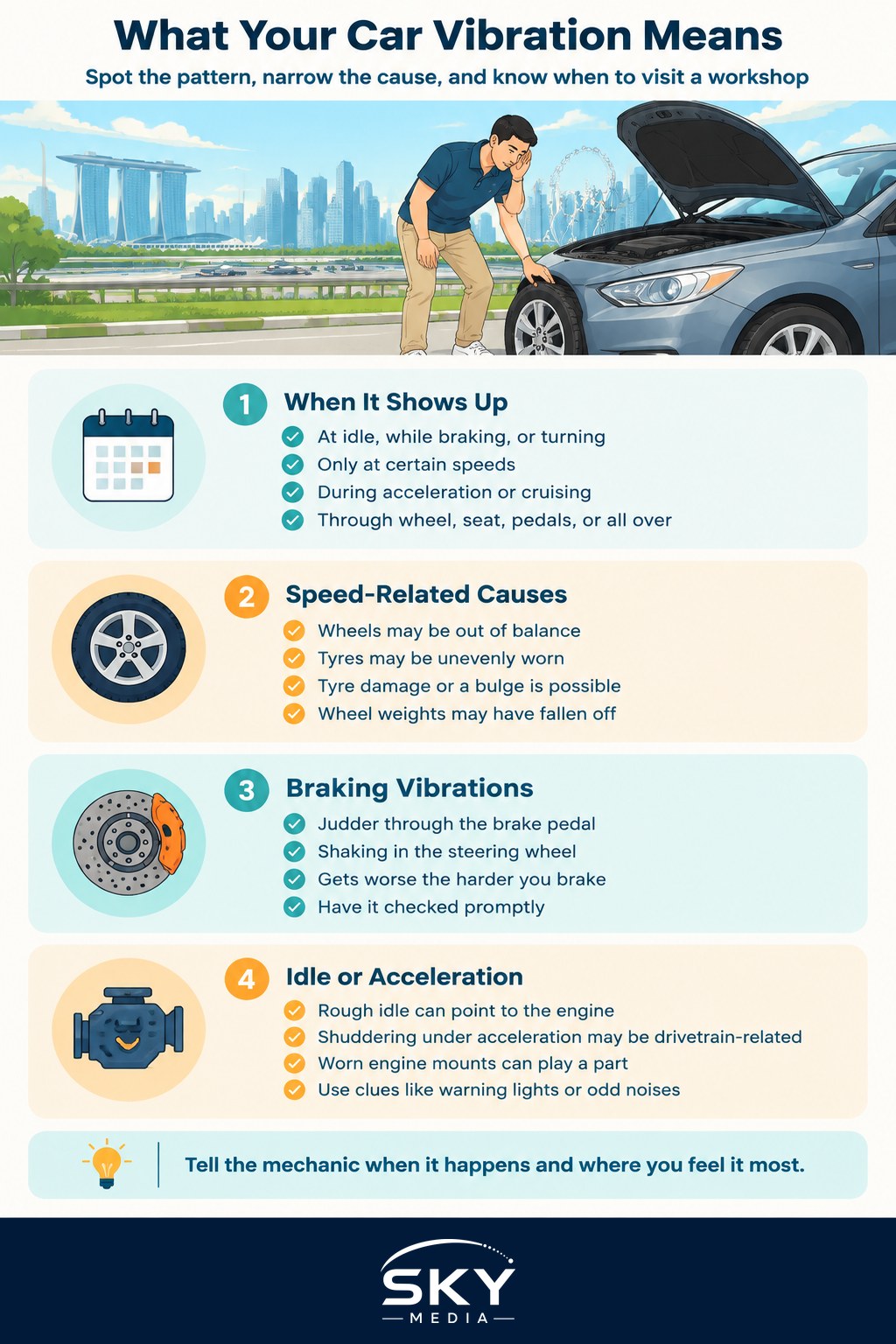
Vibrations Linked to Speed
If the car feels smooth at low speed but starts to shake as you pick up pace on an expressway, then smooths out again or gets worse at a particular speed, the wheels and tyres are a common place to look. Tyres are round, but they do not always stay perfectly balanced or evenly worn.
General possibilities in this category include:
- Wheels that have lost their balance, often felt as a steady shake through the steering at higher speeds.
- Uneven or worn tyre tread, which can come from age, potholes, or alignment issues.
- A tyre with an internal problem or a bulge, which is a safety concern.
- Wheel weights that have fallen off after hitting a kerb or pothole.
Balancing and alignment are routine services, and it helps to know the difference. Our guide to wheel alignment and balancing explained breaks down what each one fixes. Because Singapore roads and carpark kerbs can be unforgiving, it is also worth reading tyre care and when to replace them so you can spot uneven wear early.
Vibrations When You Brake
If the shaking or juddering appears mainly when you press the brake pedal, and especially if you feel it through the pedal or steering while slowing down, the braking system is the natural suspect. This is not something to leave for later, since brakes are safety critical.
Common patterns people describe:
- A pulsing or judder through the brake pedal when slowing from higher speeds.
- Shaking in the steering wheel under braking.
- A vibration that gets worse the harder or longer you brake.
These symptoms can relate to worn or unevenly worn brake components, but the exact cause needs proper inspection. Do not diagnose this by feel alone. If you notice any braking vibration, have it checked promptly, and in the meantime read when to replace your brake pads so you understand what a workshop might be looking at. Anything affecting braking should go to a qualified mechanic without delay.
Vibrations at Idle or Under Acceleration
Some cars shake most when sitting still at a traffic light or when you accelerate, rather than at speed. A rough, shuddering idle can come from the engine not running smoothly, while a vibration that appears under hard acceleration may relate to the drivetrain or worn engine mounts that normally cushion the engine’s movement.
A rough idle sometimes pairs with other clues, such as hesitation, a warning light, or unusual sounds. If your car is also making odd noises, our guide on what your car noises mean can help you gather the full picture before you visit a workshop. Because these causes overlap and are hard to confirm without tools, treat any guesses as a starting point for a professional, not a final answer.
When to Get It Checked
A mild vibration that you can clearly trace to a recent pothole hit, and that a balancing job fixes, is usually nothing to worry about. But you should book a workshop visit promptly if any of the following apply:
- The vibration involves the brakes or steering in any way.
- It is getting steadily worse or came on suddenly.
- It is paired with a warning light, a burning smell, or strange noises.
- The car pulls to one side or feels unstable.
Safety critical systems such as brakes, steering, and tyres are not the place for guesswork or DIY fixes beyond basic checks. Describe to the mechanic exactly when the vibration happens and where you feel it, since that detail speeds up diagnosis. When you are planning a longer trip, it is also worth running through your usual pre-drive checks so a small shake does not turn into a roadside problem far from home.
Trust your senses. A new vibration is your car asking for attention, and catching it early usually means a smaller, cheaper fix and a safer drive.