
The carbon tax in Singapore is one of the country’s main tools for cutting greenhouse gas emissions and steering the economy towards net zero. Put simply, it attaches a price to the carbon dioxide and other greenhouse gases that heavy industrial facilities release. By making emissions a cost rather than something free to pump into the atmosphere, the tax gives businesses a clear reason to run cleaner, invest in better technology, and use energy more efficiently. This guide explains how the carbon tax works, who it applies to, and why Singapore chose this approach, without quoting current rates that shift over time.
Why Singapore Prices Carbon
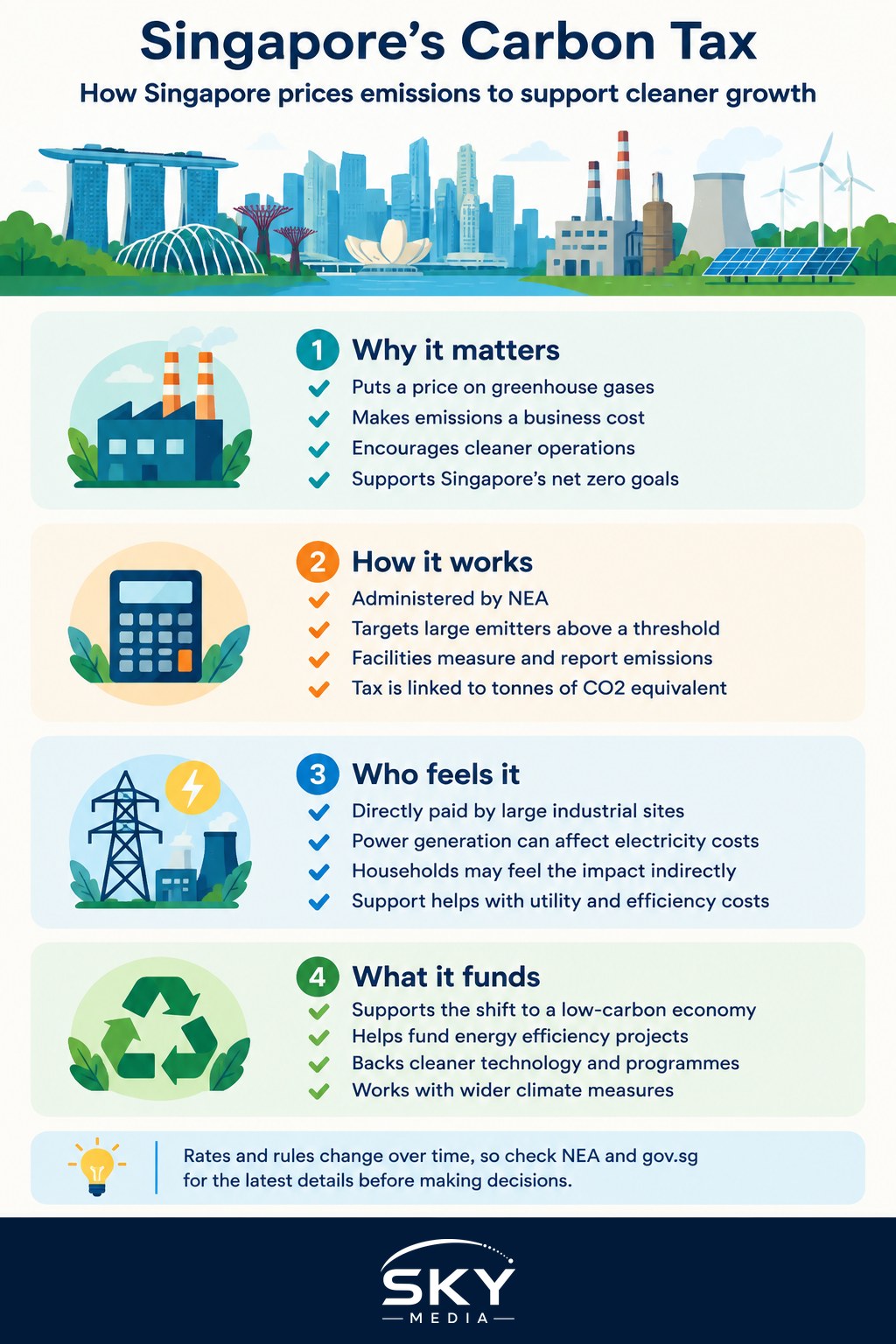
Singapore is a small, low-lying island with limited access to cheap renewable energy sources like large-scale hydro or wind. That makes decarbonising harder here than in many other places. At the same time, rising sea levels and more extreme weather pose a real long-term risk to a coastal city. Pricing carbon is the government’s way of tackling both the climate challenge and the economic one at once.
The logic behind carbon pricing is straightforward. When emitting greenhouse gases is free, businesses have little financial reason to reduce them. When each tonne of emissions carries a cost, cleaner choices suddenly make commercial sense. A company weighing whether to upgrade a boiler, switch fuels, or improve insulation now has a number to put against the pollution it avoids. Over time, this nudges the whole economy towards lower-carbon ways of operating.
The carbon tax also signals seriousness. It tells investors, trading partners, and international bodies that Singapore is committed to its climate pledges. As global markets increasingly favour low-carbon goods and services, that reputation carries economic weight too.
How the Carbon Tax Actually Works
The carbon tax is a price applied per tonne of greenhouse gas emissions, expressed as carbon dioxide equivalent so that different gases can be compared on a common scale. The National Environment Agency (NEA) administers the scheme.
Rather than taxing every household or small shop, the tax targets large emitters. Facilities that release greenhouse gases above a defined threshold must measure and report their emissions, and pay tax on them. This design keeps the administrative burden focused on the sites that account for the bulk of the country’s industrial emissions, such as power stations and large manufacturing plants.
The broad mechanism works like this:
- Measure and report. Covered facilities monitor their emissions and submit verified reports to NEA.
- Buy and surrender credits. Emitters pay for their emissions, typically by purchasing and surrendering carbon credits that represent their reported tonnes.
- Face a rising price signal. The government has set out a trajectory for the tax to increase over time, giving businesses advance notice so they can plan investments rather than being caught out.
Because the price is scheduled to climb, companies are encouraged to act early. Cutting emissions this year avoids paying a higher price later, which rewards forward planning over delay.
Who Pays and Who Feels the Effect
The direct payers are large industrial and power-generation facilities that cross the emissions threshold. But the effect ripples wider. Because power generation is covered, some of the cost can flow through to electricity prices, which touches businesses and households indirectly.
To ease that transition, the government has paired the tax with support measures, including help for households with utility costs and assistance for companies investing in energy efficiency and cleaner technology. The aim is to keep the price signal intact while cushioning the adjustment, so that decarbonising does not simply become a cost passed straight to consumers with no relief.
Here is a simple comparison of how carbon can be priced, to show where Singapore’s approach sits.
| Approach | How the price is set | Who is covered | Main trade-off |
|---|---|---|---|
| Carbon tax (Singapore’s model) | Government fixes a price per tonne | Large emitters above a threshold | Price certainty, but emissions volume is not capped |
| Emissions trading (cap and trade) | Market sets the price under an emissions cap | Firms holding tradable permits | Emissions certainty, but the price can swing |
| No carbon price | Emissions are effectively free | No one pays directly | Simple, but little incentive to cut emissions |
| Hybrid schemes | A tax with market features, such as tradable credits | Varies by design | Blends certainty of price and flexibility |
Singapore’s design leans on price certainty. Businesses know roughly what a tonne of emissions will cost them in future, which makes long-term investment decisions easier to justify.
What It Means for Your Household
Even though the tax lands on large emitters rather than on you directly, it still shapes the environment your household lives in. A price on carbon encourages cleaner electricity generation and more efficient industry over time, supporting the same shift you contribute to through your own choices. Costs and benefits can flow through the economy in complex ways, and the government has spoken about using revenue to support the transition, but how that works in practice is something to verify from official channels rather than assume.
For most people, the practical takeaway is not about tax mechanics at all. Reducing your own energy use remains one of the clearest ways to lower both your bills and your footprint, whatever the policy backdrop. A few reliable habits:
- Choose efficient appliances and lighting, using the official efficiency labels as your guide.
- Cut standby power and switch off what you are not using.
- Use air conditioning thoughtfully, since cooling is a big part of many Singapore electricity bills.
Our guides to reducing your carbon footprint in Singapore and saving electricity at home have plenty of doable steps that put you on the same side as the policy.
Where the Money Goes and What It Achieves
Revenue from the carbon tax is not simply absorbed into general spending and forgotten. The government has said proceeds help fund the transition to a low-carbon economy, supporting measures such as energy efficiency projects, cleaner technology, and programmes that cushion the cost impact for households and firms. In effect, money raised from emissions is recycled into cutting future emissions and easing the shift.
The tax also works alongside other national efforts. It is one pillar of a broader sustainability agenda that includes greening the power grid, exploring low-carbon fuels and carbon capture, and importing cleaner electricity. On its own, a carbon price cannot deliver net zero. Combined with these measures, it makes the cleaner path the more economical one across the whole economy.
For everyday residents and small business owners, the carbon tax is mostly felt indirectly, through the gradual push towards energy efficiency and the incentives it creates across supply chains. Understanding it helps explain why energy-saving upgrades, cleaner appliances, and efficient practices increasingly make financial sense, not just environmental sense.
Keeping Perspective on the Numbers
The carbon tax is deliberately designed to strengthen over time, so the exact rate, the emissions threshold, and the coverage rules are reviewed and updated by the authorities. This article explains the mechanism and intent rather than the current figures, because those change. For the latest rate, thresholds, and scheme details, check the National Environment Agency (NEA) and gov.sg, which publish the official and up-to-date information.
This guide is general information to help you understand how carbon pricing works in Singapore. Rates, thresholds, and rules change, so verify current details with NEA before making decisions. It is not personalised financial or tax advice; for how any of this affects a specific business, speak to a qualified professional.
Where to Check the Real Details
Because rates and rules are periodically reviewed, the most useful thing you can do is go to the source. The National Climate Change Secretariat, the Ministry of Sustainability and the Environment, and the National Environment Agency publish the current details of how the carbon tax works. If you see a specific figure quoted in a chat group or an old article, treat it as possibly out of date and confirm it officially before relying on it.
A short checklist for staying accurate:
- Look for the latest figures on official government sites, not secondhand posts.
- Remember that policy can be updated, so a number that was true a while ago may have changed.
- Keep in mind that the tax mainly targets large emitters, not individual homes.
Explore more
To see how the carbon tax fits into the bigger climate picture, read our guide to the Singapore Green Plan and national sustainability push and how the country is preparing through coastal protection and climate adaptation. For the wider economic context, our overview of the Singapore economy shows how policies like carbon pricing shape long-term growth.
Official sources: National Environment Agency (NEA)
Further reading: Understanding the Carbon Tax in Singapore