
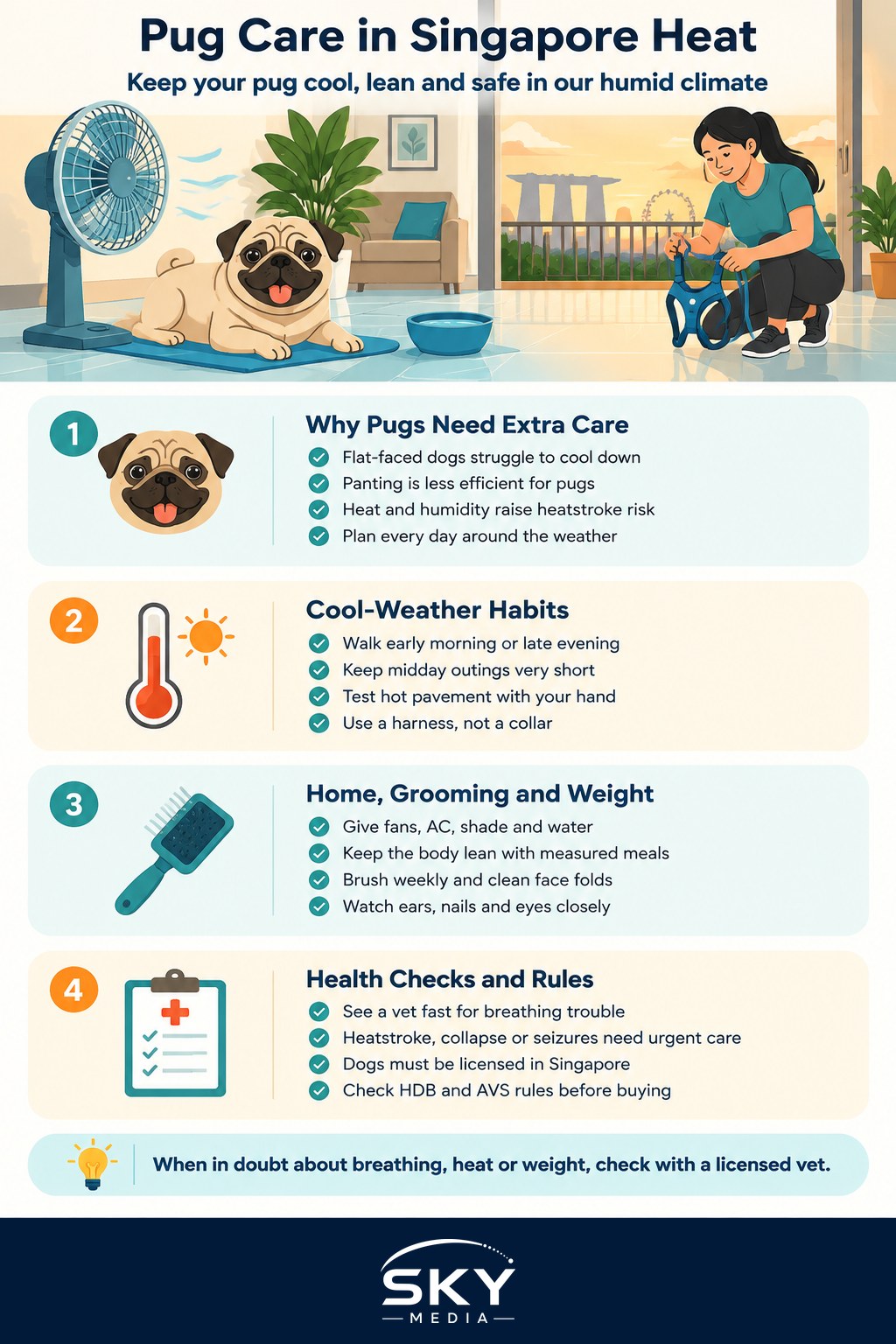
Few dogs win hearts as quickly as a pug. Those big eyes, the curly tail and the clownish personality make the pug a favourite in flats and condos across the island. Yet owning a pug in Singapore comes with real responsibilities that go beyond cuddles, because this is a flat-faced breed living in one of the hottest, most humid climates on earth. This guide walks you through daily care, grooming, weight and, most importantly, keeping a pug safe in our heat. It is general information, not veterinary advice, so please see a licensed vet who knows your dog for anything specific.
Understanding the Pug and Our Climate
The pug is a brachycephalic, or flat-faced, breed. Selective breeding for that adorable squashed face has also narrowed and shortened the airway behind it. Many pugs have pinched nostrils, an overlong soft palate and a smaller-than-normal windpipe, a bundle of issues often grouped as BOAS, or brachycephalic obstructive airway syndrome.
Why does this matter so much here? Dogs cool themselves mainly by panting, moving air over a wet tongue so heat evaporates away. A pug has to force air through a cramped passage, so panting is far less efficient and takes much more effort, which in turn generates even more heat. In Singapore’s steady warmth and heavy humidity, evaporation slows further because the air is already loaded with moisture. The result is a dog that overheats fast, and heatstroke can turn deadly within minutes. Be honest with yourself before you commit: a pug is a demanding companion in this climate, and it needs an owner who plans around the heat every single day.
Keeping a Pug Cool and Safe
Prevention is far kinder than any rescue. Small daily habits keep a pug comfortable through our long, hot year.
- Walk in the cool of early morning or late evening, and keep midday outings to quick toilet breaks only.
- Do the pavement test: press the back of your hand to the ground for seven seconds. If it is too hot for your hand, it is too hot for a low-slung dog breathing that hot air.
- Keep walks short and gentle, let your pug set the pace, and turn back at the first sign of hard, noisy panting.
- Use a well-fitted harness rather than a collar, which spares an already struggling windpipe.
- At home, give access to air-conditioning or fans, cool tiled floors and shade, and always keep fresh water within reach.
- Consider a cooling mat, and never let your pug become overweight, as extra fat crowds the chest and airway.
Two rules are absolute. Never leave a pug in a parked car, not even for a minute with a window cracked, because the interior becomes an oven with frightening speed. And never restrict a pug’s ability to pant, because panting is its only way to cool down.
Learn the signs of heatstroke so you never dismiss them as tiredness: frantic or laboured panting that will not settle, a bright red or bluish tongue and gums, thick ropey drool, wobbliness or confusion, vomiting, or collapse. Heatstroke is an emergency. Move your dog into cool air at once, wet the coat with cool, not iced, water over the belly and armpits, keep air moving with a fan, and get to a vet even if the dog seems to recover, because internal damage can appear hours later.
Daily Care, Grooming and Diet
A pug’s short coat is easy to brush but sheds a surprising amount, so a weekly brush helps. The famous face wrinkles need attention: wipe the folds gently and keep them dry, as trapped moisture in our humidity can lead to irritation and odour. Check the ears, keep nails trimmed, and watch those large eyes, which sit prominently and are prone to scratches and dryness.
Weight is the single biggest thing you control. A lean pug breathes more easily, moves better and lives more comfortably. Feed measured meals rather than free-feeding, go easy on treats, and remember that some human foods are toxic to dogs, including chocolate, grapes and raisins, onion and garlic, caffeine and xylitol. Introduce any diet change gradually and check portions with your vet.
| Care area | Everyday routine | See a vet promptly |
|---|---|---|
| Breathing | Gentle exercise, keep cool, stay lean | Noisy or laboured breathing, blue gums |
| Skin folds | Wipe and dry weekly, watch for redness | Sore, smelly or weeping folds |
| Weight | Measured meals, few treats | Rapid gain or loss of appetite |
| Eyes | Keep clear of hair, watch for rubbing | Cloudiness, redness or a scratch |
Health, Rules and Choosing Responsibly
Watch for red flags that mean get to a vet or an emergency clinic now: trouble breathing, collapse, refusing food or water, suspected heatstroke, seizures, or a bloated hard abdomen. Keep up regular check-ups so your vet can track your pug’s breathing and weight, and ask whether your dog might benefit from procedures that ease brachycephalic breathing. Never guess with medicines or dosages, and never rely on invented figures from the internet.
On the practical side, dogs in Singapore must be licensed, and HDB restricts which breeds and how many dogs are allowed in a flat. Check the current HDB-approved list and the rules from AVS, the Animal and Veterinary Service under NParks, before you bring any dog home. If you are still deciding, resist an impulse buy. Adopt where you can, or choose an AVS-licensed source, meet the parents, and favour a pug with more open nostrils and a slightly longer muzzle.
A pug gives enormous love and asks only that we respect its limits. Keep it cool, keep it lean, know the warning signs, and keep an emergency vet’s number somewhere you can find it in a panic. For anything about your own pug’s breathing, weight or fitness for exercise, talk to a licensed vet in person.
Explore more: flat-faced dog breeds and heat safety, keeping pets cool in Singapore’s heat, HDB-approved dog breeds and choosing a vet in Singapore.
Further reading: Caring for a Puggle in Singapore