
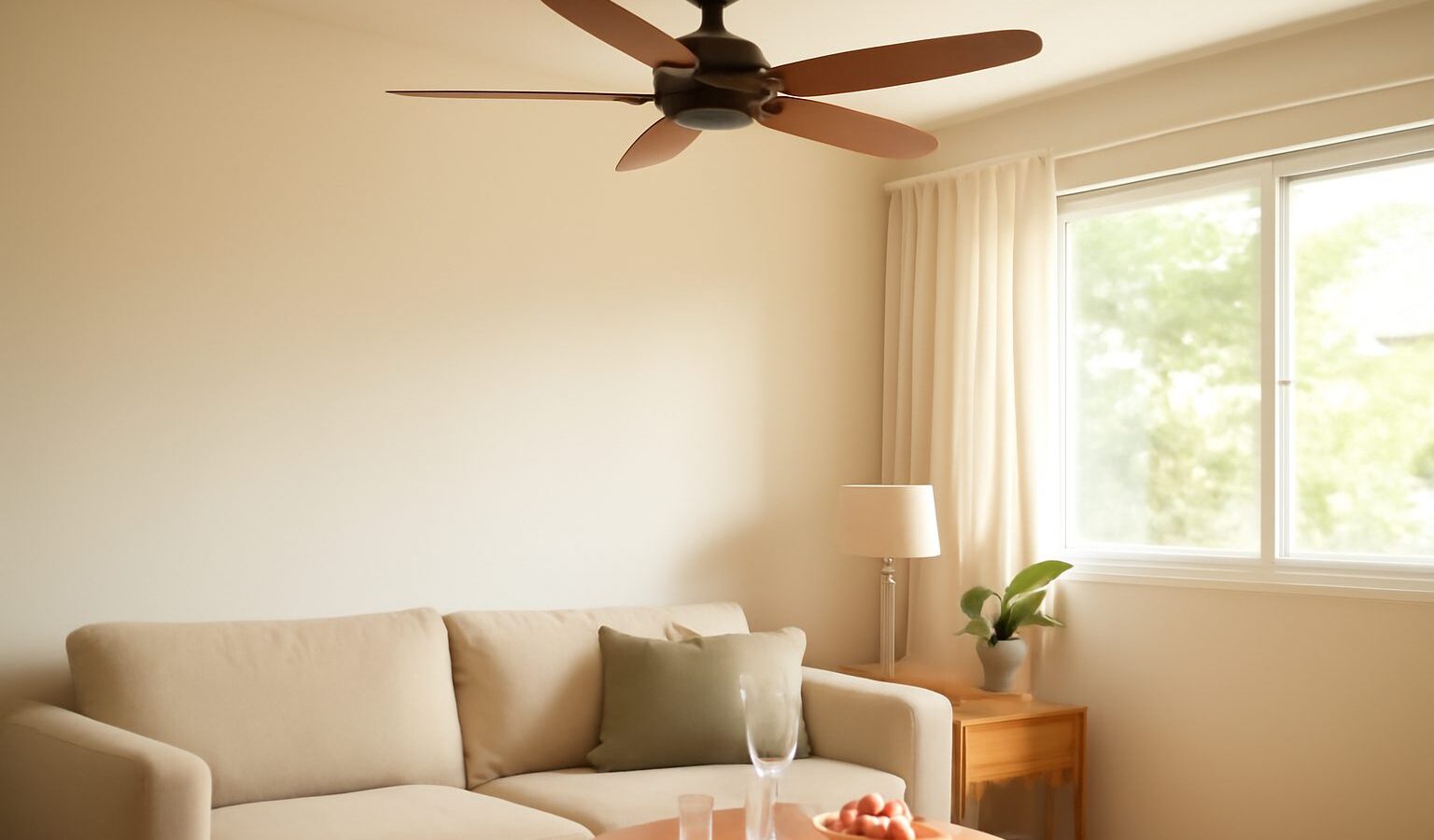
Few purchases matter more for daily comfort than getting your cooling right, and ceiling fans in Singapore quietly do a lot of that heavy lifting. In a climate that stays warm and humid all year, moving air is the cheapest way to feel cooler, and a good ceiling fan runs for a fraction of what aircon costs. Whether you live in a compact HDB flat, a condo unit, or an older resale home with high ceilings, the right fan keeps rooms breathable and shaves a noticeable amount off your electricity bill. This guide walks through fan types, motors, sizing, and how to pair a fan with your aircon so both work harder for less.
Ceiling Fans Versus Standing, Wall and Air-Conditioning
Every cooling option here has a job it does best, and most homes end up using a mix. Understanding the trade-offs helps you spend where it counts.
Ceiling fans cool the widest area evenly and disappear into the ceiling, which matters when floor space is tight. They circulate air across a whole room rather than blasting one spot, so a living room or bedroom feels uniformly fresher. Standing and wall fans are cheaper, portable, and need no installation, making them ideal for renters, service yards, or targeted cooling at a study desk. Their downside is that they take up floor or wall space and only cool where they point.
Air-conditioning is the only option that actually lowers the temperature and pulls humidity out of the air, which is why it wins on the hottest, stickiest nights. The catch is running cost and the need for regular servicing. The smart move for most Singapore homes is not choosing one over another but layering them: fans for everyday comfort, aircon for the peak of the afternoon or for sleeping through a humid night.
| Cooling option | How it cools | Rough running cost | Best for |
|---|---|---|---|
| Ceiling fan | Circulates air across whole room | Very low | Living room, bedroom, all-day use |
| Standing or wall fan | Directs air at one spot | Very low | Renters, desks, service yard |
| Air-conditioning | Lowers temperature, removes humidity | High | Peak heat, sleeping, sealed rooms |
Running costs vary with usage and your tariff, so treat these as relative rather than exact and check your own bill. The general rule holds: a fan costs far less to run than a compressor.
DC Versus AC Motor Fans
The biggest technical choice you will face is the motor type, and it genuinely affects your bill over the years. Traditional ceiling fans use an AC motor, while newer models use a DC motor, and the difference is real.
DC motor fans use noticeably less electricity for the same airflow, run more quietly, and usually come with more speed settings and a remote as standard. They tend to start and stop more smoothly and often include a reverse function. The trade-off is a higher upfront price and, in some cases, reliance on a small controller or receiver that can be fiddlier to replace years down the line.
AC motor fans cost less to buy, are simpler, and have a long track record, which suits a spare room or a budget setup where the fan runs less often. For a fan that will run many hours a day in a living room or bedroom, though, a DC motor usually pays back its higher price over time through lower consumption and quieter running. Look for the energy label and tick rating when comparing models, as a more efficient fan sipping power all day adds up. Do not fixate on a single advertised figure; compare current models in store at Courts, Harvey Norman, or the heartland electrical shops, and online on Shopee and Lazada.
Sizing a Fan to Your Room and Ceiling
A fan that is too small barely stirs the air, and one hung too low in a flat with standard ceilings feels intrusive. Getting blade span and mounting height right matters more than most people expect.
As a rough guide for local homes:
- Small bedrooms and study corners suit a more compact blade span, enough to move air without overwhelming a tight space.
- Master bedrooms and typical HDB living rooms need a mid to large span to reach the corners.
- Large open-plan condo living areas or landed homes may need a large fan, or even two fans, to cover the floor evenly.
Ceiling height is the other half of the equation. Most HDB flats have standard ceilings, so you want the fan close-mounted (a hugger or low-profile model) to keep safe clearance below the blades. Aim to keep the blades well above head height. Homes with high ceilings, common in some older or landed properties, can use a down-rod to drop the fan to the effective height where its airflow reaches you. If your ceiling has a false or bulkhead section, factor that in before buying, because the mounting point and clearance change.
Using a Fan With Aircon to Save Energy
This is where a ceiling fan earns its keep. Running a fan alongside your aircon lets you set the thermostat a degree or two warmer while feeling just as cool, because moving air helps sweat evaporate and makes the room feel fresher than the thermostat reading suggests.
A few habits that genuinely help:
- Nudge the aircon warmer. With a fan running, a slightly higher set temperature feels the same, and every degree eases the compressor’s workload.
- Let the fan spread the cold. Aircon tends to pool cold air near the unit, and a ceiling fan pushes it around the whole room so you cool evenly instead of over-cooling one corner.
- Fan first, aircon later. On milder evenings the fan alone may be enough, so reach for the aircon only when the heat genuinely calls for it.
- Turn both off when you leave. A fan cools people, not rooms, so there is no point leaving it running in an empty space.
Pair this with a well-serviced aircon and the savings compound. Our aircon-servicing-guide-singapore covers keeping the unit efficient, and energy-efficient-appliances-singapore explains how to read the tick rating across your whole home.
Bladeless, Smart and Other Modern Options
The fan aisle has grown well beyond the classic three-blade design, and some of the newer options suit specific needs.
Bladeless ceiling and standing fans appeal to homes with young children or anyone nervous about exposed blades, and they look cleaner in a minimalist room, though they often move less air than a traditional fan for the money. Smart fans add app control, scheduling, timers, and integration with a wider smart-home setup. Many modern fans also build in a dimmable light, handy in a bedroom where you want one fitting instead of two.
Weigh these features honestly against the basics. A well-sized DC fan with a decent remote covers most needs, and the extras are worth it only if you will use them. Do not pay for app control you will never open.
Installing a Ceiling Fan Safely
Mounting a ceiling fan is not a casual DIY job, because it hangs a spinning weight over your head and wires into your mains. Treat it as electrical work.
Engage a licensed electrician to install a ceiling fan, especially where new wiring, a fan point, or a wall control is involved. The installer needs to confirm the ceiling mounting point can bear the weight and vibration, wire it correctly, and balance the blades so the fan does not wobble. In an HDB flat, check HDB renovation rules before adding new fan points or wall controls, and in a condo, clear anything that touches common property or wiring with your MCST. If you are only swapping a like-for-like fan on an existing, sound fan point, a professional can still do it quickly and safely; do not improvise with a shaky bracket or an overloaded circuit. The small cost of proper installation is cheap insurance against a fan coming loose.
Explore more
For the fuller picture on staying comfortable without over-relying on the compressor, read our guide on keeping your home cool naturally in Singapore, which covers shading, ventilation, and layout. When you are choosing the fan itself alongside your other appliances, energy-efficient appliances in Singapore explains the tick rating and running costs, and the aircon servicing guide keeps your cooling working hard for less.