
When skin feels tight, looks dull or stings when you apply your usual products, a weakened barrier is often the culprit, and that is exactly where ceramides skincare singapore shoppers keep hearing about comes in. Ceramides are one of the most reassuring ingredients you can add to a routine, because they support the skin rather than pushing it, and they suit almost every skin type.
This article is general information, not medical or dermatological advice. If your skin is persistently irritated, cracked or worsening, please see a doctor or dermatologist.
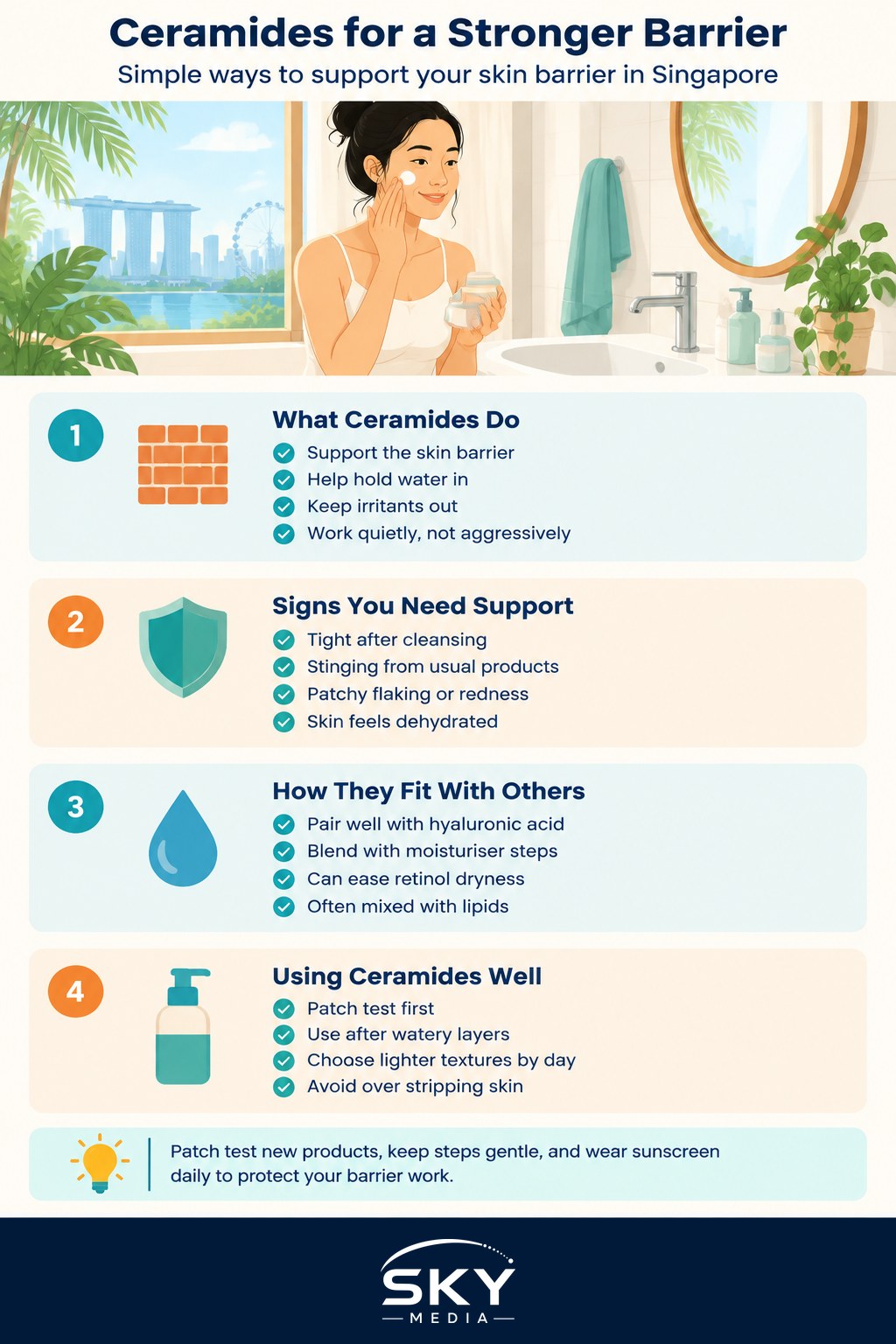
What Ceramides Do
Your skin barrier is the outermost layer, and a helpful way to picture it is a brick wall. The cells are the bricks and the fatty materials between them are the mortar. Ceramides are a major part of that mortar, alongside other lipids like cholesterol and fatty acids. When the mortar is intact, the wall holds water in and keeps irritants out. When it is depleted, water escapes more easily and the skin feels dry, sensitive and reactive.
Your skin already makes ceramides, but levels can dip because of over cleansing, harsh actives, weather changes, air conditioning and simply getting older. Applying ceramides in skincare tops up that supply and helps the barrier do its job. The result is usually skin that feels more comfortable, looks smoother and copes better with the rest of your routine.
Crucially, ceramides are not an aggressive active. They do not exfoliate or force change. They restore and reinforce, which is why they pair so well with stronger ingredients that can otherwise leave skin feeling raw.
It also helps to know that ceramides come in several types, often listed on labels with letters and numbers, and formulas frequently blend them with cholesterol and fatty acids because that mix mirrors how the barrier is naturally built. You do not need to memorise the chemistry. The practical takeaway is that a well formulated ceramide moisturiser is doing quiet, cumulative work every time you use it, and the benefits tend to hold as long as you keep the habit going rather than treating it as a one off rescue.
Signs Your Barrier Needs Support
How do you know your barrier is struggling? Common signals include a tight or stretched feeling after cleansing, unexpected stinging from products you normally tolerate, patchy flaking, redness that lingers, and skin that suddenly seems dehydrated no matter how much water you drink.
In Singapore there is a particular twist. We live in constant humidity, yet many of us move between hot outdoor air and cold, dry air conditioned rooms all day. That repeated swing, combined with sweat, frequent cleansing and sometimes layered actives, can quietly wear the barrier down even though the air outside feels moist. So a damaged barrier is not just a dry country problem.
Ceramides Compared To Other Popular Ingredients
It helps to see where ceramides sit next to other ingredients people often reach for. This is a general guide, not a rule book.
| Ingredient | Main job | Best thought of as |
|---|---|---|
| Ceramides | Rebuild and reinforce the barrier | Repair and protection |
| Hyaluronic acid | Draw in and hold water | Hydration |
| Niacinamide | Support barrier and even out tone | All rounder |
| Retinol | Encourage renewal over time | Active treatment |
| Squalane | Soften and lock in moisture | Emollient comfort |
You do not have to choose only one. In fact, ceramides work beautifully in company. A common comfortable routine pairs a humectant like hyaluronic acid to pull in water, then ceramides and an emollient to seal it and rebuild the wall. If you use a treatment active such as retinol, ceramides can help offset the dryness it sometimes causes.
How To Use Ceramides In Singapore
Because ceramides are gentle, they are easy to fit in, but a few habits make them work harder.
First, patch test any new product. Dab a little on your inner forearm for a few days before applying it to your face, and introduce only one new product at a time so you can tell what your skin likes.
Second, think about order. Ceramides usually appear in moisturisers and richer serums, so they tend to go on after your thin, watery hydrating steps. Apply them to slightly damp skin to help trap moisture, then finish your morning routine with sunscreen.
Third, match the texture to the weather. Our humidity means a heavy cream can feel suffocating, so many people prefer a lighter ceramide lotion or gel cream by day and something a touch richer at night. Comfort is a good guide. If a product feels greasy and never sinks in, it is probably too heavy for the climate.
Fourth, do not over strip in the first place. The fastest way to damage your barrier is aggressive cleansing and too many strong actives at once. A gentle cleanser, fewer harsh steps and consistent ceramide use will do more than any single miracle product.
Finally, keep wearing sunscreen every day. Sun exposure stresses the barrier too, and daily broad spectrum protection, reapplied outdoors, protects all the repair work your ceramides are doing.
Building A Barrier Friendly Routine
A simple, sustainable approach looks like this. Cleanse gently. Add a hydrating layer. Apply a ceramide moisturiser suited to the weather. Protect with sunscreen in the day. When your skin feels calm, you can slowly introduce a treatment active, always one at a time, always patch tested.
Ceramides rarely cause drama, which is exactly the point. They are the quiet, dependable part of a routine that lets everything else work better. If your barrier feels stronger, less reactive and more comfortable over a few weeks, they are earning their place.
If your skin stays sore, cracked or inflamed despite a gentle barrier focused routine, stop guessing and see a doctor or dermatologist. Persistent problems deserve professional eyes.
Explore more
Repairing Your Skin Barrier
Caring for Dry and Dehydrated Skin in Singapore
Hyaluronic Acid Explained
Skincare for a Humid Climate
Frequently Asked Questions
Are ceramide moisturisers too heavy for oily or acne-prone skin? Not necessarily, because the texture matters more than the ingredient. Ceramides themselves are not an oil, and many come in light lotions or gel creams that suit humid weather. Pick a formula that sinks in without feeling greasy, patch test first, and see a doctor or dermatologist if breakouts persist.
How long does it take for ceramides to make skin feel better? Many people notice skin feeling more comfortable within a few weeks of regular use, though it varies. Ceramides do quiet, cumulative work rather than giving overnight results, so consistency matters more than quantity. If your skin is still sore or cracked after that, get it checked rather than guessing.
Should I put ceramides on in the morning, at night, or both? Both work well, and you can adjust the texture to the time of day. A lighter ceramide lotion suits mornings under sunscreen, while a slightly richer cream can go on at night when skin repairs. Apply to slightly damp skin after any watery hydrating steps.
Do I need a separate ceramide serum if my moisturiser already has them? Usually not. A well formulated ceramide moisturiser already does the job, and adding more products raises the chance of irritation without much extra benefit. A separate serum only makes sense if your skin still feels depleted, and you should introduce it alone so you can judge how it behaves.
Can ceramides help with eczema-prone or very sensitive skin? Ceramide products are often chosen by people with dry, sensitive skin because they support the barrier and are gentle. They are not a treatment for eczema or any medical condition, though. If you have patches that are itchy, inflamed or recurring, a doctor or dermatologist should guide your care.
Further reading: Skin Fasting and Minimal Skincare