

Businesses rename for many reasons: a rebrand, a merger, a shift into a new market, or simply a name that no longer fits. If you need to change company name details in Singapore for an existing company, the process runs through the Accounting and Corporate Regulatory Authority (ACRA), the body that registers companies and businesses.
This guide focuses on renaming a company that is already incorporated, not choosing a name before you register. It covers the approvals you need, the filing, and the long list of updates that follow. It is general information, not legal advice. Fees, forms and procedures can change, so confirm current requirements on the ACRA website or with your company secretary.
What Stays the Same and What Changes
A common worry is that a new name means starting over. It does not. Renaming changes the company’s name, not its legal identity.
| Item | After a name change |
|---|---|
| Unique Entity Number (UEN) | Stays the same |
| Legal entity, contracts and liabilities | Continue under the new name |
| Bank accounts | Remain open, but the bank must update its records |
| Company name on official records | Updated by ACRA once the change is approved |
| Trade marks and domain names | Not changed automatically; handle separately |
| Invoices, letterheads, signage | Must be updated by you |
Because the UEN stays the same, your filing history, tax records and existing agreements carry over. That said, many counterparties will still want written notice of the new name.
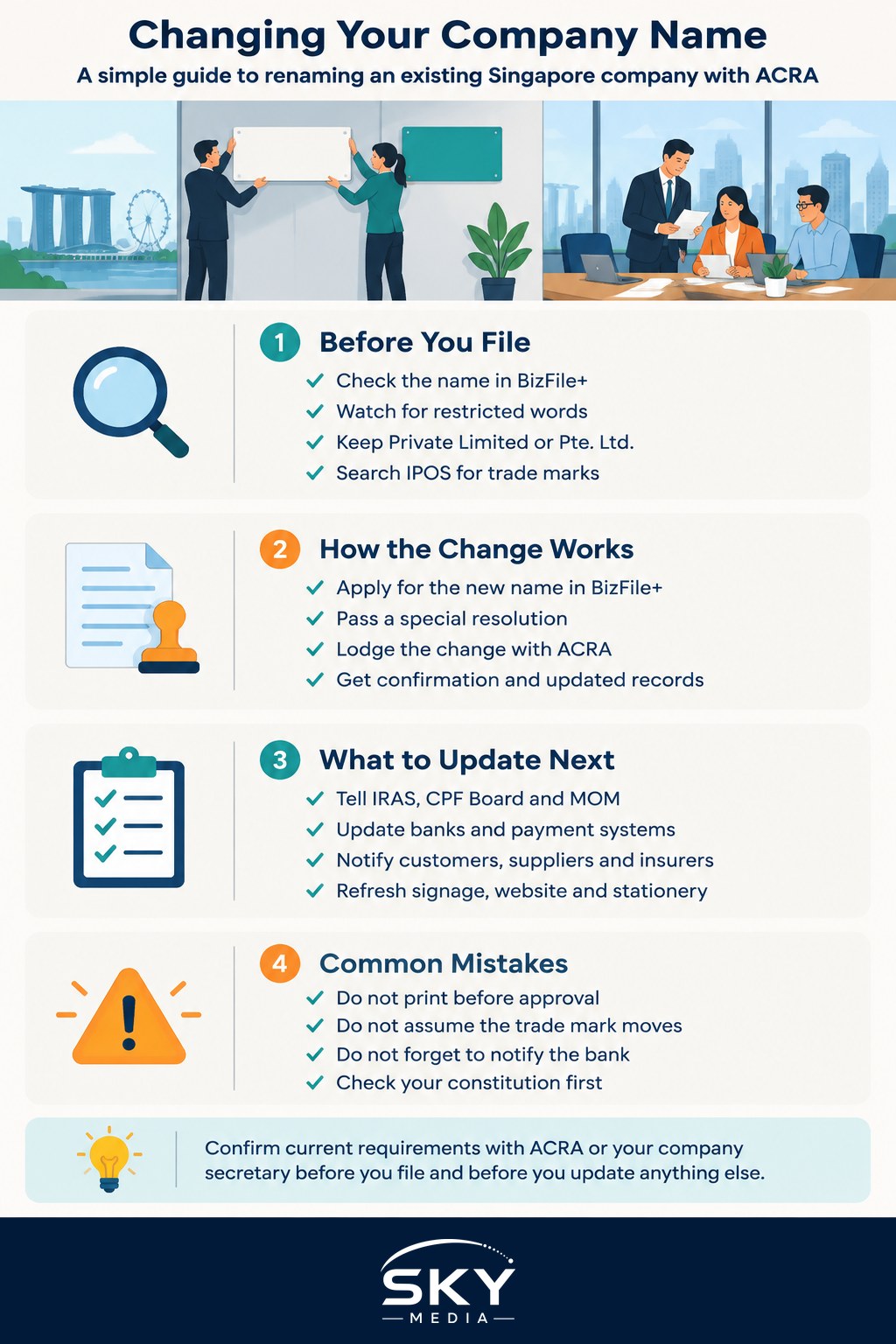
Before You File: Check the New Name
Do the groundwork before any meeting or filing.
- Run a name search. Use BizFile+, ACRA’s online portal, to check whether the name is available. ACRA may reject names that are identical to an existing name, undesirable, or otherwise not allowed under its guidelines.
- Watch for names needing approval. Certain words, for example those suggesting a regulated activity such as banking, insurance or education, may need approval from another government agency before ACRA accepts them. Check ACRA’s guidance on restricted words.
- Keep the correct suffix. A private limited company still needs “Private Limited” or “Pte. Ltd.” at the end of its name.
- Check trade marks. A company name being available with ACRA does not mean you have the right to use it as a brand. Search the Intellectual Property Office of Singapore (IPOS) database for existing trade marks, and consider registering your own.
- Secure the digital name. Check domain names and social media handles before announcing anything.
If you are working with Chinese-speaking customers, think about how the new name reads and sounds in Chinese too. Our guide to choosing a Chinese name for your Singapore brand explains the considerations.
Step-by-Step: How the Name Change Works
The exact flow on BizFile+ may change over time, but the process generally involves these stages.
- Reserve or apply for the new name. Through BizFile+, an authorised person, often the company secretary or a director, applies for the name. Approval may be immediate or may take longer if the name is referred to another agency.
- Pass a special resolution. Under the Companies Act, changing a company’s name generally requires shareholders to pass a special resolution. This can be done at a general meeting or, where the constitution allows, by written resolution. A special resolution needs a higher level of shareholder support than an ordinary resolution, so check your constitution and the Act, or ask your company secretary.
- Lodge the change with ACRA. The change of name, supported by the resolution, is lodged through BizFile+ within the required timeframe. Fees are payable; check the current amount on ACRA’s website.
- Receive confirmation. Once ACRA approves and registers the change, the new name appears on the company’s records. You can buy an updated business profile from BizFile+ as proof for banks and partners.
Many small companies have their corporate secretarial provider handle all of this. Make sure your provider tells you the exact date the change takes effect, because that date drives everything else.
Updating Everyone After the Change
The ACRA filing is often the easy part. The real work is telling everyone else and updating your materials. Plan this as a checklist.
Government and compliance
- IRAS (the Inland Revenue Authority of Singapore): records are linked to the UEN, but check whether any update is needed, especially if you are GST-registered and issue tax invoices showing the company name.
- CPF Board and MOM (Ministry of Manpower): employer records are usually tied to the UEN, but check that work pass records and correspondence reflect the new name.
- Licences and permits: any licence issued by other agencies in the old name may need updating. Contact each issuing agency.
- Annual filing: future filings will be under the new name. See our guide to ACRA annual filing and compliance to stay on track.
Banks and finance
- Notify your bank with the updated business profile and the resolution. Banks may need to update account names, cheques, payment links and corporate cards.
- Update payment gateways, PayNow details and merchant accounts so customers see the correct name.
- Tell your insurers, lenders and leasing companies.
Customers, suppliers and contracts
- Send formal notice to key customers and suppliers, explaining that the company and UEN are unchanged.
- Update invoice templates, quotations and purchase orders.
- Review contracts that require notice of a name change.
Branding and operations
- Signage, letterheads, business cards, email signatures and uniforms.
- Website, domain, social media profiles and online listings.
- Your company seal, if you use one, and any rubber stamps.
If your rename coincides with a move, our guide to changing your company address in Singapore covers the separate filing for that.
Common Mistakes to Avoid
- Printing before approval. Do not order signage or stationery until ACRA has registered the new name.
- Assuming the trade mark follows. Your old trade marks remain in the old name until you record the change with IPOS, and the new name is unprotected unless you register it.
- Forgetting the old name entirely. For a while, customers and suppliers will still search for and pay to the old name. A short line such as “formerly known as” on invoices and your website helps.
- Not updating the bank promptly. Payments made to the new name may be held or rejected if the bank’s records still show the old one.
- Skipping the constitution check. Some constitutions have their own requirements for resolutions. Read yours first.
Planning a Smooth Rename
A company name change in Singapore is a manageable process if you work in the right order: check the name and trade marks, pass the shareholder resolution, file through BizFile+, then roll out the updates in a planned sequence. Your UEN and legal history stay intact, so the main risk is confusion among customers and partners.
Give yourself a realistic timeline, appoint one person to own the checklist, and confirm each step with ACRA or your company secretary. Done carefully, the new name becomes a fresh start for your brand rather than an administrative headache.
Frequently Asked Questions
How long does a company name change take in Singapore? It depends on how quickly the name is approved, how fast shareholders can pass the resolution and how promptly the filing is submitted. A straightforward name may be approved quickly, while one referred to another agency takes longer. Ask your company secretary for the expected date and check ACRA.
Is changing a business name different for a sole proprietorship or partnership? Yes. Sole proprietorships and partnerships are registered as businesses rather than companies, so the steps and approvals differ, and the special resolution that companies need does not apply. Check ACRA’s current guidance for your business type before you apply.
What happens to my employees when the company changes its name? Employment contracts and service history continue because the company is the same legal entity. Give staff written notice of the new name, update payslips and related documents, and check that MOM and CPF Board records show the correct name where relevant.
What if ACRA rejects the new company name? ACRA gives reasons, which often involve a name that is too similar to an existing one or contains restricted words. Adjust the name, check whether another agency’s approval is needed and try again through BizFile+. Run searches on IPOS and your domain too.
Can I keep trading under the old name after the change? Not simply as the company name, since the legal name will be the new one. Some businesses use a short ‘formerly known as’ line for a period to help customers. If you want to keep using the old name as a trade name, check the registration rules with ACRA first.
Official sources: ACRA