

Choosing a name feels like the fun part of starting up, until the application comes back rejected or referred for review. If you want to register business name Singapore style without delays, it helps to understand that the name is assessed on its own, with its own rules and checks, before your business or company is actually registered. This guide focuses only on that naming step: what ACRA looks for, how to check availability, what tends to get rejected, and what a reserved name does and does not protect.
ACRA is the Accounting and Corporate Regulatory Authority, the government body that registers businesses and companies in Singapore. Its online portal is Bizfile, where name searches and applications are done. This is general information, not legal advice. Rules and fees can change, so always confirm the current requirements on the ACRA and Bizfile websites before you file.
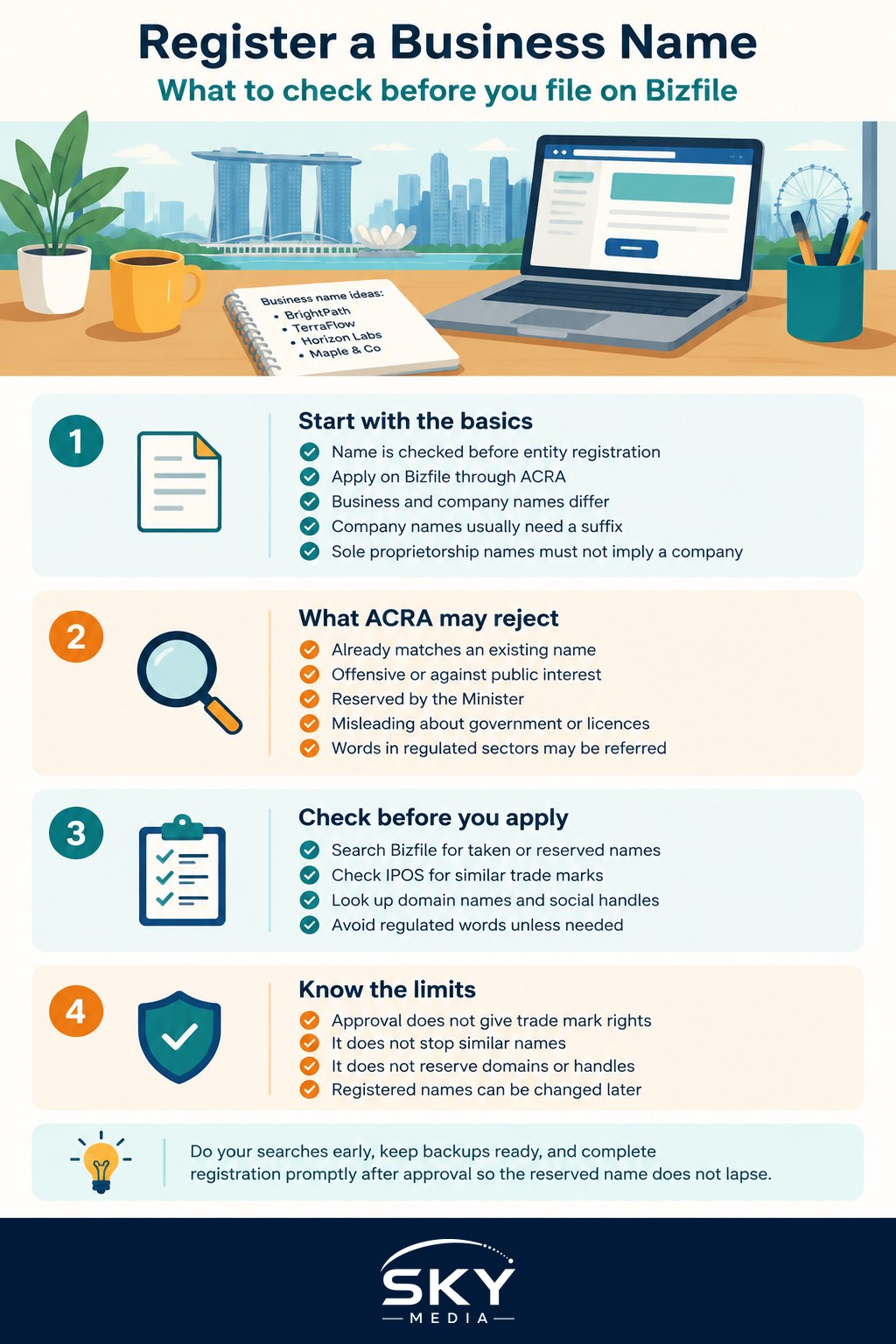
How the Name Fits Into Registration
In Singapore, the name application is the first part of setting up either a business (a sole proprietorship or partnership) or a company (such as a private limited company). You propose a name on Bizfile, ACRA assesses it, and once it is approved you complete the registration of the entity itself within the period ACRA allows. If you do not complete registration in time, the reserved name lapses and becomes available to others again.
If you are still deciding between a sole proprietorship and a company, our guide on how to register a company in Singapore covers the wider process. This article stays with the name itself, because it is where many first-time founders lose time.
A few points worth knowing early:
- Business names and company names follow slightly different conventions. A company name normally ends with a suffix that shows its legal form, such as “Pte. Ltd.” for a private limited company. A sole proprietorship name does not carry that suffix and must not suggest it is a company.
- One application, one name. Have two or three backup names ready in case your first choice is not approved.
- Approval is not instant in every case. Straightforward names can be approved quickly, but some names are referred to other government agencies, which takes longer.
What ACRA Checks When You Submit a Name
ACRA will generally not approve a name that falls into any of these groups. The wording on ACRA’s website is the authority, but the broad categories are well known:
- Identical to an existing name. If the name matches an existing business, company or reserved name, it will be rejected. ACRA’s comparison usually ignores small differences such as “the”, “and”, punctuation, spacing, plurals and legal suffixes, so “Blue Kite Studio” and “The Blue Kites Studio Pte. Ltd.” may be treated as identical.
- Undesirable names. Names that are offensive, vulgar, or contrary to public interest are not allowed.
- Names reserved by the Minister. Certain names and words are set aside and cannot be used.
- Names that mislead. A name that suggests a link with the government, a statutory board, or a regulated activity you are not licensed for can be refused or flagged.
Beyond outright refusal, some words trigger a referral to another authority. Words relating to regulated sectors, such as banking, finance, insurance, education, medical or legal services, may need approval from the agency that oversees that sector. If your proposed name contains such a word, expect extra time, and be ready to show you are actually allowed to carry on that activity.
How to Search and Test Your Name Before Applying
Doing your own checks first saves the frustration of a rejected application. Here is a simple routine:
- Run a name search on Bizfile. The portal lets you check whether a name is already taken or reserved. Try variations too, including the singular and plural, and versions with and without “the”.
- Search the trade mark register. ACRA approval does not check trade marks. Search the IPOS (Intellectual Property Office of Singapore) database to see whether someone has registered a similar mark for similar goods or services. A name can be approved by ACRA and still infringe a trade mark.
- Check domain names and social handles. Finding them already taken is a common reason founders rename later.
- Avoid regulated words unless you need them. If you do not plan to offer, for example, financial advice, leave words like “capital” or “wealth” out unless you have checked how ACRA treats them.
Common Naming Situations Compared
The table below summarises how typical naming situations tend to play out. Treat it as a guide only; ACRA decides each application on its own facts.
| Situation | What usually happens | What to do |
|---|---|---|
| Name is new and contains ordinary words | Usually approved without referral | Search Bizfile first, then apply with backups ready |
| Name is identical to an existing entity after ignoring minor differences | Rejected | Change a distinctive word, not just punctuation or “the” |
| Name contains a word linked to a regulated sector | Referred to another agency, longer wait | Prepare evidence of the relevant licence or approval |
| Name is approved but matches someone’s registered trade mark | ACRA may approve, but you risk an infringement claim | Search IPOS before applying and get advice if unsure |
| Approved name not used to register the entity in time | Reservation lapses, name becomes free again | Complete registration promptly after approval |
What a Registered Name Does Not Give You
A common misunderstanding is that registering a business name gives you exclusive ownership of it. In practice, ACRA registration mainly stops another entity from registering an identical name on the register. It does not:
- give you trade mark rights across Singapore or overseas;
- stop someone using a similar, non-identical name;
- reserve the matching website domain or social media handles;
- protect your logo or brand design.
If the name is central to your brand, consider registering a trade mark with IPOS. That is a separate process with its own fees and timelines, which IPOS publishes on its website.
Changing or Fixing a Name Later
Names can usually be changed after registration through a filing on Bizfile, subject to the same checks as a new name. Changing later costs time and money, since signage, invoices, bank records, contracts and marketing materials all need updating. It is far easier to spend an extra hour on searches at the start.
If someone complains that your name is too similar to theirs, get proper legal advice rather than relying on general guides.
Tips for Newcomers and Foreign Founders
Newcomers, including those from mainland China, sometimes want a Chinese name alongside the English one. ACRA registers names in English letters, so a Chinese-character name typically appears on your signage and marketing rather than as the registered name. Make sure the two are consistent enough that customers recognise them as the same business.
If you hold a work pass, remember that whether you may run or register a business depends on the rules for your specific pass. Check with MOM (the Ministry of Manpower) before you file anything. Foreign founders setting up a company may also need a locally resident director and a registered filing agent, which our guide on registering a company with ACRA in Singapore explains in more detail.
A Quick Pre-Filing Checklist
Before you click submit on Bizfile, run through this list:
- Bizfile search done, including plural, singular and “the” variations
- IPOS trade mark search done for similar marks in your field
- No regulated-sector words, or evidence ready if you need them
- Correct legal suffix for a company, none for a sole proprietorship
- Two or three backup names prepared
- Domain and social handles checked
- Pass holder? Eligibility confirmed with MOM
These steps do not guarantee approval, but they remove the most common causes of rejection or delay. Once the name is approved, move promptly to complete your registration so the reservation does not lapse.
Explore more: How to Register a Company in Singapore · Registering a Company With ACRA in Singapore
Frequently Asked Questions
Does registering a business name protect it from being copied? Only partly. ACRA registration mainly stops another entity from registering an identical name on the register. It does not give trade mark rights, stop similar names, reserve your domain or protect your logo. If the name is central to your brand, consider a trade mark with IPOS.
How can I tell if my business name will be rejected? Run a Bizfile name search, including singular, plural and “the” variations, since ACRA’s comparison ignores small differences. Avoid offensive wording, names that suggest a government link, and regulated-sector words unless you can show approval. Prepare two or three backup names.
Can I register a Chinese-character business name in Singapore? ACRA registers names in English letters, so a Chinese-character name typically appears on your signage and marketing rather than as the registered name. Keep the two consistent enough that customers recognise them as the same business.
What happens if I do not finish registration after my name is approved? The reserved name lapses and becomes available to others again. Complete the registration of the entity within the period ACRA allows, so move promptly once you receive approval. Check Bizfile for the exact timeframe.
Can I change my business name after it has been registered? Usually yes, through a filing on Bizfile, subject to the same checks as a new name. It costs time and money later, though, since signage, invoices, bank records and contracts all need updating. An extra hour of searching at the start is cheaper.
Official sources: ACRA · GoBusiness
Further reading: How to Start a Laundry Business in Singapore · How China Founders Can Choose a Singapore Company Name · Starting a Photography Business · How to Choose and Update Your SSIC Code in Singapore