

If you are a founder from mainland China opening a business here, picking a Chinese brand name in Singapore can feel familiar at first. Singapore uses simplified Chinese characters and Hanyu Pinyin, just like the mainland, and Mandarin is widely spoken. But the market works differently. English is the main language of business, customers come from many backgrounds, and local Mandarin carries its own flavour. A name that works well in Shanghai or Shenzhen may need adjusting to land well here.
This guide covers how to choose, test and protect a Chinese name for a brand you are localising for Singapore.
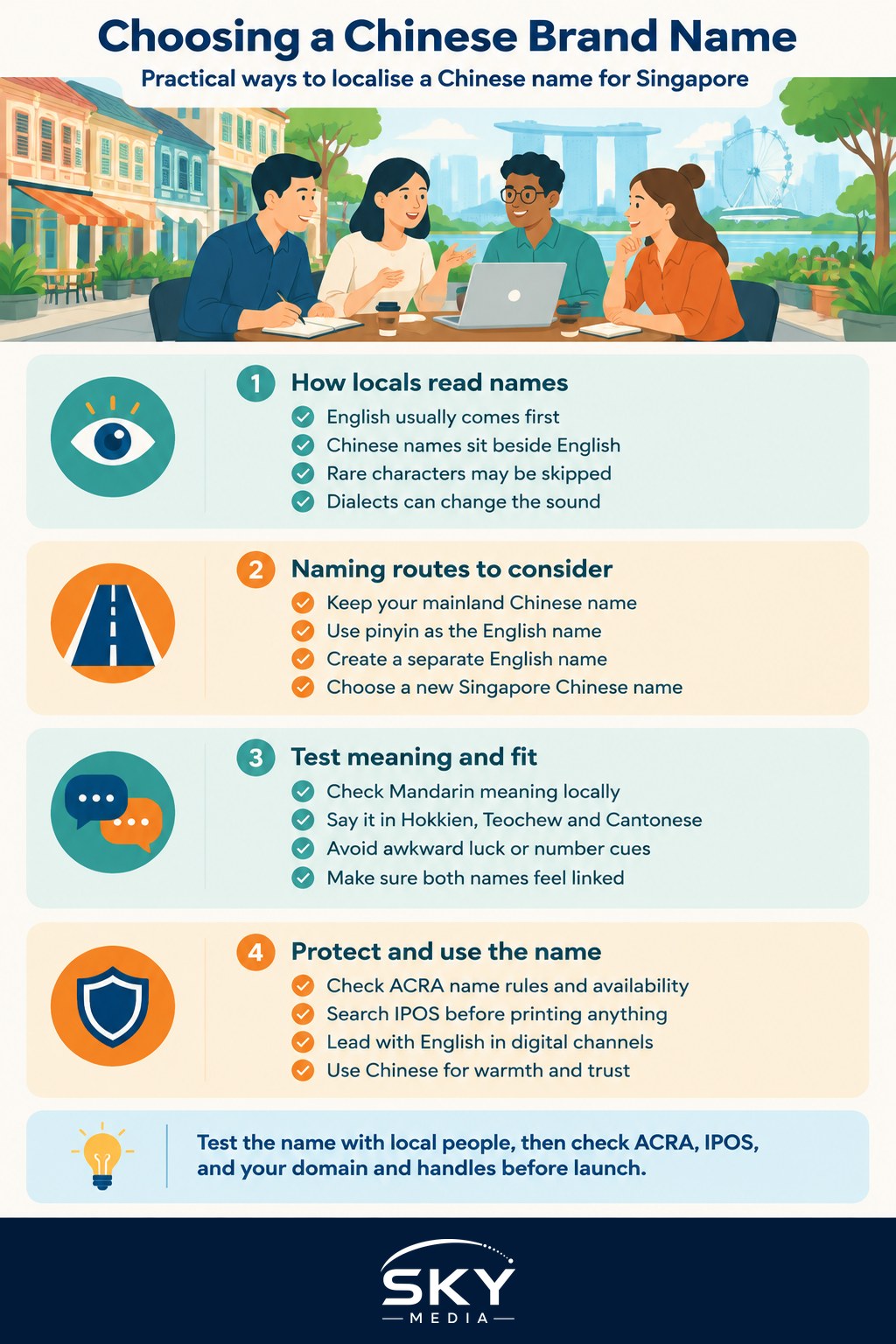
How Singapore Customers See a Chinese Brand Name
Singapore is a multiracial society. Chinese Singaporeans are the largest group, but Malay, Indian and other communities, plus many expatriates, are part of most customer bases. Some practical points:
- English comes first in most settings. Shop signs, menus, websites, receipts and official documents usually lead with English. Your Chinese name often appears alongside, not alone.
- Not every Chinese Singaporean reads Chinese fluently. Many younger customers are comfortable speaking Mandarin but read English more easily. A Chinese name with rare characters may simply be skipped.
- Dialects still matter. Many older Chinese Singaporeans also speak Hokkien, Teochew, Cantonese, Hakka or Hainanese. Family surnames and place names are often romanised from these dialects rather than from pinyin, which is why many local names look unfamiliar to mainland visitors. Our article on why Singapore Chinese names are spelled differently explains this background.
- Local Mandarin vocabulary differs. Some everyday words used in Singapore differ from mainland usage, and a few mainland internet terms may not be understood here.
In short, your Chinese name is one part of a bilingual identity, not the whole of it.
Four Common Naming Approaches
Mainland brands entering Singapore usually take one of a few routes. The table compares them.
| Approach | How it works | Strengths | Watch out for |
|---|---|---|---|
| Keep your mainland Chinese name | Use the existing name and add an English name | Consistent with home market, easy for mainland customers | English name must stand on its own for non-Chinese readers |
| Pinyin as the English name | Use the pinyin spelling of your Chinese name | Simple, keeps a single identity | Hard for non-Mandarin speakers to say or remember |
| Separate meaningful English name | Create an English name related to your brand idea | Easy for all customers, works on signs and search | Two names to build and protect |
| New Chinese name for Singapore | Rename in Chinese to suit local tastes | Can avoid unlucky or confusing meanings locally | Loses recognition from the home market |
Many founders end up with a combination: keep the Chinese name for continuity and pair it with a short, easy English name designed for Singapore.
Checking Meaning, Sound and Feel
Before you commit, test the name with real local people, not only colleagues from home. Check:
- Meaning in Mandarin as used here. Ask Singaporean Chinese friends what the name brings to mind. Some words feel old-fashioned, playful or formal in ways you may not expect.
- Sound in major dialects. Say the characters in Hokkien, Teochew and Cantonese. A neutral name in Mandarin may sound like something awkward or unlucky in a dialect.
- Number and luck associations. Many customers notice numbers like 4 and 8, but avoid overdoing lucky symbols, which can look dated or gimmicky.
- Readability. Prefer common characters that people can read and type easily. Rare characters cause problems on menus, delivery apps and social media searches.
- The English pairing. Say both names aloud together. They should feel like one brand, not two unrelated businesses.
- Fit with other communities. Ask Malay, Indian and expatriate contacts how the English name sounds to them. Avoid words that have unfortunate meanings in Malay or other local languages.
A small round of feedback with ten to fifteen local people often reveals issues you would never find on your own.
Registration and Trademark Basics
This section is general information, not legal advice. Confirm current requirements with the official bodies before you register anything.
- Business registration with ACRA. The Accounting and Corporate Regulatory Authority (ACRA) registers companies and business names through its Bizfile portal. Check ACRA’s current rules on what characters and words a registered name may include, and whether your preferred name is already taken or too similar to an existing one. Your registered name and the brand name you display on signs do not have to be identical, but they should be consistent enough to avoid confusing customers.
- Trademarks with IPOS. The Intellectual Property Office of Singapore (IPOS) handles trademark registration. Trademark rights in China do not automatically protect you in Singapore. Consider whether to register your Chinese name, your English name, your logo, or all of them, and in which classes of goods or services. Our guide to protecting your China brand and trademark in Singapore goes into more detail.
- Search first. Before printing signage or packaging, search the IPOS database and ACRA records for similar names. Changing a brand after launch is expensive.
- Domain and social handles. Check that a matching website domain and social media handles are available, especially for the English name, since that is what most people will type.
For complex cases, speak to a Singapore-registered trademark agent or lawyer.
Making the Name Work in Daily Business
Once you have a name, how you present it matters as much as the name itself:
- Lead with the English name in digital channels. Most Google searches, delivery app searches and map lookups in Singapore are typed in English.
- Use the Chinese name for warmth and recognition. On signage, packaging and social posts aimed at Mandarin speakers, the Chinese name builds familiarity and trust.
- Keep the style consistent. Use the same logo, colours and tone across both languages. Our guide on building a brand identity in Singapore covers the wider brand system.
- Explain your story. Many Singapore customers are curious about new mainland brands. A short line explaining what your Chinese name means can turn the name into a talking point.
- Prepare staff. Make sure frontline staff can say both names clearly and explain them if customers ask.
A Simple Decision Checklist
- Is the English name easy to say, spell and search for any Singapore customer?
- Does the Chinese name use common characters with a positive local meaning?
- Have you tested it in Mandarin and major dialects with local people?
- Have you searched ACRA and IPOS records for conflicts?
- Do you plan to register trademarks for the names and logo you will actually use?
- Do both names look like one brand when placed side by side?
A good Chinese brand name in Singapore respects your origins while speaking to the people who live here. Take time to test it locally, protect it properly, and pair it with an English name that carries your brand to every customer.
Frequently Asked Questions
Do I need to register a Chinese brand name separately from my English one? Possibly. Trademark registration with IPOS can cover your Chinese name, English name, logo, or all of them, in the classes of goods or services you use. Trademark rights in China do not automatically protect you here, so consider registering what you actually display.
Is it a problem if my registered company name and my shop name differ? Not necessarily. Your registered name and the brand name on your signs do not have to be identical, but they should be consistent enough not to confuse customers. Check ACRA’s current rules on what a registered name may include.
How many local people should I ask before settling on a name? A small round of feedback with ten to fifteen local people often reveals problems you would never find alone. Include Chinese Singaporeans, plus Malay, Indian and expatriate contacts. Ask what the name brings to mind and how it sounds.
Should I worry about dialect meanings in a Mandarin brand name? Yes, it is worth a check. Many older Chinese Singaporeans speak Hokkien, Teochew, Cantonese, Hakka or Hainanese, and a neutral Mandarin name may sound awkward or unlucky in a dialect. Say the characters aloud in major dialects with local speakers.
Which name should I use online, English or Chinese? Lead with the English name on digital channels, since most searches in Singapore, including delivery apps and maps, are typed in English. Use the Chinese name for warmth and recognition on signage, packaging and posts for Mandarin speakers. Check that matching domains and handles are free.