

Picking a Singapore company name as a China founder is rarely as simple as copying the name on your mainland business licence. Singapore registers company names in English letters, the rules are set by a different regulator, and a name that sounds elegant in Mandarin can read awkwardly, or mean something unintended, once it is romanised. This guide walks through the naming rules, the translation choices you will face, and how to keep one consistent brand across both markets.
This is general information, not legal advice. Naming rules and practices can change, so confirm the current requirements with ACRA before you file.
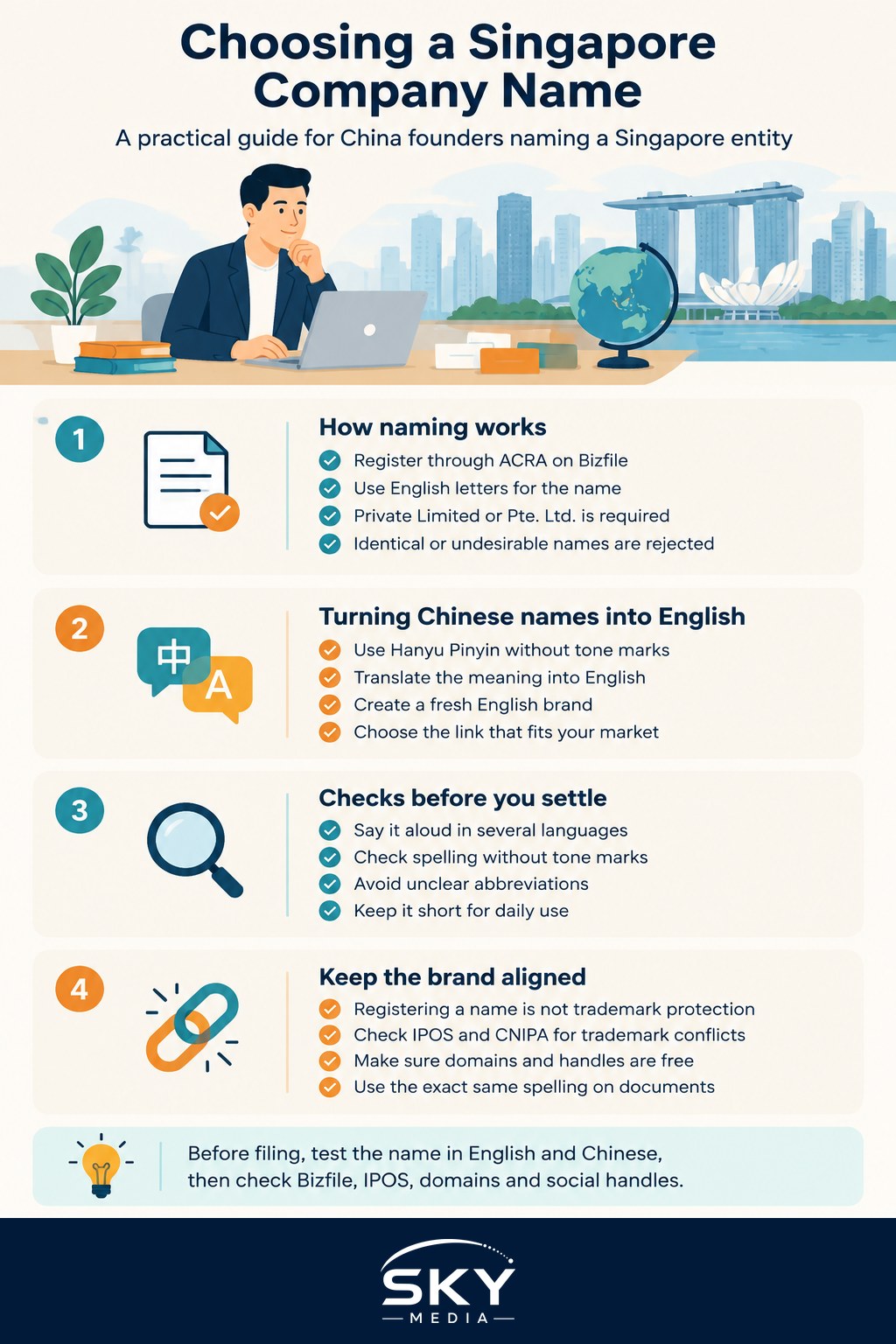
How Company Naming Works in Singapore
In Singapore, companies are registered with ACRA, the Accounting and Corporate Regulatory Authority. You apply for a name through Bizfile, ACRA’s online filing portal, usually as the first step of incorporation. If you have been in China, think of it as the Singapore counterpart to the name pre-approval step you may have done with the local market regulation bureau, but run by one national body.
A few points that often surprise mainland founders:
- There is no city or region prefix. In China a company name often includes the city, the trade description and the organisational form. In Singapore you do not need a place name at all.
- The legal suffix is mandatory. A private company limited by shares ends with “Private Limited” or “Pte. Ltd.”. You do not choose a separate industry descriptor as part of a fixed formula.
- Identical names are rejected. ACRA will not accept a name that is identical to an existing company or business name, and it can reject names it considers undesirable.
- Some words need another agency’s approval. Words linked to regulated activities, such as banking, finance, insurance, education or law, may be referred to the relevant authority. That can slow things down or lead to a rejection if your business does not fit.
- Name approval is not a trademark. Having the company name registered with ACRA does not give you exclusive rights to use that name as a brand. That is a separate process with IPOS, the Intellectual Property Office of Singapore.
If you are setting up as a sole proprietor rather than a company, the process differs, and our guide on how to register a business name in Singapore explains it.
Translating a Chinese Name Into an English Company Name
Most mainland founders already have a Chinese brand name. The key decision is how to carry it into Singapore. There are three common approaches, each with trade-offs.
| Approach | Example of how it works | Strengths | Watch out for |
|---|---|---|---|
| Hanyu Pinyin transliteration | Using the pinyin of your Chinese name, without tone marks | Keeps the link to your China brand, easy for mainland partners | Hard for non-Mandarin speakers to say or spell, may look generic |
| Meaning-based translation | Translating what the Chinese characters mean into English words | Easy for an international audience to remember | Often already taken, can lose the feel of the original |
| New English brand | Creating a separate English name that suits the Chinese one in spirit | Distinctive, easier to protect and to search online | Weaker link to your China brand unless you present both together |
Practical checks before you settle on a name
- Say it out loud in English, Mandarin, Malay and Singlish. Singapore is multilingual. Ask friends from different backgrounds whether the romanised name sounds odd or rude in any language spoken here.
- Drop tone marks and check the spelling. Pinyin without tone marks can collapse different Chinese names into the same English spelling, which makes clashes with existing companies more likely.
- Avoid unclear abbreviations. Strings of capital letters may be accepted, but they are hard to remember and hard to find in search results.
- Check the meaning in dialects too. Hokkien, Teochew and Cantonese are still heard in Singapore, and a pinyin sound can mean something different in a dialect.
- Keep it short enough for daily use. Your name will appear on invoices, bank records, GST registration, contracts and signage, so long names become tiring quickly.
Keeping Your Brand Consistent Across China and Singapore
Your registered Singapore name, your Chinese trading name and your trademark do not have to be identical, but they should clearly belong together. Customers, banks and partners on both sides will compare them.
Using your Chinese name in Singapore
Your Singapore company name is registered in English letters, but you can still present your Chinese brand on your website, packaging and shopfront, as long as you are not misleading anyone about who you are. Many companies show the Chinese name beside the registered English name so mainland partners recognise the brand. Confirm with ACRA what must appear on official documents such as invoices and letterheads.
Protecting the brand in both places
- Singapore: Search the IPOS trademark database, then consider filing a trademark for your English name, your Chinese characters and any logo.
- China: Trademark rights in mainland China work on a first-to-file basis through CNIPA, the China National Intellectual Property Administration. If you only registered the Chinese characters there, think about whether your new English name should also be protected in China.
- Domains and social handles: Check that the matching .sg or .com domain and your main social media handles are free before you file the company name. A name you cannot use online is much less valuable.
Matching your bank and pass documents
The name you register will flow into your corporate bank account, contracts and any work pass application. If you plan to apply for an EntrePass or open a corporate account, use exactly the same name and spelling everywhere. Small differences, such as “Tech” in one document and “Technology” in another, can cause questions and delays. Our guides to opening a corporate bank account for China founders and the EntrePass for China founders cover those next steps.
A Step-by-Step Naming Process for China Founders
- List five to ten candidate names. Include at least one pinyin option, one meaning-based option and one new English brand.
- Run a name search on Bizfile. Rule out names that are identical or very close to existing entities.
- Search trademarks at IPOS and CNIPA. A free company name can still clash with someone else’s registered brand.
- Check language, meaning and pronunciation. Test the shortlist with Singaporean contacts and with your team in China.
- Check domains and social handles. Prefer names where the main online addresses are available.
- Avoid restricted words unless you need them. If your business is regulated, expect a referral to the relevant authority and allow extra time.
- Submit the name application through Bizfile. If you use a corporate service provider, make sure they file the exact spelling you approved in writing.
- File trademarks soon after approval. Do not leave a gap where someone else can register your brand.
Common Mistakes Mainland Founders Make
- Copying the full mainland legal name. A literal translation of “City + brand + industry + Co., Ltd.” produces a long, clumsy name that rarely suits Singapore.
- Assuming the name is protected once approved. Company name registration and trademark protection are different things.
- Letting an agent pick the spelling. Service providers can be helpful, but the brand is yours. Approve the final spelling yourself.
- Changing the name later without planning. A name change is possible, but it means updating bank records, contracts, licences and marketing. Choosing well at the start saves effort.
Getting Help and Checking the Rules
ACRA’s website and Bizfile explain the current naming rules and list the words that may be referred to other authorities. IPOS explains trademark searches and filing in Singapore. If your structure is complex, for example a Singapore holding company above a mainland operating company, speak to a Singapore corporate secretary or lawyer before you commit to a name. Once the name is settled, consider whether you still need to sort out your EntrePass as a foreign founder before you start trading.
Frequently Asked Questions
Can I use Chinese characters in my Singapore company name? ACRA registers company names in English letters, so the registered name itself will be in the Roman alphabet. You can still show your Chinese brand name beside it on your website, packaging and shopfront, provided nobody is misled. Confirm with ACRA what must appear on official documents.
How long does Singapore company name approval take? It depends on whether the name is straightforward. A name that needs another agency’s approval, such as one containing words linked to finance or education, can take longer or be rejected. Check ACRA’s website for the current process, and allow extra time if your business is regulated.
Is a company name the same as a trademark in Singapore? No. Registering a company name with ACRA does not give you exclusive rights to use it as a brand. Trademark protection is a separate process with IPOS, so search and consider filing there soon after the name is approved.
Can I change my Singapore company name later if I do not like it? Yes, a change is possible, but it means updating bank records, contracts, licences and marketing materials. Choosing carefully at the start saves effort. Ask ACRA or your corporate service provider about the current steps if you need to rename.
Should my company name match the one on my EntrePass and bank account? Yes, use exactly the same name and spelling everywhere. Small differences, such as “Tech” in one document and “Technology” in another, can raise questions and cause delays with your bank or pass application. Approve the final spelling yourself rather than leaving it to an agent.
Official sources: ACRA
Further reading: How to Change Your Company Name With ACRA in Singapore