

Ask a room of Singapore parents how much sleep their children get and you will hear a wide range of answers, often followed by a sigh about early school starts, tuition and screens. Knowing how much sleep child need by age gives you a simple benchmark to work back from. This guide sets out the commonly recommended sleep ranges from newborn to teen, then turns them into sample bedtimes that fit the early mornings of Singapore school life.
This is general information, not medical advice. Every child is different, and if you are worried about your child’s sleep, speak to your family doctor, a polyclinic or a paediatrician. HealthHub also has parent resources on sleep.
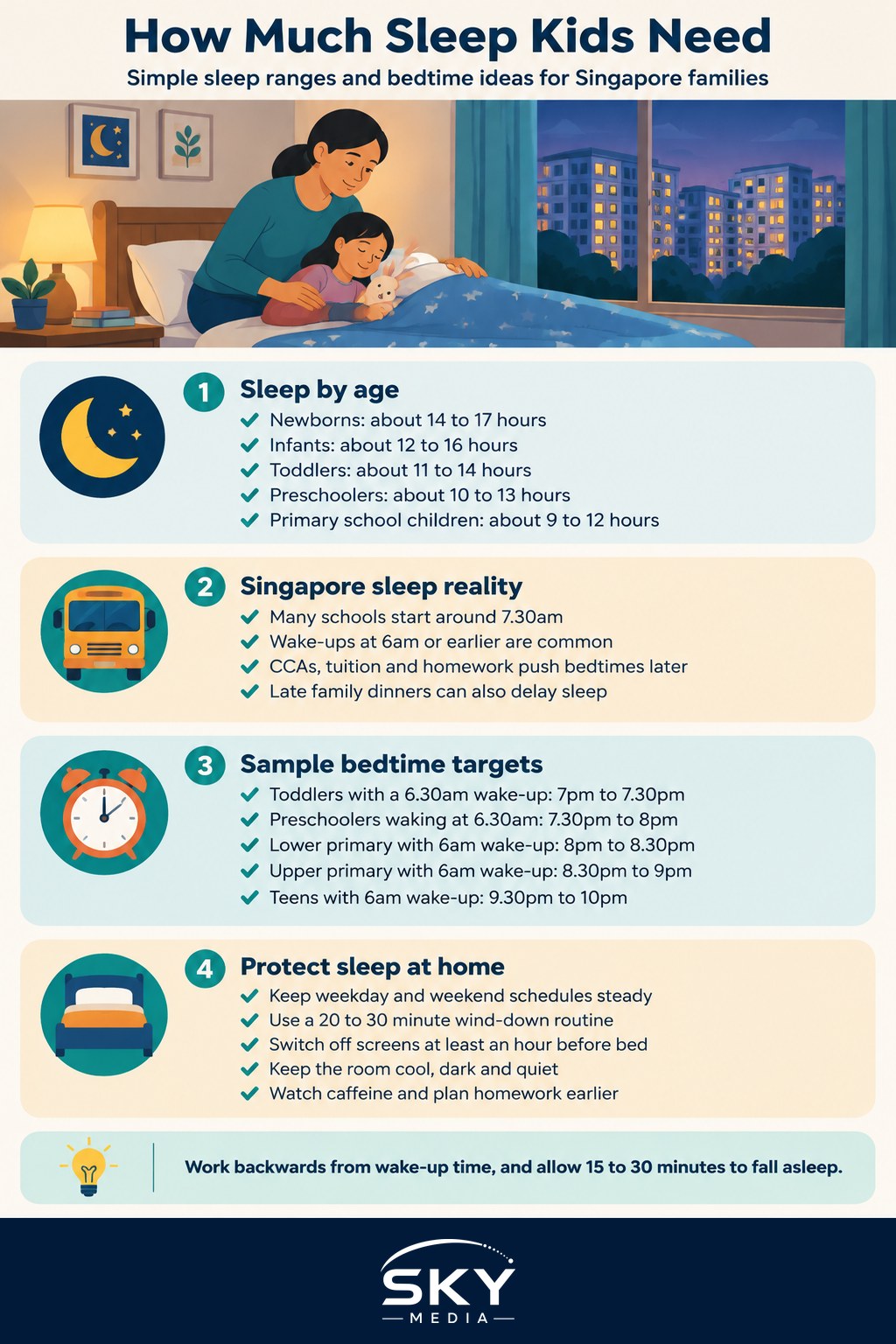
Recommended Sleep Hours by Age
The ranges below follow widely used guidance from international paediatric and sleep medicine bodies. They are total hours in 24 hours, so for younger children they include naps. Think of them as a healthy range, not an exact target.
| Age group | Recommended total sleep per 24 hours | Naps |
|---|---|---|
| Newborn (0 to 3 months) | About 14 to 17 hours | Many short sleeps across day and night |
| Infant (4 to 11 months) | About 12 to 16 hours | Usually 2 to 3 naps |
| Toddler (1 to 2 years) | About 11 to 14 hours | Usually 1 to 2 naps |
| Preschooler (3 to 5 years) | About 10 to 13 hours | Often one nap, which many drop by 5 or 6 |
| Primary school (6 to 12 years) | About 9 to 12 hours | Generally no daytime nap needed |
| Teen (13 to 18 years) | About 8 to 10 hours | Short naps can help but should not replace night sleep |
A child who sits at the low end of the range but wakes easily, stays cheerful and concentrates well may simply need less. A child who regularly falls below the range, or who is grumpy and sleepy despite being in it, is worth a closer look.
Why Singapore Schedules Make This Tricky
Many primary and secondary schools in Singapore start early, often around 7.30am, and some children travel a fair distance by school bus or MRT. That means wake-up times of 6am or earlier are common. Add CCAs (co-curricular activities), tuition, homework and family dinners that start late because parents work long hours, and bedtime easily slides past 10pm.
The maths is unforgiving. A primary school child who needs 10 hours and wakes at 6am needs to be asleep by 8pm, not just in bed. A teen who needs 9 hours and wakes at 6am needs to be asleep by 9pm, which is far earlier than most teenagers manage. Knowing this helps families make deliberate choices rather than wonder why everyone is tired.
Sample Bedtimes for Singapore Families
Work backwards from wake-up time. Allow 15 to 30 minutes for falling asleep, and set lights-out accordingly. These are examples to adapt, not rules.
Newborns and infants. Sleep is not yet tied to the clock. Follow your baby’s cues, keep nights dark and quiet, and keep daytime feeds brighter and more social. Many families start a simple routine (bath, feed, story, sleep) from a few months old. For infants in childcare, align naps with the centre’s schedule where possible.
Toddlers (1 to 2 years). If wake-up is 6.30am and your toddler has one nap of about two hours after lunch, a bedtime around 7pm to 7.30pm often works. Watch for overtiredness on days the nap is skipped.
Preschoolers (3 to 5 years). For a child waking at 6.30am to get to preschool or kindergarten, aim for lights-out around 7.30pm to 8pm. If your child has dropped the nap, an earlier bedtime on busy days helps.
Lower primary (6 to 9 years). With a 6am wake-up for a 7.30am school start, lights-out around 8pm to 8.30pm usually gives 9.5 to 10 hours. This is often the age when evening tuition and CCAs start eating into sleep, so protect bedtime on weekdays.
Upper primary (10 to 12 years). Around 8.30pm to 9pm lights-out with a 6am wake-up. PSLE preparation can tempt families into later nights, but tired children learn and remember less well. If you are weighing extra lessons, our guide on deciding whether your child needs tuition may help you think it through.
Teens (13 to 18 years). Teenagers’ body clocks naturally shift later, making early sleep hard. With a 6am wake-up, a target of 9.30pm to 10pm lights-out is realistic for many, giving around 8 hours. Longer weekend lie-ins are fine in moderation, but sleeping until noon makes Monday harder.
Signs Your Child May Not Be Getting Enough Sleep
- Hard to wake on most mornings, or falls asleep on the school bus or in the car.
- Irritable, tearful or hyperactive in the late afternoon.
- Struggles to concentrate in class or with homework, as noted by teachers.
- Needs long naps on weekends, or sleeps much longer on holidays.
- Frequent headaches or seems unwell without a clear cause.
Snoring most nights, pauses in breathing, very restless sleep or frequent night waking beyond toddlerhood are reasons to see a doctor rather than just adjusting bedtime.
Practical Ways to Protect Sleep at Home
- Keep a consistent schedule, including weekends within an hour or so of weekday times.
- Create a wind-down routine of 20 to 30 minutes: shower, pyjamas, brush teeth, reading or quiet chat.
- Set a screen curfew. Many families switch off phones, tablets and games at least an hour before bed and keep devices out of the bedroom.
- Make the room sleep-friendly. Singapore’s heat matters, so use a fan or air-conditioning at a comfortable temperature, blackout curtains and quiet.
- Watch caffeine. Bubble tea, iced coffee and some soft drinks contain caffeine, which can affect sleep for hours.
- Plan homework and tuition earlier. If evenings are packed, consider whether some activities can move to weekends.
- Model it yourself. Children notice when adults stay on screens late.
If bedtime is a struggle because your child is anxious about sleeping alone, our guide on helping a child who is scared to sleep alone covers that specific challenge. Families who have just relocated may also find routines need resetting; see our guide to moving to Singapore with a school-age child.
When to Seek Professional Help
Talk to your family doctor, polyclinic or paediatrician if poor sleep lasts more than a few weeks despite good habits, if your child snores loudly or seems to stop breathing during sleep, if daytime sleepiness affects school or safety, or if sleep problems come with low mood or worry. School counsellors can also help if stress about exams or friendships is keeping your child awake.
Knowing how much sleep your child needs by age is the first step. The next is fitting it into real family life, which in Singapore often means an earlier bedtime than feels natural. Small, steady changes, such as moving lights-out 15 minutes earlier each week, are usually easier to stick to than a sudden overhaul.
Official sources: HealthHub
Further reading: White Noise for Babies: Does It Help and Is It Safe? · Gentle Sleep Training For Toddlers · Dropping the Daytime Nap