
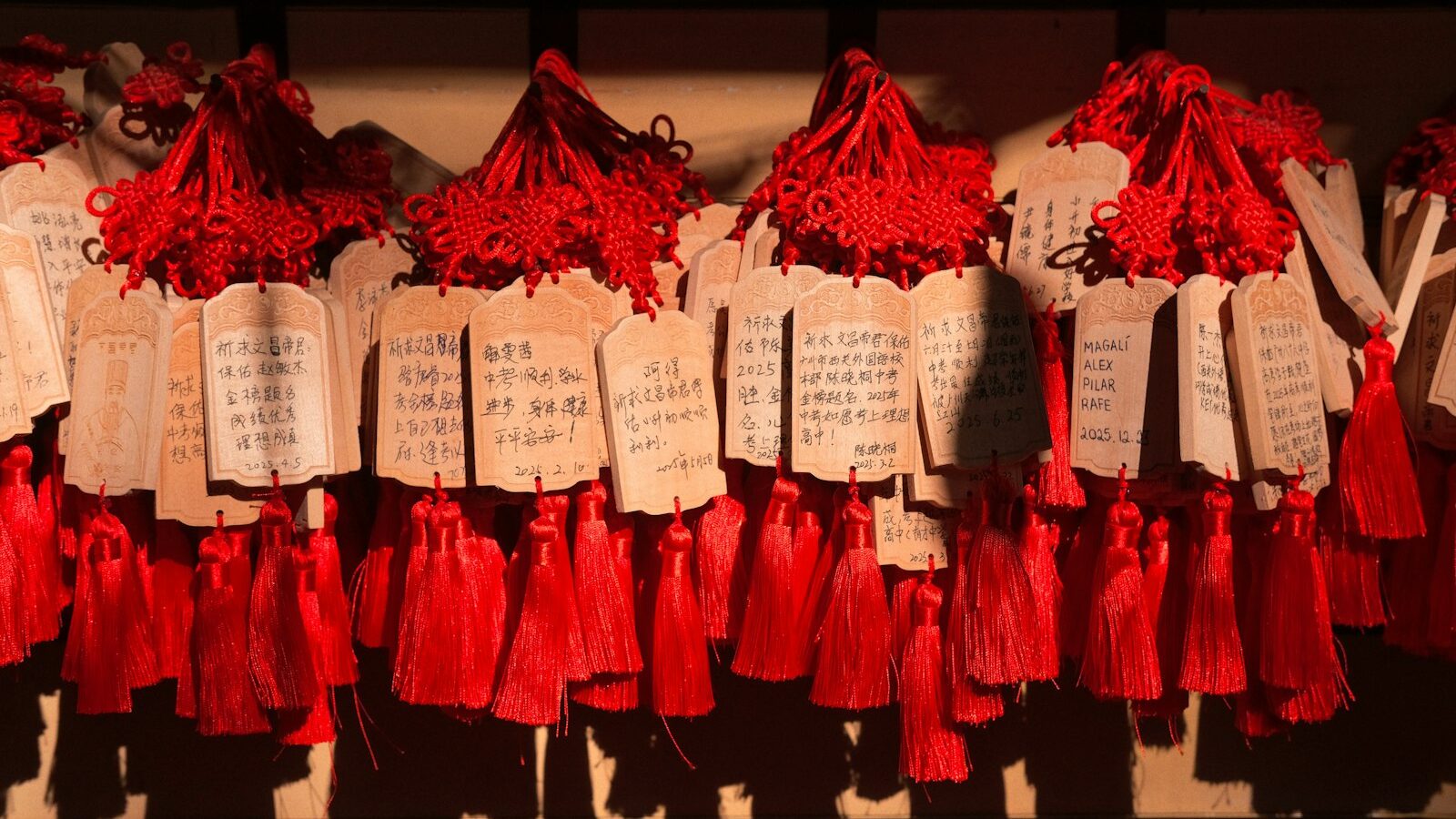
Chinese knotting is a quietly astonishing craft in which a single length of cord is folded, looped and tightened into a symmetrical ornament rich with meaning. From the familiar red tassels that swing at doorways during festivals to fine jewellery and gifts, these knots turn plain cord into carriers of blessing and beauty. This guide introduces the craft, its symbolism and its living place in Singapore.
The Idea Behind The Knot
What sets Chinese knotting apart from ordinary knot-tying is its ambition and its logic. Each traditional design is typically made from one continuous cord, worked so that the two ends can meet, and most knots are symmetrical when viewed from front or back. The maker is not simply securing something. The knot itself is the object, an ornament complete in its own right.
The craft belongs to the family of Chinese folk arts that prize patience, symmetry and auspicious meaning. Like paper cutting, it uses humble material, in this case cord, and elevates it through skill. A finished knot is admired for the evenness of its loops, the tightness of its structure and the grace of its overall shape.
A Vocabulary Of Good Fortune
Chinese knots are named and loved for what they represent, and their meanings are woven into daily and festive life.
- Knots for long life and good fortune, given as blessings and worn as charms.
- Knots shaped around the idea of union, offered at weddings and to loved ones.
- The colour red, the most common choice, standing for joy and vitality.
- Tassels and beads, added to finish a piece and to lengthen its graceful fall.
Because the meanings are widely shared, a knot is more than decoration. To give one is to give a specific wish, for a long life, a happy marriage, a prosperous year. This is why knots appear so often at Chinese New Year and at celebrations, where the hope they carry matches the mood of the moment.
How A Knot Is Formed
The process looks like magic to the newcomer but rests on method and repetition. The maker begins with a length of cord and works through a planned sequence of loops, each held in place by the tension of the next.
The Basic Discipline
- Looping the cord into a set pattern without pulling it tight too soon.
- Adjusting each loop so the design stays even and symmetrical.
- Tightening the whole knot gradually so no part is pulled out of shape.
- Finishing with a hanging loop above and a tassel or beadwork below.
The hardest part is the tightening. A knot may be loosely arranged and look correct, then lose its shape entirely if it is pulled in the wrong order. Skilled makers learn to draw the cord evenly so the finished knot is firm, balanced and clean. This patience is the craft.
Common Knots At A Glance
| Feature | What it means for the piece |
|---|---|
| One continuous cord | The whole design is tied from a single length |
| Front-and-back symmetry | The knot looks complete from either side |
| Red as the usual colour | Signals joy, luck and festive spirit |
| Added tassels and beads | Complete the piece and add graceful length |
| Even, firm tightening | The mark of a well-made, lasting knot |
Where You Will See It
The most familiar form is the large decorative hanging, a bold knot finished with a flowing tassel, hung at doorways and windows during Chinese New Year to invite good fortune. Beyond the festive season, the craft appears in smaller forms too, as pendants, bracelet and necklace cords, keychain charms and finishing touches on gifts. The same technique scales from a modest charm to an elaborate wall hanging.
The craft also travels well because it needs so little. A reel of cord and a pair of hands are enough to begin, which is part of why the tradition has taken root wherever Chinese communities have settled.
Chinese Knotting In Singapore
In Singapore, Chinese knotting is a familiar part of the festive landscape, especially the red knotted hangings that appear across homes, shops and public spaces at Chinese New Year. Beyond the seasonal displays, the craft is kept alive through workshops, community classes and cultural demonstrations, where beginners learn the basic knots and more advanced makers pursue intricate designs.
Its appeal to learners is easy to understand. The first knots can be mastered in a single sitting, giving quick satisfaction, while the more complex designs offer a challenge that rewards years of practice. That range, from simple to demanding, helps the craft attract and keep new hands. Teaching it to children, in particular, passes on both a skill and the meanings that come with each knot.
Keeping The Craft Alive
- Choosing handmade knots over machine-made imitations supports real makers.
- Attending a workshop puts the technique into your own hands.
- Giving knots as gifts keeps their meanings in circulation.
- Encouraging young learners passes the tradition to the next generation.
Honouring The Practitioners
The best knotters make the work look effortless, but their ease hides long practice. Watch a skilled maker and you will see the same loop formed again and again with perfect evenness, then tightened in a precise order so the whole design snaps into shape. That control is earned. When you admire a fine knot, you are admiring the discipline behind it as much as the ornament itself.
A Thread Worth Holding
Chinese knotting shows how a single cord, in patient hands, can become a symbol of luck, love and long life. It asks for little in the way of material and a great deal in the way of care, and it repays that care with objects that families are proud to hang and to give. As long as the red knots swing at Singapore’s doorways each new year, and as long as new hands learn to loop and tighten the cord, this quiet, generous craft will remain part of the island’s living heritage.
Explore more: Chinese paper cutting (jianzhi) · Traditional trades of Singapore · Chinese calligraphy heritage