
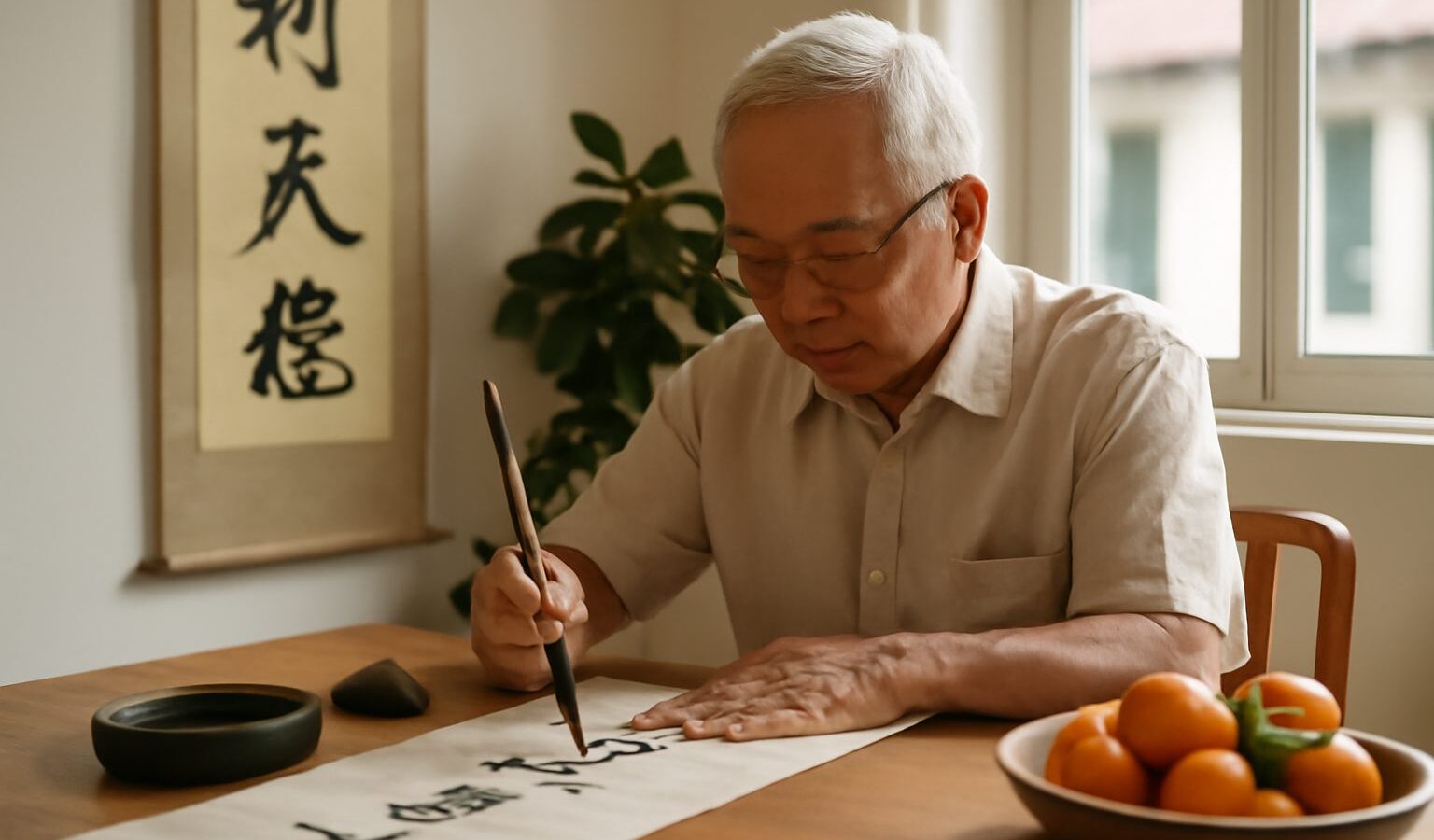
At Chinese New Year, red banners of flowing black characters appear on doorways across Singapore, each one brushed with care and full of good wishes. Those characters are the work of Chinese calligraphy, an art in which writing itself becomes a thing of beauty. Practised for many centuries and still taught and loved here today, it offers newcomers a graceful, meditative window into one of the region’s oldest cultural traditions.
What Chinese calligraphy is
Chinese calligraphy is the art of writing Chinese characters with brush and ink so that the writing is expressive and beautiful, not merely legible. In Mandarin Chinese it is called shufa, which can be understood as the art or method of writing. It has long been regarded as one of the highest of the arts in Chinese culture, sitting alongside painting and poetry, and prized because every stroke reveals the writer’s control, rhythm and state of mind.
Unlike printed type, calligraphy is alive with movement. The thickness of a line, the speed of the brush, the balance of a character and the spaces left empty all carry meaning. A single character can be written boldly or delicately, and a skilled hand makes even a familiar word feel fresh. Because the same characters are shared across the Chinese speaking world, calligraphy is also a thread of continuity linking generations and communities, including the Chinese communities that form part of Singapore’s multiracial society.
The tools and script styles
Traditional calligraphy relies on a set of implements so cherished that they are known in Chinese as the Four Treasures of the Study. They are:
- The brush, made with a tapering tuft of animal hair that can produce both fine lines and broad strokes.
- The ink, traditionally ground from an ink stick.
- The paper, often soft and absorbent so that the ink spreads in a controlled way.
- The inkstone, on which the ink stick is ground with water to make liquid ink.
Learning to hold the brush upright, load it with ink and move it with a steady arm is the foundation of the craft, and it takes patient practice. Beginners often spend a long time simply repeating single strokes, since the horizontal, vertical, hook and sweeping strokes are the building blocks of every character. Posture matters too, with a relaxed shoulder and a grounded, unhurried movement giving the line its life. Many learners describe the early stages as humbling and calming in equal measure, because progress is slow but deeply satisfying once the brush begins to feel like an extension of the hand.
Over the centuries, several script styles developed, each with its own character. Beginners often start with the clear, upright regular script before exploring the more flowing forms. The general shape of a learner’s journey often runs like this:
- Learn to sit, hold the brush and control basic strokes.
- Practise regular script, where each stroke is distinct and balanced.
- Move towards running script, where strokes begin to connect and flow.
- Study older or freer styles, such as seal, clerical or cursive script, to widen understanding.
| Script style | Chinese name | What to notice |
|---|---|---|
| Regular script | Kaishu | Clear, upright characters, ideal for beginners |
| Running script | Xingshu | Flowing, semi joined strokes with natural rhythm |
| Cursive script | Caoshu | Fast, sweeping and highly expressive |
| Clerical script | Lishu | Broad, even strokes from an earlier era |
| Seal script | Zhuanshu | Ancient, rounded forms often used on seals |
Where to see and learn Chinese calligraphy in Singapore today
In multiracial Singapore, Chinese calligraphy is very much a living art. Curious newcomers, of any background, can encounter it in several ways:
- Festive seasons, especially Chinese New Year, when spring couplets, known in Mandarin as chunlian, are brushed onto red paper with messages of prosperity and good fortune.
- Exhibitions and cultural events, where works by calligraphers are displayed and demonstrations are held.
- Community centres, clubs and calligraphy societies, which run classes for beginners and enthusiasts.
- Schools and enrichment programmes, where children learn the basics as part of cultural education.
Museums and galleries also show calligraphy within the wider story of art in the region, and institutions supported by the National Heritage Board programme talks, demonstrations and family activities from time to time. As always, it is best to check current listings rather than rely on fixed dates. Many demonstrations welcome onlookers warmly, and festive stalls sometimes invite passers by to receive a freshly brushed greeting, a lovely first encounter for newcomers.
If you would like to try it yourself, beginner classes are widely available and require no prior knowledge of the Chinese language, since the first lessons focus on brush control and basic strokes. Even a single session gives you a new appreciation for the discipline behind every graceful line.
Why Chinese calligraphy matters
Chinese calligraphy is both an art and a practice of mindfulness. To sit with brush and ink, to slow the breath and commit fully to each stroke, is a calming discipline that many find rewarding in a fast paced city. It also carries culture forward, preserving classic poems, sayings and well wishes in a form that is admired as much for how it looks as for what it says.
Like other heritage crafts, calligraphy needs teachers and learners to continue. Handwriting has given way to keyboards and screens, so the deliberate, unhurried art of the brush can seem a world away from daily life. That is exactly why its survival depends on people choosing to learn, display and celebrate it. Calligraphy societies, community groups, schools and individual artists all play a part, and each new learner helps keep the tradition breathing.
For newcomers, appreciation can be as simple as pausing to admire a set of spring couplets, watching a demonstration, or signing up for a beginners class. Calligraphy also sits within a wider family of Singapore heritage crafts worth discovering. Explore more: read our guides to traditional lantern making, songket weaving, and Peranakan beadwork and slippers.
Approached with respect and an open mind, Chinese calligraphy offers newcomers a quiet, beautiful way into heritage that is still very much alive on Singapore’s doorways, in its classrooms and at the tip of a well loaded brush.