
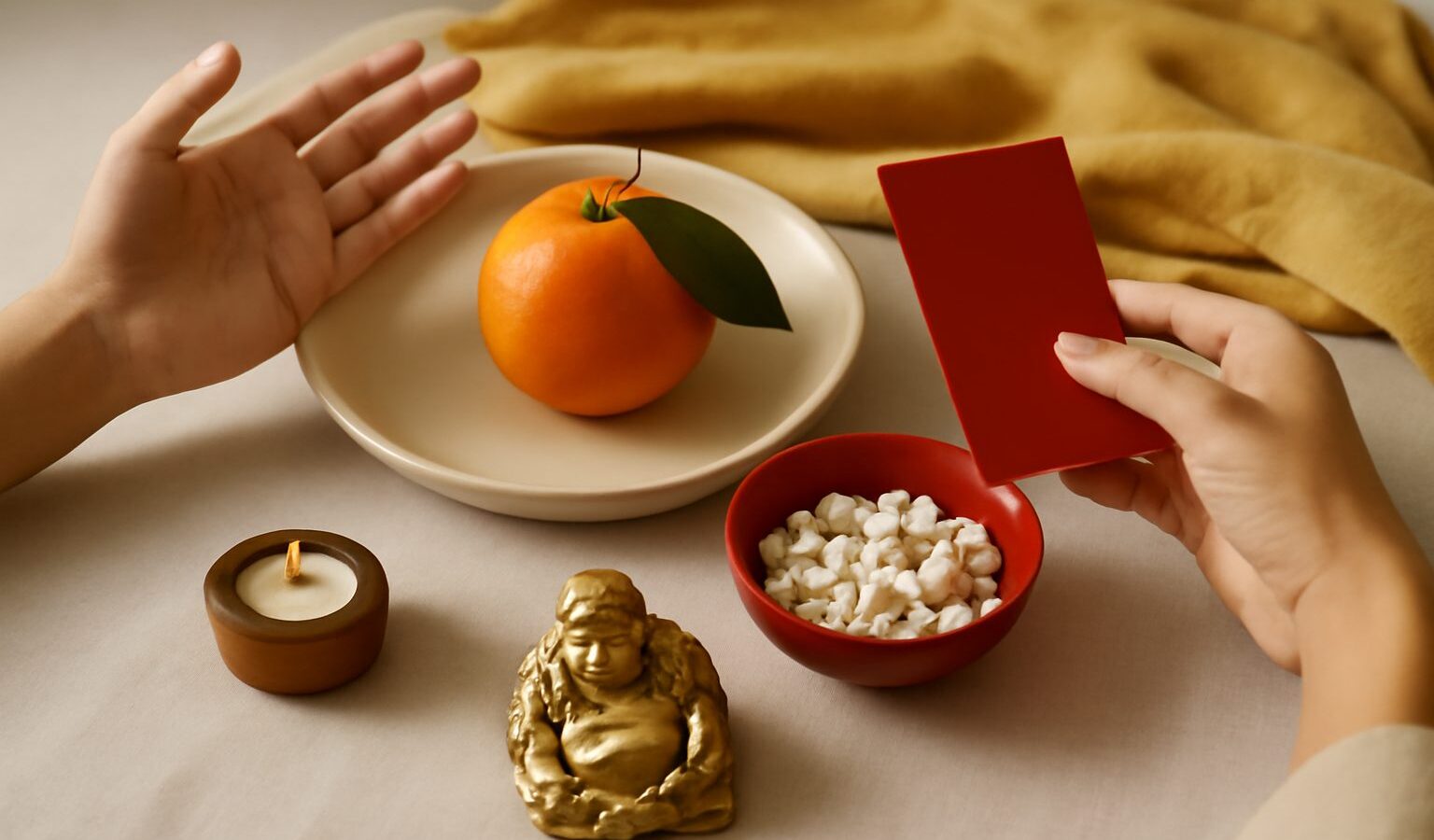
Colours in Chinese culture are never merely decorative. Each carries associations built up over centuries, shaping what people wear to a wedding, what they avoid at a funeral, and how they decorate a home for a new year. In Singapore, where these meanings sit alongside many other traditions, understanding the language of colour helps everyone take part in celebrations and observances with the right touch.
Red: luck, joy, and vitality
Red is the most important auspicious colour. It stands for good fortune, happiness, celebration, and the warding off of bad luck. This is why red dominates Chinese New Year, from banners and lanterns to the ang bao, the red packet in which money is given as a blessing.
Red appears at almost every happy occasion. Traditional brides wear red, wedding invitations and decorations are red, and businesses hang red for a lucky opening. The colour is linked to fire and to life, and its brightness is meant to drive away misfortune. Giving or wearing red at a joyful event is always a safe and welcome choice.
Gold and yellow: wealth and honour
Gold signals wealth, prosperity, and high status. Paired with red, it forms the classic festive combination seen everywhere during Chinese New Year: red for luck, gold for riches. Gold lettering on red paper, gilded ornaments, and golden coins as symbols all carry this promise of abundance.
Yellow historically carried imperial associations and stood for the centre and for the earth. It remains a colour of respect and value, though red and gold lead the way at celebrations.
During festive shopping in Singapore, the pairing is unmistakable. Reunion tables are dressed in red cloth, oranges echo the gold theme, and decorative characters for luck and prosperity are printed in gold on red paper. The combination is so ingrained that the sight of red and gold alone is enough to signal that the new year is near.
White and black: mourning and solemnity
At the other end of the spectrum, white is the traditional colour of mourning and death in Chinese culture. Mourners at a funeral wear white or plain, subdued clothing, and white flowers are associated with condolence. For this reason, white is generally avoided as a gift wrapping or a main colour at happy events, and giving white flowers on a celebratory occasion is best avoided.
Black is likewise linked to solemnity and, in many contexts, to mourning or bad luck. It is worn at funerals and treated with care at festive times. Neither colour is forbidden in everyday life, of course, but at ceremonies their symbolic weight is taken seriously.
Other colours and their notes
Beyond the main four, several colours carry their own softer associations.
| Colour | Common association | Where it shows up |
|---|---|---|
| Red | Luck, joy, celebration | New year, weddings, red packets |
| Gold and yellow | Wealth, honour, prosperity | Festive decor, gilded ornaments |
| White | Mourning, purity, plainness | Funerals, condolence flowers |
| Black | Solemnity, mourning | Funerals, formal restraint |
| Green | Growth, health, harmony | Everyday use, wealth in some settings |
| Blue | Calm, healing, immortality | Home and dress, generally neutral |
These associations are broad and not absolute. Meaning shifts with context, dialect group, and generation, and modern taste has softened some older rules.
Colour in the home
Beyond ceremonies, colour shapes how many families arrange their living spaces. Some pay attention to the ideas behind feng shui, choosing warm, lucky tones for the main hall or the entrance and gentler colours for rooms meant for rest. A splash of red at the door during the new year, a gold ornament placed for prosperity, or the avoidance of too much stark white in a bedroom are all small ways the language of colour enters daily life. None of this is compulsory, and preferences differ widely, but the underlying instinct to match colour to intention runs deep.
How colour shows up in daily Singapore life
You do not need to look far to see these ideas at work across the island.
- Festive seasons. In the weeks before Chinese New Year, shopping malls, homes, and shopfronts turn red and gold. Reunion tables, decorations, and clothing all lean towards lucky colours.
- Weddings. Chinese wedding invitations, tea ceremony outfits, and decor frequently feature red and gold, even when the couple also wears Western white for a separate part of the day.
- Funerals and wakes. Guests dress in sombre, plain colours and avoid bright red. Condolence flowers and offerings follow the muted palette of mourning.
- Business and shopfronts. New businesses often open with red decorations for luck, and brands aiming at the festive market lean into red and gold packaging.
- Gifts. Wrapping and presentation matter. Red and gold wrapping suits a celebration, while white or black wrapping would strike the wrong note.
A note on mixed traditions
Singapore is multicultural, and colours carry different meanings across communities. White, sombre in a Chinese funeral context, is the very picture of a bridal gown in a Western-style wedding. Many Singaporean families comfortably hold both meanings at once, choosing colours to suit the specific occasion and audience. Sensitivity lies in reading the setting rather than applying one fixed rule everywhere.
Practical guidance
A few simple habits keep you on the right side of these customs:
- For a happy occasion, favour red and gold, and avoid predominantly white or black gifts and wrapping.
- For a wake or funeral, dress plainly in dark or muted tones and avoid bright red.
- When giving money, use a red packet for celebrations and a white envelope for condolence, following the local convention.
- When unsure, ask the host or observe what others are wearing; there is no shame in checking.
Colour as a living language
The meanings attached to colours in Chinese culture form a kind of unspoken language, one that Singaporeans read fluently every festive season and every solemn occasion. Red brightens a new year, gold promises abundance, and white and black hold space for grief. Learning this vocabulary is not about rigid rules but about respect: choosing colours that match the moment, and joining in the celebration or the mourning in a way that everyone around you understands.
Explore more: Traditional Chinese customs in Singapore · Singapore superstitions and taboos · Lunar New Year in Singapore