
A good car phone mount Singapore drivers can rely on keeps your phone visible for navigation, secure over bumps, and off your lap where it becomes a hazard. Paired with a sensible charging setup, it means you arrive with directions on screen and a battery that is not flat. This guide covers the main mount types, how to position one safely, and how to keep your phone powered on the move, all without naming specific brands or models.
Before anything else, a word on safety. A mount exists to let you glance at navigation, not to let you use your phone while driving. Mount your phone where it does not block your view of the road, and never handle or operate it while the vehicle is moving. Follow the law and pull over safely if you need to interact with your device.
Types Of Car Phone Mount
Mounts differ mainly in where and how they attach to your car. Each has strengths and weaknesses, and the best choice depends on your dashboard, your phone and your habits.
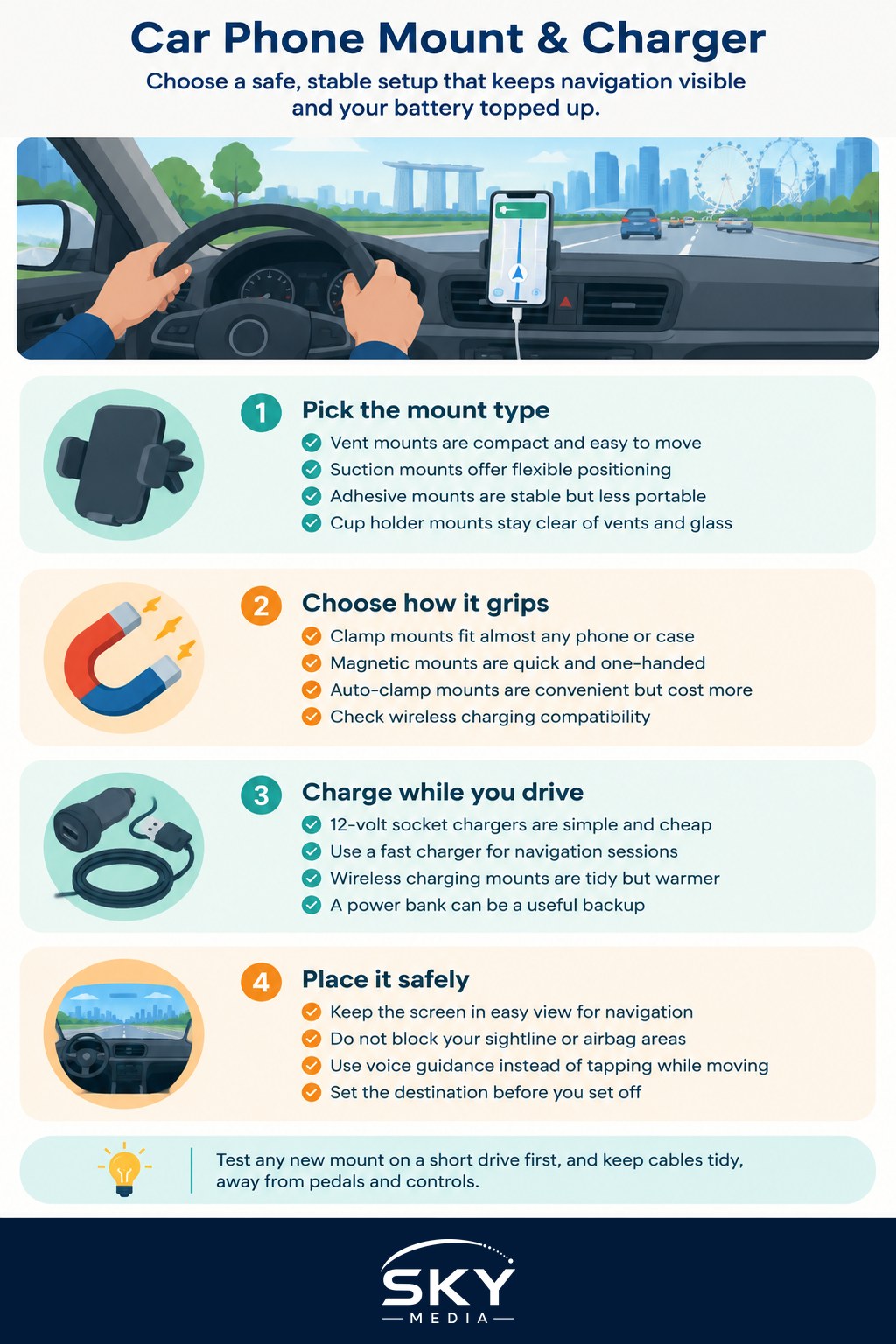
Vent mounts clip onto the air-conditioning vent. They are compact, cheap and easy to move between cars, and they keep the phone fairly high near your line of sight. The downsides are that they can stress the vent fins, they may block airflow, and a heavy phone can droop or fall in a hard-cornering moment.
Dashboard and windscreen suction mounts stick to a flat surface using a suction cup, often with a sticky pad for grip. They hold larger phones well and offer flexible positioning. However, suction can weaken over time or in heat, and a windscreen mount must be placed low and to the side so it does not obstruct your view.
Adhesive mounts stick permanently to the dashboard with a strong pad. They are very stable and low-profile, but they are not easily moved and leave residue if removed.
Cup holder mounts sit in your cup holder on a weighted or adjustable base with an arm holding the phone. They are stable and do not touch your vents or glass, though they use up a cup holder and can place the phone a little low.
How The Phone Attaches
Beyond where the mount fixes to the car, consider how it grips your phone. Spring-loaded clamp mounts hold the phone with arms that squeeze the sides, working with almost any phone and case. They are reliable but need two hands or a firm push to insert and release.
Magnetic mounts use a metal plate on your phone or case that snaps to a magnet. They are quick and satisfying to use with one hand, but you must attach a plate, and a very heavy phone on a bumpy road can occasionally slip. Automatic clamp mounts, which sense the phone and grip it electronically, are the most convenient but the most expensive and require power.
If you use wireless charging, note that a magnetic plate or certain thick cases can interfere, so check compatibility. Choose the attachment style that matches how you get in and out of the car; if you mount and unmount every trip, one-handed magnetic or auto-clamp saves fuss, while a set-and-forget clamp is fine if the phone lives in the car.
Charging On The Move
Navigation, screen brightness and mobile data drain a battery quickly, so charging while you drive is often worth arranging. Your options fall into a few groups.
A charger plugged into the car’s 12-volt socket, feeding a cable to your phone, is the simplest and cheapest approach. Look for one that supports faster charging so it keeps up with a demanding navigation session rather than slowly losing ground. Some mounts combine holder and charger, offering wireless charging as you dock the phone, which is tidy but can charge more slowly and generate heat.
The table below compares the common charging routes.
| Charging option | Convenience | Speed | Notes |
|---|---|---|---|
| Cable to 12-volt socket charger | Plug in each trip | Fast if charger supports it | Cheapest, works with any phone |
| Wireless charging mount | Just dock the phone | Moderate | Tidy but can run warm, check phone fit |
| Power bank in the car | Portable, no socket needed | Depends on the bank | Backup if the socket is used or faulty |
Whichever route you choose, use a good quality cable and keep it tidy so it does not dangle near the pedals or controls. Heat is the enemy of batteries, and a parked car gets hot, so avoid leaving your phone charging on the mount in direct sun for long periods.
Placement And Safety
Where you put the mount matters as much as which mount you buy. Position the phone so you can see navigation with a brief downward glance, while keeping the road, mirrors and instruments clearly in view. Never place a mount where it blocks your sightline, sits in front of an airbag area, or obscures any part of the windscreen you rely on.
Keep the phone within easy reach for when you are safely stopped, but resist the temptation to tap it while moving. Set your destination before you drive off, use voice guidance so you can keep your eyes on the road, and if a message or call needs attention, pull over where it is safe and legal to do so. A mount is a safety aid only if it reduces the urge to hold your phone, not if it becomes a screen you keep prodding.
Also consider stability over Singapore’s bumps, speed humps and sharp turns. Test a new mount on a short, careful drive to check it holds firm and does not vibrate or droop. A phone that rattles loose is both a distraction and a hazard.
Choosing What Suits You
If you drive one car and rarely swap, a stable dashboard or adhesive mount paired with a fast socket charger is a clean, reliable setup. If you move between cars or a shared vehicle, a compact vent or cup holder mount that travels easily makes more sense. For frequent, quick trips where you grab the phone each time, a magnetic or auto-clamp mount speeds things up.
Prioritise a secure grip, safe placement and reliable charging over gadgetry. A modest mount fitted thoughtfully and used responsibly beats an elaborate one placed where it blocks your view. Get those basics right and your phone will stay powered, visible and out of your hands where it belongs while you drive.
Explore more
Power Banks and Charging Gear
Understanding USB-C and Charging Cables
Take Better Photos With Your Phone
Choosing a Portable Bluetooth Speaker
Frequently Asked Questions
Is it legal to use my phone in a mount while driving? The article says to follow the law and never handle the phone while moving, so check LTA and Traffic Police guidance on current rules. A mount is only meant for a glance at navigation. Set your destination before you drive off and use voice guidance.
Where is the safest place to put a car phone mount? Where you can see navigation with a brief downward glance while keeping the road, mirrors and instruments in view. Never block your sightline, sit in front of an airbag area, or obscure any part of the windscreen you rely on.
Can a vent mount damage my aircon vents? It can stress the vent fins, may block airflow, and a heavy phone can droop or fall during hard cornering. Vent mounts are compact, cheap and easy to move between cars, so weigh that against your phone’s weight.
Why does my phone get hot when charging in the car? Heat is the enemy of batteries, and a parked car gets hot. Wireless charging mounts can also run warm and charge more slowly. Avoid leaving your phone charging on the mount in direct sun for long periods.
Magnetic or clamp car phone mount, which is better? It depends on your habits. Magnetic mounts are quick with one hand but need a metal plate, and a heavy phone on a bumpy road can occasionally slip. Spring-loaded clamps work with almost any phone but need a firm push to insert.
Further reading: Choosing a Dashcam for Your Car