

Walk into a local arcade or a fighting game meetup and you will see players hunched over chunky controllers with a big stick and rows of buttons. These are fight sticks, and for many people they are part of what makes fighting games feel right. This guide explains what to look for in a fight stick singapore players can enjoy at home, without pretending any one model is “the best” or quoting prices that quickly go out of date.
What a Fight Stick Is and Why People Use Them
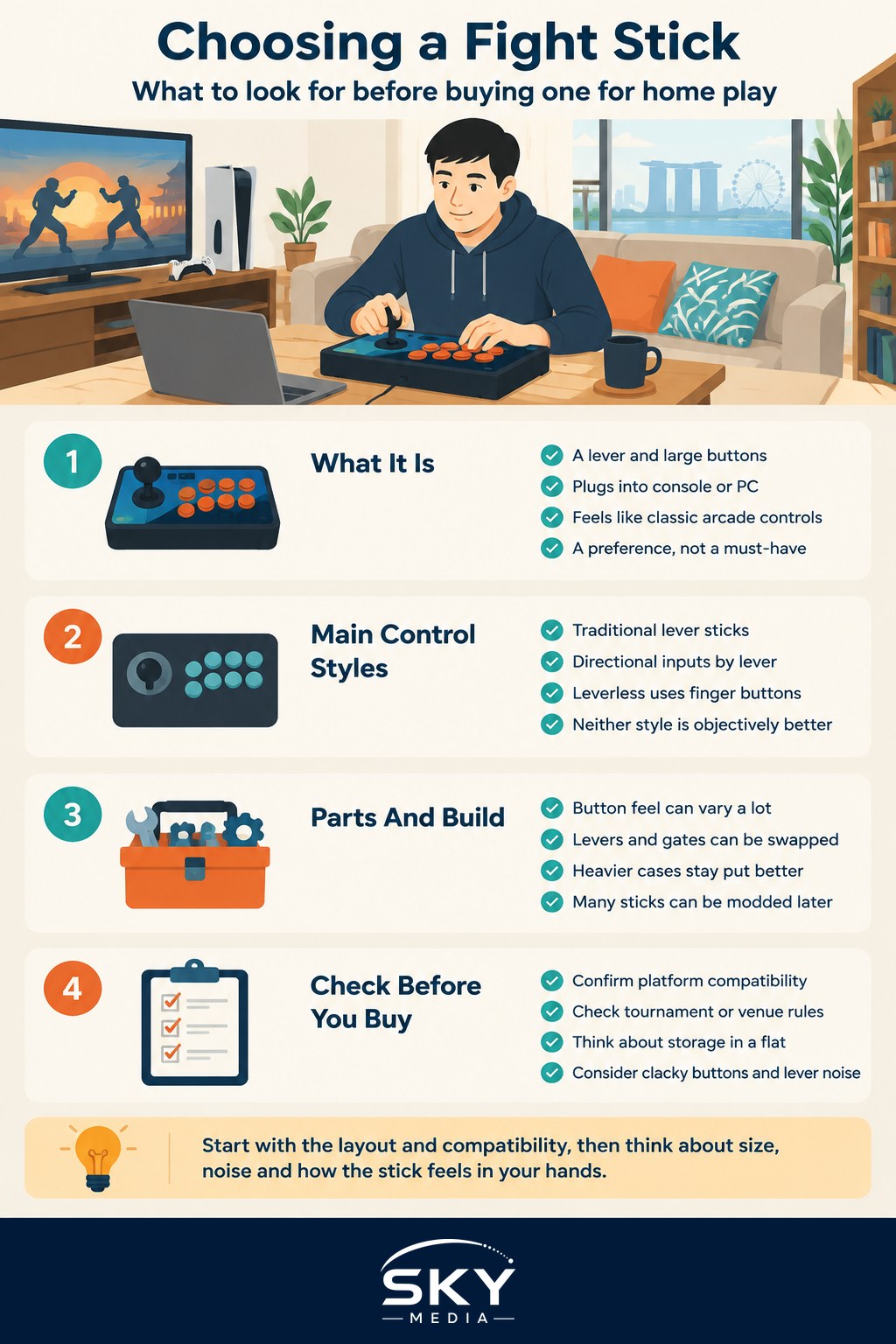
A fight stick, or arcade stick, recreates the classic arcade cabinet control layout: a lever you push with one hand and a cluster of large buttons you press with the other. It plugs into your console or PC like any other controller.
The appeal is partly feel and partly heritage. Fighting games grew up in arcades, so the arcade layout is what many moves and combos were designed around. Larger buttons and a defined lever can make certain motions and multi-button presses feel cleaner once you adjust. That said, a fight stick is a preference, not a requirement. Plenty of strong players use a normal controller, and if you are just starting out, our guide on getting into fighting games will help more than any piece of hardware.
The Main Control Layouts
There are two broad families of fight controller, and they play quite differently.
Traditional lever sticks
This is the classic setup with a lever and buttons. You make directional inputs by moving the lever, and the physical throw and click of it is a big part of the feel. Within this family, sticks differ in button layout, the lever’s stiffness, and the size of the case.
Leverless controllers
A newer style replaces the lever with directional buttons you press with your fingers, sometimes called a leverless or button-based controller. These are flatter, often more portable, and some players find fast, precise inputs easier on them. They have become common in the competitive scene. Neither style is objectively better. It comes down to what feels natural to your hands.
Parts and Build Quality
One thing that sets fight sticks apart from ordinary controllers is that the internal parts are often a talking point, because they shape the feel.
- Buttons: these come in different mechanisms and stiffness. Some are light and springy, others firmer. The difference is personal, and many enthusiasts eventually swap buttons to taste.
- The lever or gate: on lever sticks, the shape of the internal gate changes how the directions feel, for example whether the corners are pronounced. Levers can also be swapped.
- Case size and weight: a heavier case sits more stably on your lap or a table and does not slide around, while a lighter one is easier to carry to a friend’s place or a meetup.
- Modding: many sticks are designed to be opened up so you can replace parts later. This is a hobby in itself, but you do not need to touch it to enjoy the stick out of the box.
You do not need to memorise part names to get started. A solid ready-made stick from a reputable maker works well as it comes.
Compatibility Comes First
Before you fall for a particular stick, check what it works with. Controllers are not universally compatible, and a stick built for one console may not work on another, or may need extra support on PC. Confirm that the stick supports your specific platform and, if you play competitively, that it is allowed at the local tournaments or venues you care about. This is the easiest thing to get wrong and the most annoying to discover after buying.
Fitting It Into a Singapore Home
Fight sticks are bigger than normal controllers, so think about where it will live. In a compact flat, a larger case might be awkward to store, while a slimmer leverless controller tucks away more easily. Consider noise too, since clacky buttons and a knocking lever can carry in a quiet HDB flat at night. A desk mat or a cushioned lap position helps with both comfort and sound.
If you want to sharpen up once your stick arrives, our guides on how to learn combos in fighting games and how to use training modes effectively will get more out of it than any upgrade.
Do You Even Need One?
It is worth saying plainly that a fight stick is optional. Many top players compete on standard controllers, and the games are built to be fully playable that way. Buy a stick because you like the arcade feel or want that connection to how fighting games began, not because you think it will make you win. If you are unsure, spend time with the games on a normal controller first, and get a stick only once you know you enjoy the genre enough to want one.
The Practical Takeaway
Choosing a fight stick comes down to layout, lever versus leverless, build and button feel, and above all whether it is compatible with your platform. Decide which control style suits your hands, confirm it works with your console or PC, and think about size and noise in your home. Treat it as a fun way to enjoy fighting games rather than a shortcut to skill, and you will get the most out of whichever stick you pick.
Frequently Asked Questions
Can I use a fight stick to play other types of games? You can, though it is built for fighting games and may feel awkward elsewhere. Many sticks work for platformers and some arcade titles. Games needing analogue movement or a mouse are a poor fit, so keep a normal controller handy.
How long does it take to get used to a fight stick? It varies by person, but expect an awkward stretch at first as your hands relearn motions. Short, regular practice in training mode helps more than long marathons. Give it a few weeks before judging whether it suits you.
Is a leverless controller allowed in tournaments? Rules differ by event and game, so there is no blanket answer. Many events accept leverless controllers, but some have specific restrictions. Check the rulebook or ask the organiser before you travel with one, especially for a larger tournament.
Can I build or modify my own fight stick? Yes, many people do as a hobby, swapping buttons, levers or even whole cases. It needs some care with wiring and tools, so start with small swaps on a stick designed to be opened. Check the warranty first, since modifying can void it.
Which hand should I use for the lever? Most players use their dominant hand, while others choose the opposite for comfort. Many sticks let you mirror the layout in software, so try both for a few sessions. What matters is which setup feels natural for your most-used moves.
Further reading: Choosing a Flight Stick and HOTAS