
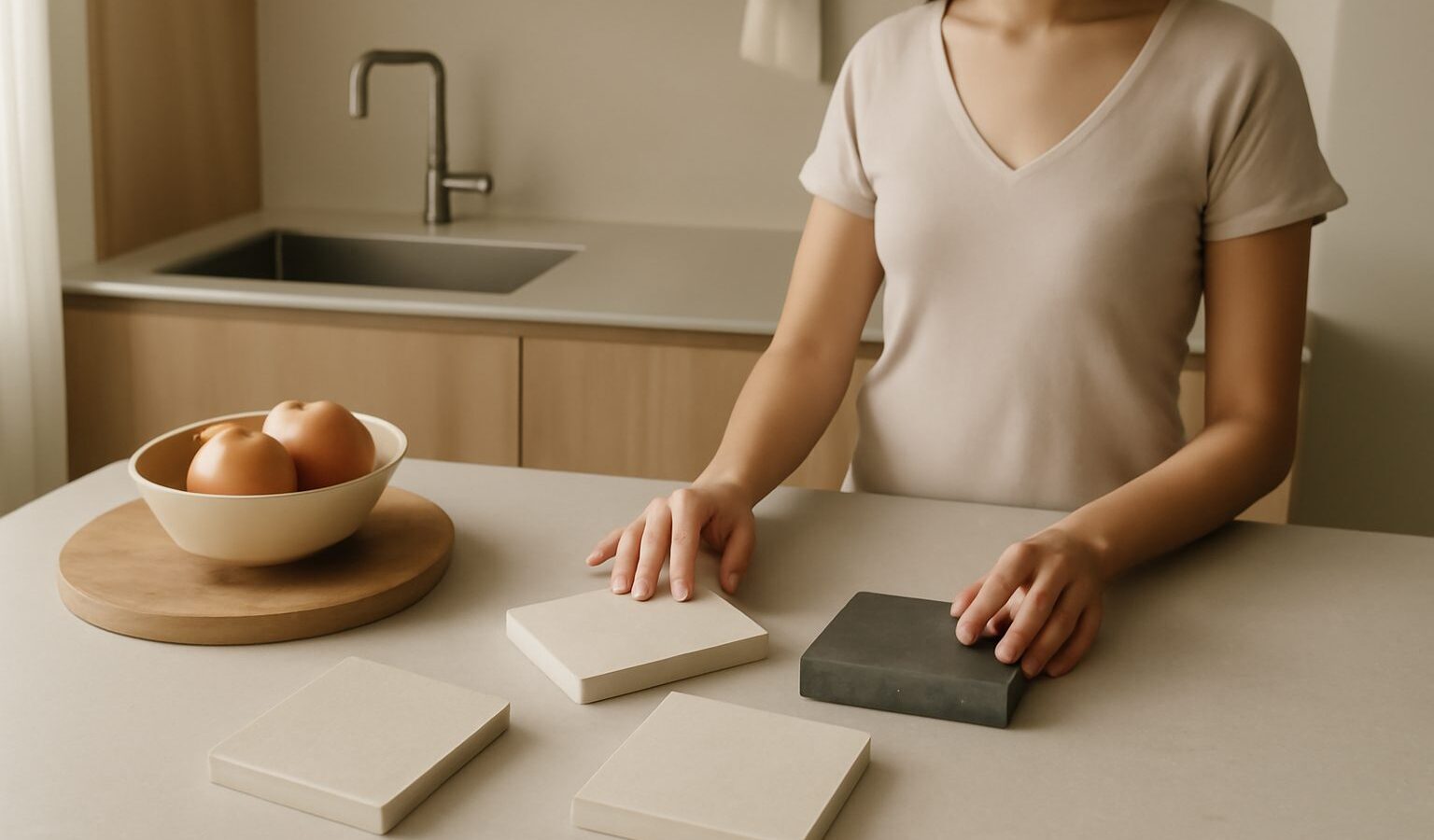
The countertop is the hardest-working surface in your home. It takes the knife, the hot pot, the spilt curry and the daily wipe-down, and it does so in a climate that runs warm and humid all year. Choosing kitchen countertop materials in Singapore is really about balancing looks, durability, upkeep and budget, then matching all of that to how you actually cook. Get it right and you have a surface that still looks good after a decade of hawker-style home dinners. Get it wrong and you are living with stains, chips or a joint that traps grime.
This guide walks through the main options, how they behave in a local kitchen, and what to weigh before you commit.
What to Look For in a Countertop Here
Before comparing materials, it helps to know what a Singapore kitchen throws at a worktop. We cook hot and fast, often with a wok and plenty of oil, sauces and turmeric-heavy dishes that stain. Our flats are compact, so the counter doubles as prep station, drop zone and sometimes dining ledge. Humidity is constant, which matters for any material that can warp or grow mould at the seams.
A few qualities separate a countertop that lasts from one that disappoints:
- Heat tolerance. Can you rest a hot pan on it, or will it scorch and discolour?
- Stain resistance. Non-porous surfaces shrug off soy sauce and oil; porous ones need sealing and quick clean-ups.
- Scratch and chip resistance. Daily chopping and heavy pots test the surface and, crucially, the edges.
- Hygiene. A non-porous, seamless surface gives bacteria and mould fewer places to settle, which suits our climate.
- Upkeep. Some materials need periodic sealing; others just want a wipe.
Keep your own cooking style in mind as you read on. A keen home cook who braises and fries daily has different needs from someone who mostly reheats and assembles.
The Main Countertop Materials, Compared
Most kitchens here end up with engineered stone, but it is worth knowing the full field. The table below gives a quick, honest overview. Prices vary widely by brand, thickness and installer, so treat cost as rough bands and always get a current quote.
| Material | Durability and heat | Upkeep | Rough cost band | Best for |
|---|---|---|---|---|
| Quartz (engineered stone) | Very hard, scratch and stain resistant; not fully heat proof | Low, just wipe; no sealing | Mid to premium | Most HDB and condo kitchens |
| Sintered stone | Extremely hard, heat and scratch resistant, non-porous | Very low | Premium | Heavy cooks who rest hot pans |
| Solid surface (acrylic) | Seamless, repairable; softer, can scorch | Low, but avoid hot pans | Mid | Seamless look, integrated sinks |
| Granite (natural stone) | Hard and heat tolerant; porous | Needs periodic sealing | Mid to premium | A natural stone look |
| Laminate | Light and affordable; can chip or swell if water gets in | Low, but keep seams dry | Budget | Tight budgets and rentals |
| Stainless steel | Very hygienic and heat proof; shows scratches | Low, wipe and buff | Mid | A pro, industrial kitchen feel |
Matching Material to How You Cook
The right choice is less about fashion and more about your habits.
If you cook heavily, with a wok on full blast and pots moving on and off the stove, prioritise heat tolerance. Sintered stone and granite handle hot cookware best, though the safe habit is always to use a trivet rather than trust any surface. Quartz is superb in almost every way but its resin binder can discolour under a very hot pan, so protect it.
If you value a seamless, joint-free look, solid surface lets fabricators glue sheets and even an integrated sink into one continuous run with no visible seams, which is easy to keep clean. The trade-off is that it scorches and scratches more easily, so it rewards a careful cook.
If budget is the deciding factor, modern laminate has come a long way and looks convincing. It suits rentals and first homes. Just keep water away from the joints and the sink cut-out, because a swollen laminate edge is hard to undo.
If you want natural character, granite and marble bring real stone veining. Marble is beautiful but soft and porous, etches with acids like lemon and vinegar, and is a demanding choice for a busy family kitchen. Granite is the more practical natural stone.
Edges, Joints and Finishing Touches
The material is only half the decision. How it is fabricated makes or breaks the result.
- Joints. In a long or L-shaped run, ask where the seams will fall and how visible they will be. A neat, well-colour-matched joint is worth paying attention to, because a bad one collects grime.
- Edge profile. A simple squared or slightly eased edge is clean and modern; chunkier profiles cost more. Softer edges are kinder if you have young children.
- Thickness. Thicker slabs feel more solid but weigh more and cost more. A mitred edge can make a thin slab look thick.
- Backsplash. A matching upstand or full-height splashback in the same material keeps oil splatter off the wall and looks seamless, which is handy behind a busy hob.
- Sink and hob cut-outs. Undermount sinks suit non-porous stone and wipe clean easily; check your chosen material can take the cut-out without weakening.
Ask to see a large sample, not a tiny chip, and view it in daylight. Patterns that look subtle on a swatch can read very differently across a two-metre run.
Where to Buy and Who to Install It
Countertops are almost always supplied and fitted by a specialist stone fabricator or your renovation contractor, not bought off the shelf. Most homeowners go through their interior designer or an HDB-registered renovation contractor, who will template the kitchen, cut the slab and install it. You can also approach stone suppliers directly, and showrooms in the industrial estates carry quartz and sintered stone samples to compare.
A few practical notes for a smooth job. Confirm the exact brand and slab, since quality varies within the same material. Ask about the warranty and what it covers. Because plumbing and any gas or electrical connections around the kitchen must be handled by licensed professionals, coordinate the countertop install with those trades so nothing is done out of sequence. And if you are hacking or moving anything structural as part of the reno, remember that renovation rules and permitted works change, so check current HDB, BCA and town council requirements and never touch a structural wall.
Choose the surface that fits how you live, protect it with simple habits like trivets and quick wipe-downs, and your countertop will earn its keep for years.
Explore More
A countertop decision sits inside the bigger renovation picture. If you are still planning surfaces, our guide to choosing tiles for your home pairs naturally with worktop choices, and renovation loan and financing options helps you budget the wider job. Before the kitchen goes in, see questions to ask your interior designer and waterproofing and wet works.