
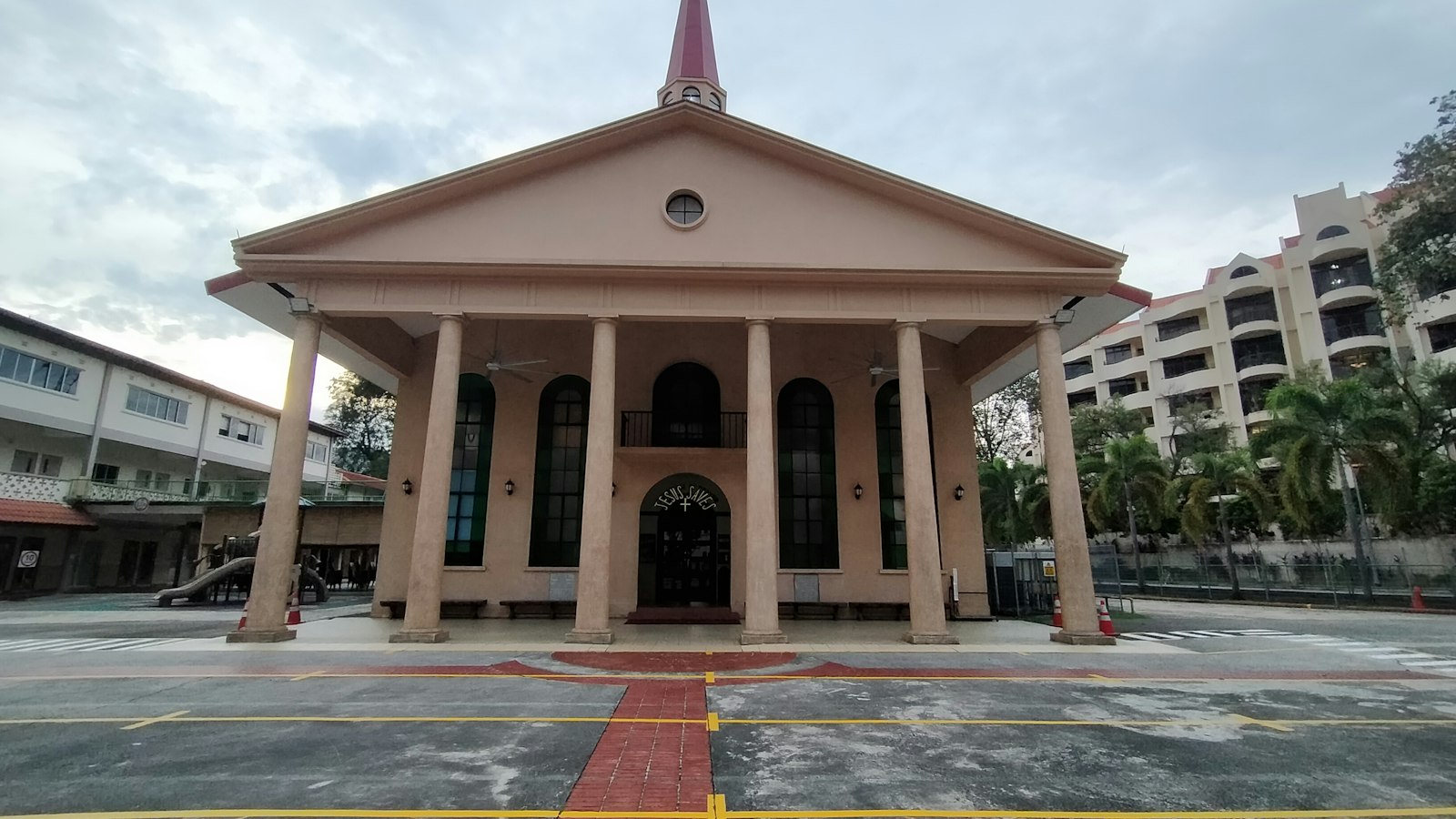
Tucked along Queen Street in the Bras Basah area, the Church of Saints Peter and Paul, Singapore, is easy to walk past on the way to the busier spots nearby. Yet this modest Gothic church holds a special place in local history: it grew up as a spiritual home for the Chinese Catholic community at a time when newcomers from different dialect groups were arriving in the port in large numbers. This guide looks at the church’s story, what to notice in its architecture, and how to visit respectfully.
Our broader guide to heritage churches of Singapore gives an overview of many places of worship. Here we focus on one church and the community that shaped it.

Origins: A Church for Chinese and Indian Catholics
The church dates to around 1870, when the Catholic mission in Singapore, run largely by French missionaries of the Paris Foreign Missions Society (often called MEP, from its French name), saw a growing need. The nearby Cathedral of the Good Shepherd mainly served European and Eurasian worshippers, while Chinese and Indian Catholics needed a parish where services, sermons and confession could happen in languages they understood.
Saints Peter and Paul was built to meet that need. In its early years it served both Chinese and Indian Catholics. As each community grew, the mission built more churches. The Indian congregation eventually moved to its own parish, Our Lady of Lourdes, and Saints Peter and Paul became closely associated with Chinese Catholics.
This history explains why the church is often described as a mother church of Chinese Catholicism in Singapore. Over the decades, Chinese Catholics from the parish and its missionaries helped establish other parishes and communities across the island as the population spread out from the old town.
The Chinese Catholic Roots and Dialect Communities
Early Chinese Singapore was not one community but many. Hokkien, Teochew, Cantonese, Hakka and Hainanese speakers each had their own clan associations, trades and neighbourhoods. A church serving “Chinese Catholics” in the 19th century therefore had to work across several spoken languages, and priests often learned one or more dialects to minister to their flock.
Some practical points help make sense of this heritage:
- Language of worship. Before the reforms of the Second Vatican Council in the 1960s, the Catholic Mass itself was celebrated in Latin worldwide. What changed from church to church was the language of preaching, hymns, catechism classes and pastoral care.
- A community anchor. Like clan associations and temples, the parish offered more than religious services. It was a place where newcomers found people who spoke their language, help with finding work and support in hard times.
- Mandarin and today’s congregation. As Singapore moved towards Mandarin as the common Chinese language, Mandarin became central to the church’s Chinese services. Mass schedules and languages change over time, so check the parish’s official website or the Catholic Archdiocese of Singapore for current times.
For readers new to Singapore, including newcomers from mainland China, the church is a useful window into how faith, language and migration shaped the city long before independence.
Architecture: What to Look For
The church is built in the Gothic Revival style that was popular for churches in the British Empire during the 19th century. It was extended in the decades after it opened, which is why some parts feel slightly different in proportion. When you visit, look out for:
- The pointed arches over windows and doors, a defining feature of Gothic Revival design.
- The bell tower and spire at the front, which once made the church a landmark in a low-rise neighbourhood.
- Stained glass windows depicting saints and biblical scenes. Many date from the church’s early decades and are among the older examples of stained glass in Singapore.
- The interior layout, with a long nave leading to the altar, side aisles and devotional statues. Note how the design keeps the interior relatively cool and airy, an important consideration in the tropics.
- Its setting. Queen Street and Waterloo Street form one of Singapore’s most interesting religious streetscapes, with Buddhist, Hindu and Christian sites close together.
The church was gazetted as a national monument, which means it is protected under Singapore’s conservation laws administered by the Preservation of Sites and Monuments division of the National Heritage Board. Restoration works over the years have aimed to keep its historic character while making it suitable for an active parish.
Visiting the Church Respectfully
The Church of Saints Peter and Paul is a working parish, not a museum. Visitors of all faiths are generally welcome outside of services, but please behave as a considerate guest. The table below sums up common etiquette.
| Situation | Good practice | Best avoided |
|---|---|---|
| Entering the church | Enter quietly, switch your phone to silent | Loud conversation in the nave |
| Dress | Cover shoulders and knees, as in most places of worship | Beachwear or very revealing outfits |
| During Mass or prayer | Sit quietly at the back if you wish to observe | Walking around the aisles or taking photos |
| Photography | Ask permission or check posted signs; avoid photographing people at prayer | Flash photography and tripods without approval |
| Weddings and funerals | Keep a respectful distance or come back later | Entering to sightsee during a private ceremony |
Opening hours, guided tours and access to particular areas can vary, especially around major feast days, Christmas and Easter. Check the parish’s official channels before you go. If you are curious about the Catholic faith, parish offices can usually point you to talks or courses for enquirers.
Exploring the Neighbourhood
A visit to Saints Peter and Paul combines well with a short heritage walk around Bras Basah and Bugis. Within easy walking distance you will find temples, other historic churches, art schools and museums. Nearby MRT stations include Bras Basah and Bencoolen, though Bugis is also a reasonable walk.
Ideas for a half-day route:
- Start at Saints Peter and Paul on Queen Street.
- Walk along Waterloo Street, where Buddhist and Hindu temples sit close together and the street is often busy with worshippers and flower sellers.
- Continue to the Bras Basah area, home to several heritage buildings now used as schools and museums.
- Finish at the Church of St Joseph on Victoria Street, another historic Catholic church with its own community story.
If you enjoy Singapore’s Catholic heritage, you may also like our guide to Novena Church and the Saturday Novena, which looks at a very different, more modern devotional tradition.
Why This Church Still Matters
Saints Peter and Paul tells a story that many Singaporeans recognise: people arriving from elsewhere, finding community in a shared language and faith, and building institutions that outlasted them. The church’s survival in the middle of a fast-changing city centre reminds visitors that heritage is not only about grand buildings, but about the communities that kept them alive.
Whether you come for the stained glass, the history or a quiet moment away from the crowds, treat it as both a monument and a living place of worship.
Frequently Asked Questions
Do I need to be Catholic to attend Mass at this church? No. Visitors of all faiths are generally welcome outside of services, and those who wish to observe a service can sit quietly at the back. Dress modestly, switch your phone to silent and avoid walking around. Check the parish’s official channels for current Mass times.
Is there an entrance fee to visit the church? It is a working parish rather than a ticketed attraction, so visitors generally just come in during opening times. Access can vary around services and feast days. Check the parish’s official channels before you go, and be ready for areas to be closed.
Can I take pre-wedding photos or hold a photoshoot at the church? Photography is usually restricted, so ask the parish office for permission first. Professional shoots, tripods and flash typically need approval, and a service or ceremony takes priority. Do not assume approval, and avoid photographing worshippers at prayer.
How long should I spend at the church on a heritage walk? Around half an hour is enough for most visitors to see the architecture and stained glass. It combines well with a longer walk around Bras Basah and Waterloo Street. If you want to see inside during a quiet period, avoid service times.
Are services held in Chinese or English? The church is closely tied to Chinese Catholics, and Mandarin is central to its Chinese services, but languages and schedules change over time. Check the parish’s official website or the Catholic Archdiocese of Singapore for current Mass times and the language of each.
Further reading: St George’s Church in Tanglin: A Heritage Guide