

Starting a new job in a new country means learning more than just the work itself. You are also learning how people here talk to each other, ask for things, disagree, and say yes or no. Getting a feel for workplace communication in Singapore takes a little time, and that is completely normal. The good news is that offices here are used to people from all over the world, so a bit of patience and observation goes a long way. This guide walks you through the general patterns you are likely to notice, so you feel more confident in your first weeks.
Remember that every company is different. A young startup and a long-established bank can feel worlds apart, and each team has its own habits. Treat what follows as a friendly orientation, not a fixed rulebook.
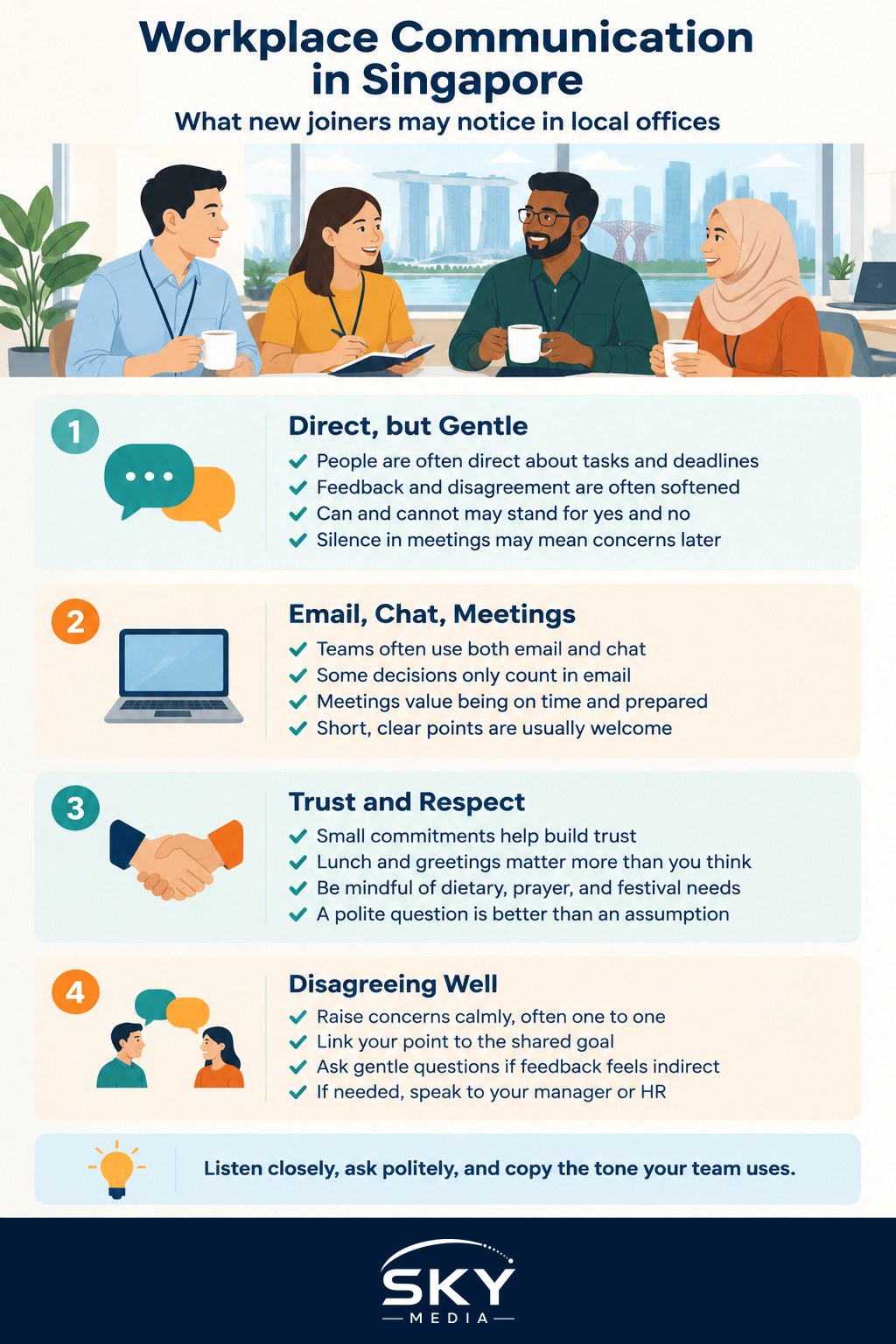
Direct Enough, But Often Gentle
Singapore sits at a crossroads of cultures, so you will hear a real mix of styles at work. Many colleagues are quite direct and practical, especially about deadlines, tasks, and logistics. At the same time, feedback and disagreement are often softened. Someone might say “maybe we can consider another way” rather than “that is wrong,” or “let me check and revert” rather than a flat no. Learning to read this gentler register is one of the most useful things you can do early on.
If you come from a culture where people speak very bluntly, you may need to add a little cushioning to your own words so you do not come across as harsh. If you come from a culture where nothing is said outright, you may need to be a bit clearer about your needs and deadlines. Watching how your manager and teammates phrase things gives you a template to copy.
A few patterns worth noticing:
- “Can” and “cannot” are used a lot, sometimes on their own, to mean yes and no.
- “Revert” locally often means “reply” or “get back to you,” not “undo.”
- “Table” a discussion usually means to raise it, closer to the British sense.
- Silence in a meeting does not always mean agreement. People may prefer to raise concerns privately afterwards.
Picking up a few local terms helps too. Our guide to basic Singlish and local terms is a fun place to start, and it makes small talk easier.
Email, Chat, and Meetings
Most offices run on a blend of email and instant messaging, and many teams live inside a group chat for quick questions. Learn which channel your team treats as important. Some decisions only count once they are in email, while day to day coordination happens in chat. When in doubt, ask a friendly colleague how things are usually done.
Meetings tend to value being on time and being prepared. It is common to see a mix of people who speak up readily and people who hold back, so if you have a point, a short and clear contribution is usually welcome. If you are more reserved by nature, you do not have to reinvent yourself. You can share your thoughts in writing after the meeting, and that is perfectly acceptable here.
Titles and seniority matter in many local firms, so it is wise to be a little more formal until you see how your team operates. Some people use first names freely, others prefer “Mr” or “Ms” plus the surname, and some go by an English name they have chosen. When you are unsure, simply ask how someone likes to be addressed. This ties closely to understanding office hierarchy and etiquette in Singapore, which is worth a read alongside this one.
Building Trust Through Small Signals
A lot of communication here happens outside formal channels. Joining colleagues for lunch at the hawker centre, saying good morning, and being reliable with small commitments all build trust quietly over time. People notice when you follow through on what you said you would do, even minor things. That reputation makes bigger conversations, like asking for help or sharing a concern, much easier later.
Be mindful of Singapore’s multicultural and multireligious workplace. Colleagues may observe different dietary customs, prayer times, or festivals, and a respectful, curious attitude is always welcome. If you are unsure about something, a polite question is far better than an assumption.
Handling Disagreement and Feedback
When you disagree, aim to raise it in a calm, low-key way, often one to one rather than in front of a group. Framing your point around the shared goal, such as the project or the customer, tends to land better than making it personal. If you receive feedback that feels indirect, it is fine to ask a gentle clarifying question so you are sure you understood. Managers generally appreciate someone who wants to get it right.
If a real communication problem comes up, such as a conflict or something about your role or entitlements, your manager and your HR team are the right people to speak with. Company policies vary, so check your own contract and ask HR rather than relying on general assumptions.
Settling In With Confidence
Give yourself a few months to find your footing. In the beginning, listen more than you speak, notice how requests and no’s are phrased, and copy the tone that works around you. Ask questions, keep your commitments, and be warm. Over time, workplace communication in Singapore will feel natural, and you will have built a network of colleagues who are glad you joined. For more on the wider transition, our guide to adjusting to Singapore work culture covers the bigger picture, and it pairs well with what you have learned here.
Further reading: Workplace Communication: China vs Singapore