

If you are applying for an Employment Pass, you will quickly run into a points system that decides much of the outcome. The compass framework singapore uses is the way the Ministry of Manpower now assesses many EP applications, moving beyond a simple salary check to a broader look at the candidate and the hiring company. Understanding how it works helps applicants and employers see where an application is strong and where it might fall short. This article is general information only, not legal or immigration advice, and the exact rules can change, so confirm current details with MOM before you act.
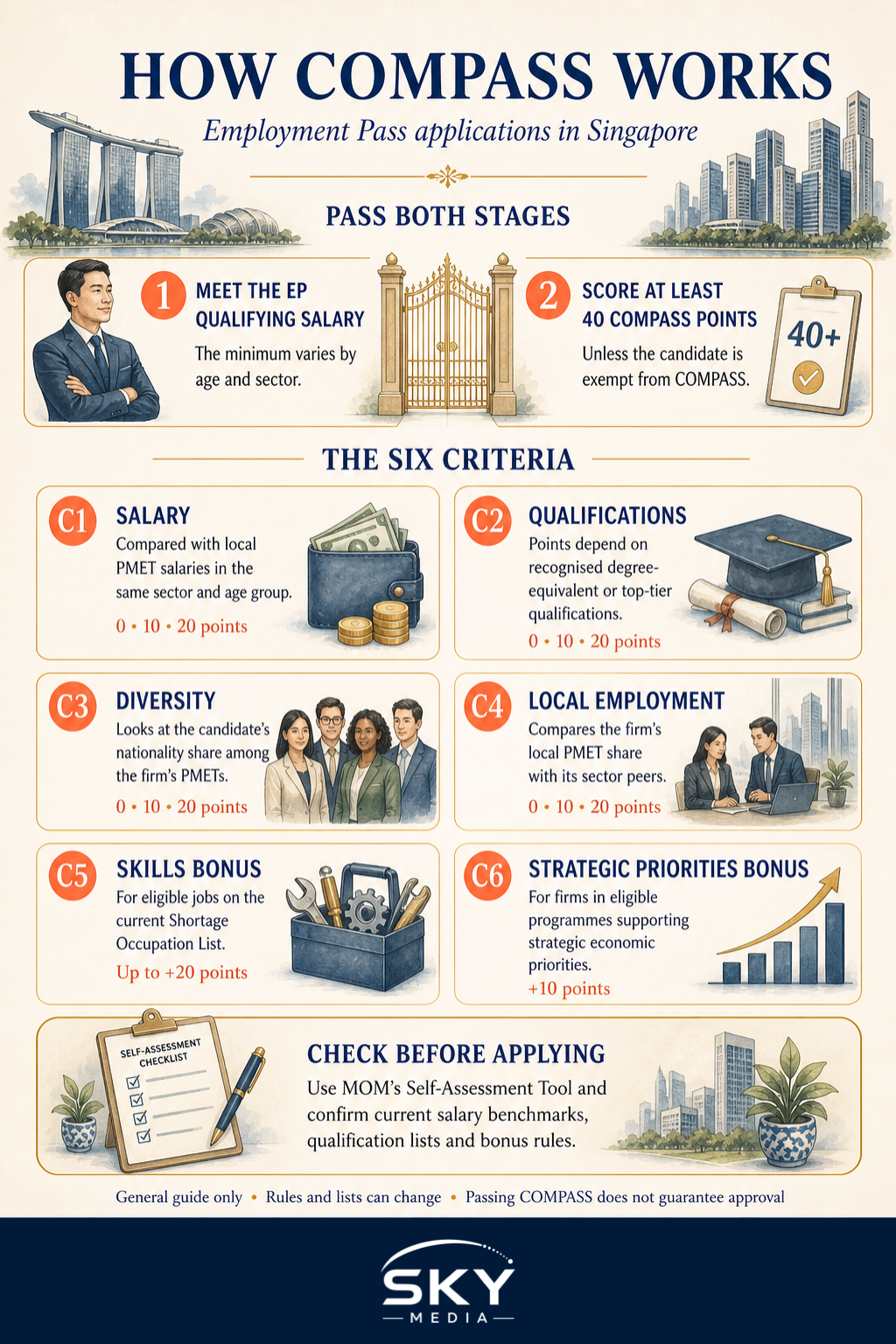
COMPASS stands for the Complementarity Assessment Framework. It applies to many new EP applications and to renewals, working alongside the minimum qualifying salary rather than replacing it. In other words, a candidate generally still needs to meet the salary bar, and then COMPASS assesses the wider fit.
What COMPASS Is Trying to Achieve
The framework is built around a simple idea: Singapore welcomes foreign professionals who complement the local workforce and who work for firms that also invest in local hiring and skills. Rather than judging an application on pay alone, COMPASS looks at the individual and the employer together, and awards points across several areas. The aim is to be more transparent and predictable, so applicants can see roughly how they score before applying.
Points are earned across a set of criteria. Some relate to the candidate directly, such as qualifications and salary relative to the market. Others relate to the employer, such as how diverse the workforce is and how much the company supports local employment. An application generally needs to reach a points threshold to pass, though meeting the salary requirement remains a separate condition.
The Criteria That Earn Points
COMPASS groups its assessment into foundational criteria and bonus criteria. The foundational areas are the core of the score, and it helps to understand what each one is looking at.
- Salary: how the candidate’s fixed monthly salary compares against local professionals in the same sector. Higher relative pay earns more points.
- Qualifications: the strength of the candidate’s academic credentials, with recognised institutions scoring higher.
- Diversity: how varied the employer’s workforce is by nationality, rewarding companies that are not overly concentrated in one foreign nationality.
- Support for local employment: how the firm’s share of local professional, managerial and executive staff compares with others in its sector.
On top of these, bonus points can be earned in areas the government wants to encourage. These include filling skills that are in shortage, and taking part in initiatives that advance national or economic priorities. Because the specific lists and shortage occupations are updated over time, check the current criteria and any bonus categories directly on the MOM website rather than assuming an older version still applies.
How the Points Work in Practice
Each criterion awards a band of points, and the totals are added to reach an overall score. A candidate who is strong on salary and qualifications may still benefit from working for an employer that scores well on diversity and local support, since the company factors count too. This is an important point that surprises many applicants: your own profile is not the only thing being assessed. The employer’s makeup matters, which means two identical candidates at two different companies can receive different outcomes.
Because of this, employers have an incentive to strengthen the parts of their profile they control, such as building a more balanced workforce over time. Candidates, meanwhile, can focus on the parts within their reach, such as securing a competitive salary offer and presenting recognised qualifications clearly.
Comparing the Foundational Criteria
The table below summarises the four foundational criteria and what each one broadly rewards. It is a simplified guide, and you should verify the exact scoring bands and any thresholds with MOM before relying on them.
| Criterion | What it looks at | Who it depends on | Broadly rewards |
|---|---|---|---|
| Salary | Pay versus local peers in the sector | Candidate and employer | Competitive, market-strong salaries |
| Qualifications | Strength of academic credentials | Candidate | Recognised institutions and degrees |
| Diversity | Nationality mix of the workforce | Employer | Balanced, less concentrated teams |
| Support for local employment | Share of local PMET staff | Employer | Firms investing in local hiring |
What Applicants and Employers Should Do
For candidates, the practical takeaways are straightforward. Aim for a salary offer that is genuinely competitive for your role and sector, keep your qualification documents clear and verifiable, and understand that the employer you join affects your chances. If a role is in an occupation facing genuine shortages, that can help, but do not assume it will since the lists are reviewed periodically.
For employers, COMPASS rewards building a workforce that is diverse and that develops local talent. Firms that concentrate hiring in a single foreign nationality, or that lag their peers on local employment, may find applications harder to approve. Planning ahead, rather than reacting application by application, tends to produce better results.
A few habits help both sides:
- Read the current criteria on MOM before applying, since bands and lists change.
- Use any self-assessment tools MOM provides to estimate a likely score.
- Keep documentation of salary, qualifications and workforce data ready and accurate.
- Treat renewals with the same care as new applications, as the framework applies to both.
Where COMPASS Fits in the Bigger Picture
COMPASS sits within Singapore’s wider approach to managing its foreign workforce, balancing openness to talent with support for local workers. It does not stand alone: it works with the qualifying salary, with sector-specific rules, and with the broader work pass system. For anyone planning a move or a hire, the sensible approach is to treat COMPASS as one important gate among several, and to confirm the live details before committing, since immigration policy is reviewed regularly and the figures quoted informally are often out of date.
Explore More
For the wider context, see our overview of the Singapore work pass guide and the more detailed look at Employment Pass eligibility in Singapore. If the EP route is not the right fit, our guide to the S Pass framework and levy in Singapore explains the main alternative for mid-skilled roles.