

When you look up a polytechnic course, you will see a short string of letters and numbers that decides a lot: ELR2B2, gross aggregate, net aggregate and COP. If you are applying through the Joint Admissions Exercise (JAE), understanding ELR2B2 poly scoring helps you list courses sensibly instead of guessing. This guide explains the vocabulary, shows how to calculate your own score, and walks through how to read a course’s cut-off point.
Admission rules are set by the Ministry of Education (MOE) and the polytechnics, and they are being updated as Singapore moves to Full Subject-Based Banding and the new Singapore-Cambridge Secondary Education Certificate (SEC). Always check the official JAE information booklet and MOE’s JAE pages for the year you are applying.
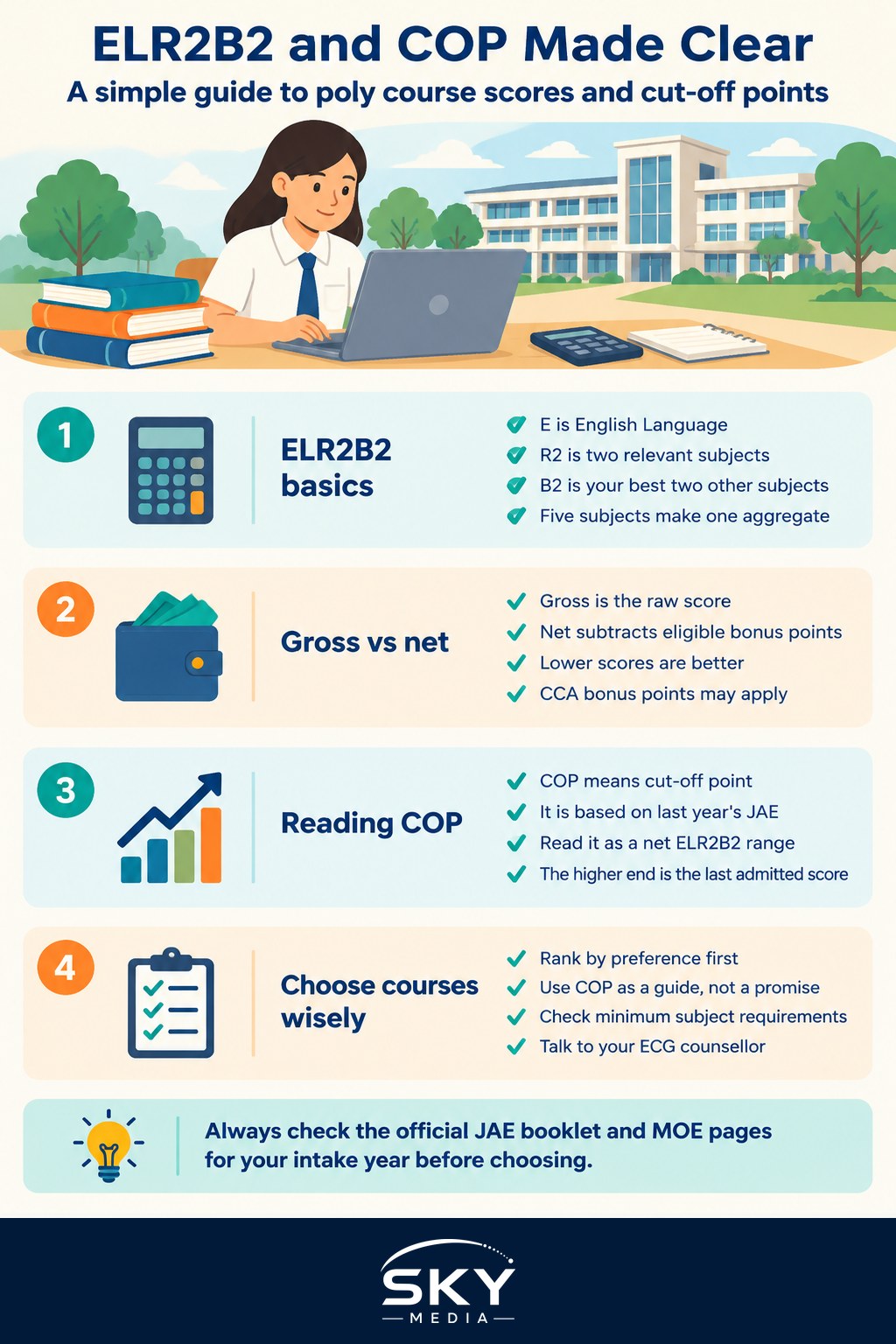
What ELR2B2 Stands For
ELR2B2 is a formula that tells you which subjects count towards your aggregate score for a poly course:
- E is English Language.
- R2 is two relevant subjects. “Relevant” means subjects that relate to the course, as defined for that course.
- B2 is your best two other subjects, which can be any other eligible subjects you have taken that are not already counted.
That makes five subjects in total. Each grade converts to points: under the O-Level grading, A1 counts as 1 point, A2 as 2, and so on down to F9 as 9. Add the five subjects together and you get your aggregate.
Lower is better. A smaller aggregate means stronger results, which surprises many students who are used to higher marks being better.
Poly courses are grouped into ELR2B2 types, labelled with a letter after the formula. Each type has its own list of what counts as a relevant subject. For example, an engineering course is likely to treat mathematics and science subjects as relevant, while a business or humanities course will accept a different set. Look up the exact type for each course you are considering, because the same results can give you different aggregates for different courses.
Gross Versus Net Aggregate
There are two versions of your score.
Gross aggregate. This is the raw total of your five subjects’ grade points, before any bonus points.
Net aggregate. This is your gross aggregate minus any bonus points you are eligible for. Since lower is better, bonus points make your score stronger.
Bonus points typically come from your co-curricular activities (CCA) record in secondary school. The number you can receive and the rules for how they apply are set by MOE, so check the JAE booklet for current details. Your school can confirm how many CCA bonus points appear on your record.
There is also a minimum requirement. To be eligible for a course, you generally need to meet a gross aggregate limit for ELR2B2, plus the course’s own minimum entry requirements, such as passing particular subjects at a certain grade. Bonus points cannot be used to meet these eligibility conditions. Check the booklet for your intake year, as these requirements can change.
How to Read a Course COP
COP stands for cut-off point. It is based on the net aggregate of students admitted to a course in the previous year’s JAE. Polytechnics usually publish it as a range of net ELR2B2 scores, showing the strongest and weakest aggregates among students who got in. The higher number at the end of the range is effectively the last score that made it.
When you read a COP, remember:
- It is history, not a promise. The COP reflects last year’s applicants and number of places. This year’s figure can move up or down depending on demand.
- It uses net scores. Compare it with your net aggregate, after bonus points, not your gross.
- It is specific to the ELR2B2 type. Calculate your aggregate using that course’s relevant subjects before comparing.
The table below shows how to interpret your score against a published COP range.
| Your net ELR2B2 compared with the COP range | What it usually suggests | Sensible approach |
|---|---|---|
| Clearly lower (stronger) than the lowest number | Your score is stronger than all students admitted last year | A reasonably safe choice, but still list it where it reflects your real preference |
| Within the range | You are competitive, but the outcome depends on this year’s demand | Place it according to how much you want it, and have backups |
| Just above (weaker than) the highest number | You are borderline and may miss out if demand rises | Keep it if you really want it, but balance it with safer options |
| Well above the highest number | Admission is unlikely through the JAE for that course | Look at related courses or other routes such as EAE |
Working Out Your Own Net ELR2B2: A Worked Approach
Here is a step by step method, using your own results:
- Find the course’s ELR2B2 type on the polytechnic’s course page or the JAE booklet.
- Write down your English Language grade and convert it to points.
- Identify which of your subjects count as relevant for that type. Choose the two that give you the best (lowest) points.
- Pick your best two remaining subjects from what is left, again choosing the lowest points.
- Add the five numbers. This is your gross aggregate.
- Check eligibility. Make sure your gross aggregate and subject grades meet the course’s minimum entry requirements.
- Subtract your eligible bonus points. This gives your net aggregate.
- Compare with the COP for that course.
Repeat this for each course you are considering. You may find that you are strong for one type of course and borderline for another, simply because different subjects count.
Using COP and ELR2B2 When Filling In Your JAE Choices
Scores are only one part of a good decision. A few tips:
- Rank by preference, then check realism. List courses you genuinely want, ordered by interest, and make sure your list includes some where your net aggregate is comfortably within or better than the COP.
- Do not rely only on the COP. Look at the course content, modules, internships and career paths. Our guide on choosing a polytechnic course covers what to look for beyond the numbers.
- Consider aptitude-based routes. The Early Admissions Exercise lets students apply based on interests and aptitude before exam results are out. See EAE for poly and ITE explained for how it works.
- Know your options if you miss out. If you are posted to a course you did not want, there is an appeal process. Read how to appeal your polytechnic course posting for the steps.
- Talk to someone. Your school’s education and career guidance (ECG) counsellor can help you check your calculations and talk through options.
Common Mistakes to Avoid
- Comparing your gross aggregate with a COP that is based on net scores.
- Using the wrong relevant subjects for a course’s ELR2B2 type.
- Assuming a course is “safe” because last year’s COP was generous.
- Forgetting to check minimum subject requirements, which can rule you out even with a strong aggregate.
- Choosing a course only because your score fits, without checking whether you will enjoy it.
Understanding ELR2B2 and COP takes some of the mystery out of poly admissions. Treat the numbers as a guide, verify everything against the official JAE booklet for your year, and pair your calculations with honest thought about what you want to study.
Official sources: Ministry of Education (MOE)