

If you already know which course you want, the Early Admissions Exercise, usually called EAE, lets you secure a place before your national exam results are out. EAE in Singapore is aptitude-based: instead of relying only on grades, schools look at your interests, talents and how well you fit the course. For many students it is a chance to show what their results cannot.
This guide explains how EAE works for polytechnics and ITE, how to prepare a strong application and what happens once you receive an offer. Details such as timelines, eligible courses and the number of choices are updated each year, so always check the current information on the official portals of the polytechnics, ITE and MOE (Ministry of Education).
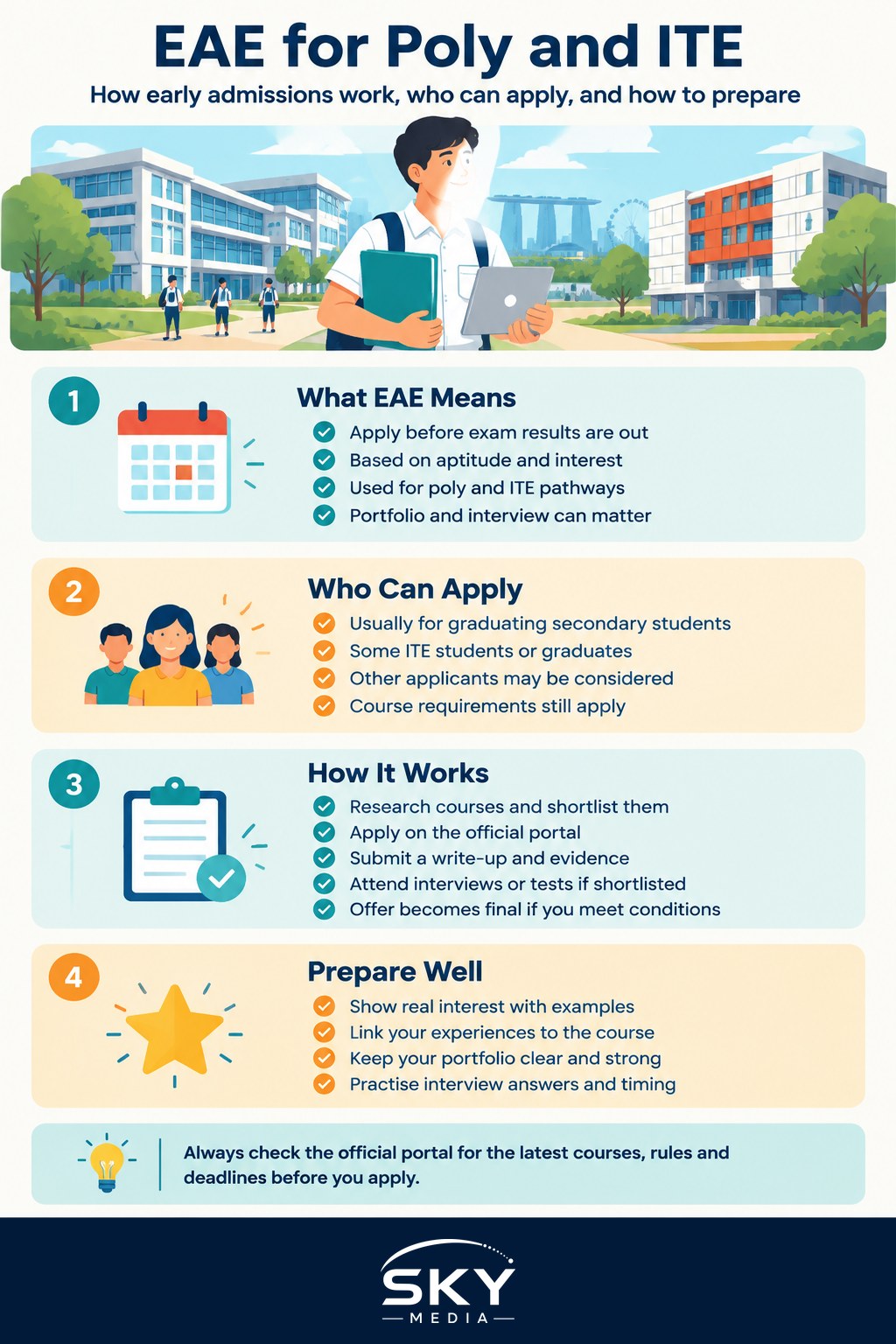
What EAE Is and Why It Exists
The EAE is an early application window run before the main admissions exercises. It lets institutions admit students based on aptitude and passion, alongside academic results.
- For polytechnics, EAE offers places in diploma courses to students who show strong interest and aptitude for a particular field.
- For ITE, an early admissions exercise lets students apply for many Nitec and Higher Nitec courses based on interest and aptitude too. Check ITE’s website for the courses involved and who is eligible.
Instead of only ranking applicants by grades, EAE asks: does this student genuinely want to do this course, and do they show the ability to thrive in it? That is why your portfolio, write-up and interview matter so much.
If you are still deciding between pathways, read JC vs poly vs ITE: choosing a pathway in Singapore first. EAE works best when you are already fairly sure of your direction.
Who Can Apply
Eligibility depends on the institution and the year, but in general EAE is open to:
- Students in their graduating year of secondary school who will sit for national exams
- ITE students or graduates applying to polytechnic diploma courses, subject to the poly’s rules
- Some other applicants, such as those with relevant qualifications or experience, depending on the course
Each course still has minimum entry requirements. Even if you receive an offer through EAE, you must meet those requirements once results are released. Check the course page and the EAE portal for your exact situation.
How EAE Compares With the Main Admissions Exercise
| Feature | EAE | Main admissions exercise (such as JAE) |
|---|---|---|
| Timing | Before national exam results | After results are released |
| Main basis for selection | Aptitude, interest, portfolio and interview, plus minimum entry requirements | Mainly academic results and course demand |
| What you submit | Personal write-up, portfolio or achievements, sometimes tests or interviews | Course choices ranked in order |
| Outcome | Conditional offer, confirmed if you meet minimum requirements | Posting based on results and available places |
| Flexibility after accepting | Usually committed to that course if you meet requirements | Choices made after seeing your results |
JAE stands for the Joint Admissions Exercise, the main route that uses your results to post you to a course. Accepting an EAE offer usually means you will not take part in the main exercise for that level if you meet the conditions, so be sure before you accept. Confirm the current rules on the official portal.
How the EAE Process Usually Works
The broad flow tends to be similar each year:
- Research courses. Attend open houses, read course pages and talk to current students. Shortlist courses you truly want.
- Apply on the official portal. Submit your application within the stated window and choose the courses you want to apply for, up to the limit allowed.
- Write your personal statement. Explain why you want the course, what you have done related to it and what you hope to achieve.
- Submit supporting evidence. This could be a portfolio, certificates, competition results, CCA (co-curricular activity) records, projects or work samples.
- Attend selection activities. Some courses invite shortlisted applicants for interviews, aptitude tests, auditions or practical tasks.
- Receive the outcome. Successful applicants get a conditional offer.
- Accept or decline. Respond by the deadline given.
- Meet the conditions. After results are out, your place is confirmed if you meet the minimum entry requirements.
Mark every deadline in your calendar. Late applications are generally not accepted.
Building a Strong Application
Your application should tell a clear story about why this course suits you.
Show genuine interest. Instead of saying “I am passionate about design”, describe what you have done: a club project, a self-taught skill, a competition, a small business or volunteering.
Connect your experiences to the course. If you want an engineering diploma, mention robotics CCA work or a project you built. If you want early childhood education, talk about helping with children’s activities.
Be specific and honest. Interviewers can tell when an answer is rehearsed or exaggerated. Real examples, even small ones, are more convincing.
Organise your portfolio. For creative courses, select your strongest pieces, label them clearly and be ready to explain your process. Quality matters more than quantity.
Ask for feedback. Your teachers, ECG (Education and Career Guidance) counsellor or parents can review your write-up. A fresh pair of eyes catches unclear sentences.
Building these materials also helps later. The skills overlap with how to build a CV as a student, which is useful for internships too.
Preparing for Interviews and Tests
If you are shortlisted for an interview, prepare thoughtfully:
- Re-read your own application so your answers match what you wrote.
- Be ready to answer why you chose this course and this institution.
- Prepare one or two examples of challenges you faced and what you learnt.
- Read up on the industry the course leads to.
- Dress neatly and arrive early, or test your device if the interview is online.
For aptitude tests or practical tasks, read any instructions sent beforehand. Do not try to “game” these; they are designed to see how you think.
Balancing EAE With Exam Preparation
EAE runs while you are preparing for national exams, so manage your time carefully. Set aside specific hours for the application and protect the rest for revision. Remember that you still need to meet minimum entry requirements, so do not let your studies slip. Our guide to time management for students has practical tips.
If you do not get an offer, it is not the end. Many students who were unsuccessful in EAE go on to secure their preferred course through the main admissions exercise. Treat EAE as an extra opportunity, not your only one.
Questions to Ask Before Accepting an Offer
- Is this the course I really want, or just the one I got first?
- Have I spoken to students in this course about workload and career options?
- Am I comfortable giving up the chance to choose after seeing my results?
- Do my parents or guardians understand what accepting means?
EAE in Singapore rewards students who know what they want and can show it. Research early, tell your story honestly, and check every rule and deadline on the official portal so your application is the best version of you.
Official sources: Ministry of Education (MOE)
Further reading: ITE Technical Engineer Diploma Explained: Who It Suits · How to Read COP and Net ELR2B2 for Poly Courses