

There are few quieter, heavier moments than opening a set of results that fall short of what you hoped for. The number on the screen or the slip in your hand seems to say something about you, and in a country where exams carry real weight, that feeling can be overwhelming. If you are sitting with disappointing exam results right now, whether you are a student, a parent reading over a shoulder, or an adult learner who resat a paper, this guide is for you. It will not pretend the disappointment is nothing. It will help you hold it sensibly and take the next steps.
A note before we go further: this is general wellbeing and study information, not medical, psychological or professional advice. If the disappointment tips into something heavier, please talk to a trusted adult, your teacher or your school counsellor. Real help is available, including mindline (call 1771) and the Samaritans of Singapore, SOS (call 1767). You do not have to carry a bad result alone.
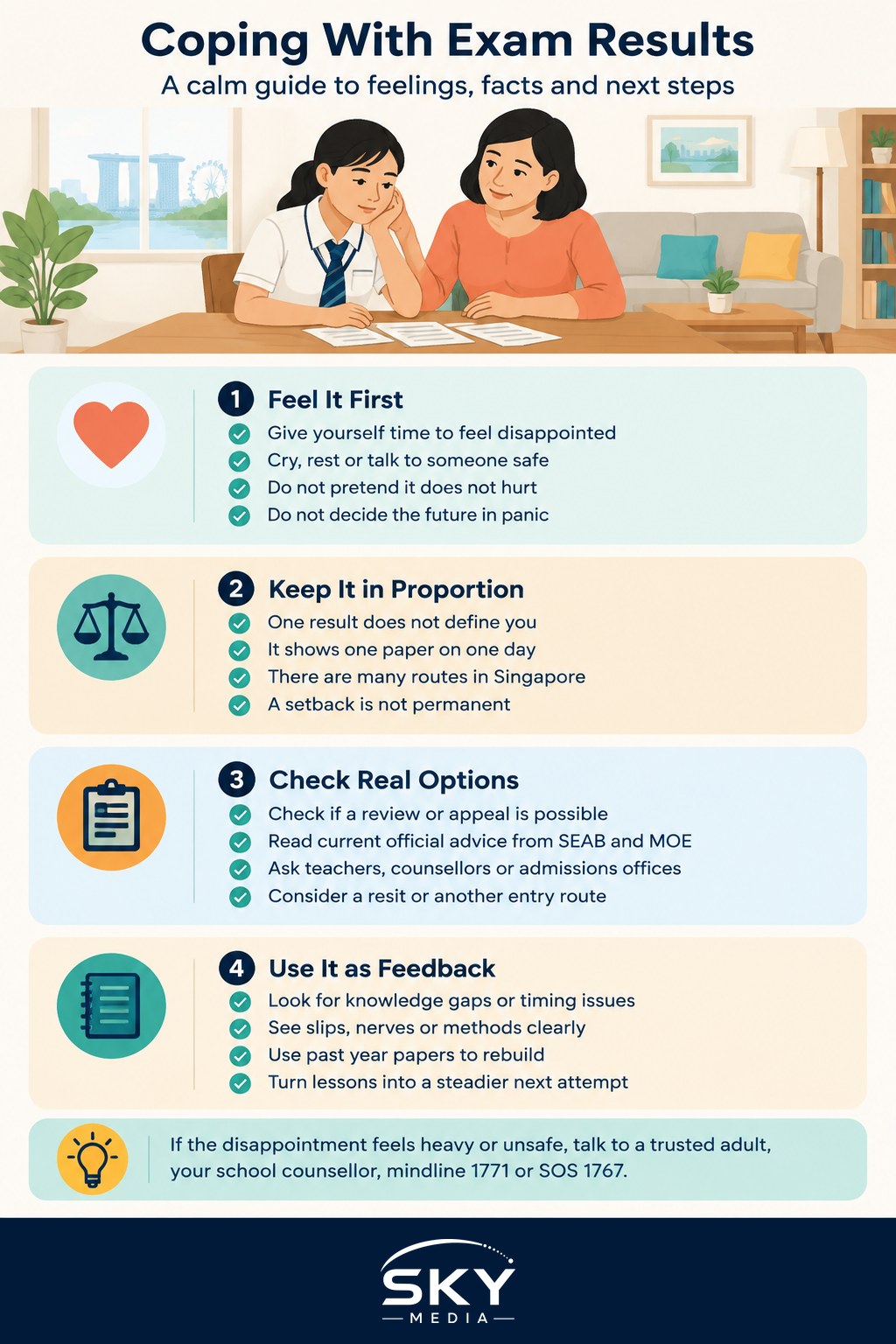
Let Yourself Feel It First
The instinct on a hard results day is often to leap straight to fixing things, or to bury the feeling under a brave face. Neither works well. Disappointment is a normal, healthy response to caring about something that did not go your way, and it needs a little room before you can think clearly.
Give yourself a short, honest window to feel it. Cry if you need to, sit quietly, talk to someone who loves you rather than someone who will lecture you. What you are trying to avoid is two extremes: pretending it does not hurt, and letting the hurt convince you that the future is now ruined. Both cloud your judgement. A day or two of genuine feeling, with a trusted person nearby, usually lets the sharpest edge pass so you can look at the situation as it really is.
If the low mood does not lift, or if you find yourself feeling hopeless or unsafe, treat that as important and reach out to a trusted adult, mindline (1771) or SOS (1767) straight away. That is not an overreaction. It is good sense.
Keep the Result in Proportion
A disappointing result feels total in the moment, as if it defines your intelligence, your worth and your whole path. It does none of those things. It measures how one paper went on one day, under one set of conditions. That is genuinely useful information, but it is not a verdict on you as a person.
It helps to widen the frame. Many people who did poorly in a particular exam went on to do work they love and lives they are proud of. Results open some doors faster than others, but in Singapore there is rarely only one route to any destination. Polytechnic, ITE, private and part-time routes, resits, appeals, later transfers and mature entry all exist precisely because people do not travel in a single straight line. A setback here narrows almost nothing permanently.
For students especially, the pressure around results is often heavier than the results themselves. If that weight is a constant in your life, our guide to handling academic pressure as a student is a gentle companion to this one.
Helpful Versus Unhelpful Ways to Respond
In the first days after bad news, the story you tell yourself matters enormously. The table below contrasts the responses that deepen the wound with the ones that let you recover and act.
| Situation | Unhelpful response | Helpful response |
|---|---|---|
| The feeling itself | “This proves I am not smart” | “This is one result, not my worth” |
| Talking to others | Hiding it, pretending you do not care | Telling one trusted person honestly |
| Looking back | Replaying every mistake on loop | Noting a few real lessons, then stopping |
| Looking forward | “My future is over” | “Which doors are still open, and how do I reach them?” |
| Taking action | Deciding everything tonight in a panic | Waiting for facts, then planning one step |
The right-hand column is not forced positivity. It is simply the version of events that is both truer and more useful than the catastrophe your tired mind is offering.
Work Out Your Real Options
Once the first wave has passed, it is time to get accurate rather than fearful. Do not plan your future on rumours, group-chat panic or a half-remembered rule. Get the facts from the bodies that actually decide these things.
- Check whether a review or appeal is possible. For national exams, the Singapore Examinations and Assessment Board (SEAB) sets out any options for a review of results and the deadlines and fees involved. Do not assume; check the current official process directly and act within the stated window.
- Understand your progression routes. The Ministry of Education (MOE) and the individual schools, polytechnics, ITE and universities publish how posting, admissions and appeals work. Requirements and cut-offs change year to year, so read the current official source rather than last year’s advice from a senior.
- Talk to the people whose job this is. Your school’s teachers and counsellors, or an institution’s admissions office, have seen many students in your position and know the routes you may not have heard of.
- Consider a resit or a different entry point. For many exams, resitting or entering through another qualification is a normal, respectable path, not a mark of shame.
Write your real options down as you confirm them. Seeing three or four genuine paths on paper does more to calm a spinning mind than any amount of reassurance.
Turn the Result Into Useful Information
When you are ready, a disappointing paper becomes one of the most honest study tools you will ever get. It shows you, without flattery, where your understanding or your exam technique let you down. Treat that as data, not as a scolding.
Look calmly at what happened. Was it a knowledge gap in certain topics, a timing problem that left questions unanswered, careless slips under pressure, or nerves that swamped you on the day? Each has a different fix. Genuine gaps call for revisiting the basics and rebuilding with methods like practising with past year papers so the exam format stops surprising you. Nerves and blanking call for calmer preparation and coping strategies; managing exam day nerves is built for exactly that. Treating the result as feedback rather than failure is the heart of learning from your mistakes, and it is what turns a bad day into a better next attempt.
Move Forward Steadily
Recovery from a disappointing result is rarely a single dramatic decision. It is a series of small, steady steps: confirm your options, choose the next realistic one, and set a couple of clear goals rather than trying to overhaul everything at once. Choosing well is easier with a little structure, and setting learning goals that stick can help you pick targets you will actually keep.
Be kind to the version of you that is reading this. You worked, you hoped, and this time it did not land the way you wanted. That is painful, and it is also survivable, common and temporary. Grades are one important thing in a life, not the whole of it. Reach out to the people who care about you, get the real facts about your next move, and take one steady step. The road is far longer, and far kinder, than a single set of results can show.