

When the preliminary exam scripts come home, most families look at the marks first and the papers second. A good PSLE prelim results plan flips that order. The marks tell you roughly where your child stands; the marked scripts tell you exactly what to do with the few weeks left before the written papers. This guide walks parents through reading the scripts properly, sorting mistakes into types, and turning that into a short, realistic plan that protects your child’s energy as well as their grades.
If you are still in the run-up to the prelims themselves, start with our Term 3 study plan for PSLE and O-Level prelims. This article picks up after the results are out.
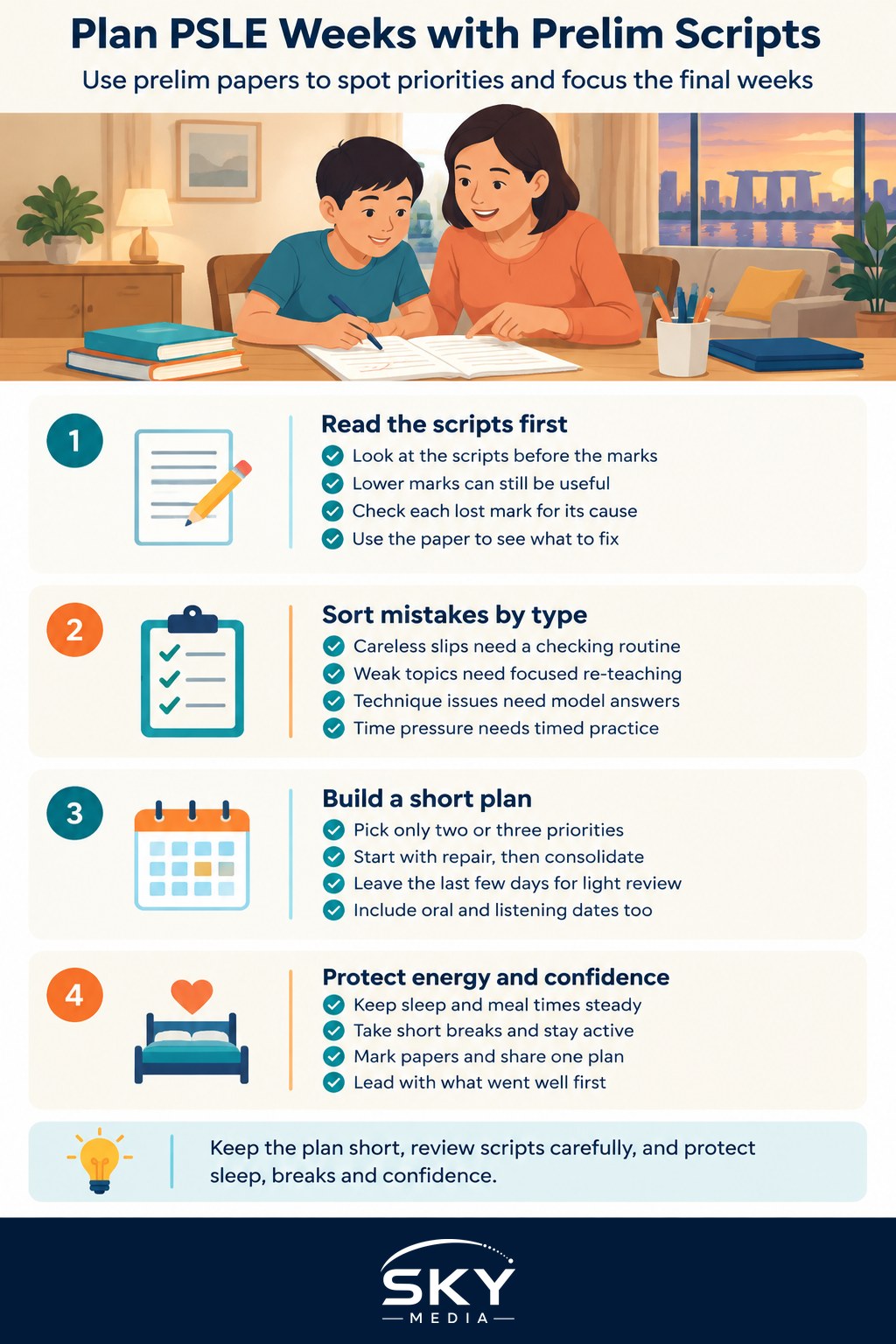
Read the Scripts Before You React to the Marks
Prelim papers are usually set by the school to mirror the PSLE format, and many schools mark them strictly on purpose. A lower mark than expected is common and is not a prediction. Under the current PSLE scoring, each subject is reported as an Achievement Level (AL) band rather than a raw mark, so a few marks either way can matter less than parents fear. Check the Singapore Examinations and Assessment Board (SEAB) and Ministry of Education (MOE) websites for how the bands currently work.
Before any discussion with your child, sit down alone with each script and a pencil. Ask three questions of every lost mark:
- Did they know it but slip? Copying errors, misread units, a skipped part (b), wrong spelling of a word they know.
- Did they half-know it? Right idea, incomplete working, a science answer missing the key term, a composition that drifted from the question.
- Did they not know it? Blank answers, guesses, or a whole topic answered wrongly in the same way.
Tally these by subject. Within an hour you will usually see that one subject is mostly careless slips, another has a cluster of weak topics, and a third is actually fine. That picture is far more useful than a single total.
Sort Mistakes Into Types, Then Match the Fix
Each mistake type needs a different response. Treating everything as “need more practice” leads to piles of assessment books and a tired child.
| Mistake type | What it looks like on the script | Best fix in the final weeks |
|---|---|---|
| Careless slips | Correct method, wrong final answer; missed question parts; units dropped | A short personal checklist used at the end of every paper; timed practice with checking time built in |
| Answering technique | Science answers without key words; Maths working skipped; English answers not lifted from the passage | Study the marking scheme and model answers; rewrite three answers per topic to full marks |
| Weak topic | Repeated errors in one area, such as fractions, energy conversion or synthesis and transformation | Re-teach the concept, then do 10 to 15 targeted questions, not full papers |
| Time pressure | Strong early sections, blanks or rushed answers at the end | Timed half papers; practise skipping and returning to hard questions |
| Stamina or nerves | Errors increase sharply in the second half of long papers | Full papers under exam conditions once a week, with proper rest around them |
Talk to your child’s teachers too. They see the whole cohort and can tell you whether a topic was weak across the class or specific to your child, and what the school is planning to revise.
Build the Final-Weeks Plan Around Two or Three Priorities
The biggest mistake at this stage is trying to fix everything. Pick no more than two or three priorities per subject, drawn straight from your tally. For example:
- Maths: speed questions and a checking routine for Paper 1.
- Science: answering technique for open-ended questions, plus one weak topic.
- English: synthesis and transformation, plus composition planning.
- Mother Tongue: comprehension answering and a vocabulary list from the prelim paper.
Then lay out the remaining weeks in phases rather than a rigid daily timetable:
- Repair phase (first half): short, focused sessions on weak topics and technique. Use the prelim script itself as the first worksheet: redo every lost question without looking at the answer.
- Consolidate phase (second half): mixed practice and timed papers, one or two a week per subject, marked together.
- Taper phase (final few days): light review of notes, formula lists and the personal checklist. No new topics.
Keep oral and listening components in mind if they fall in the same period; check the school’s schedule for the exact dates.
Use Practice Papers Wisely, Not Endlessly
More papers do not automatically mean more marks. A full paper done carelessly and never reviewed teaches little. A useful routine:
- Do the paper under timed conditions, in one sitting, at a clean desk.
- Mark it the same day if possible, ideally with your child present.
- Add any new careless errors to the personal checklist.
- Redo wrong answers two days later without help.
If your child is enrolled in tuition or enrichment, share the prelim analysis with the tutor so they work on the same priorities instead of running a separate programme. Too many voices in the final weeks causes confusion.
Protect Sleep, Mood and Confidence
Children who are well rested and calm retrieve what they know far better than tired ones. Hold the line on:
- Sleep: keep bedtimes consistent; late-night cramming tends to backfire.
- Breaks: short active breaks between sessions, some time outdoors, and at least one lighter evening a week.
- Food and water: regular meals and a water bottle at the desk.
- Screens: agree on limits together rather than banning everything overnight.
How you talk about prelim results matters as much as the plan. Lead with what went well, then present the priorities as “the few things that will help most”, not a list of failings. Avoid comparing your child with siblings, cousins or classmates. If your child seems persistently anxious, is not sleeping, or talks about being a disappointment, speak to the form teacher or the school counsellor early; schools are used to supporting students at this time of year.
What a Typical Week Can Look Like
Every family is different, but a balanced week in the repair phase might include:
- Four or five weekday sessions of 45 to 60 minutes, each focused on one priority.
- One timed paper at the weekend, alternating subjects.
- One evening completely off.
- A brief Sunday check-in: what improved, what still needs work, what to change next week.
Let your child have a say in the order of subjects and the timing. Ownership makes them more likely to stick with the plan, and it builds the independence they will need in secondary school.
After the PSLE: Keep Perspective
The PSLE matters, but it is one checkpoint, not a verdict on your child. Whatever the outcome, there are good pathways ahead, and secondary schools offer more flexibility across subjects than many parents expect. If results day brings disappointment, our guide on what to do if your child is upset after PSLE results has practical ways to help. And if you have an older child, the same “read the script, sort the mistake, fix the priority” approach works for O-Levels too; see how to read O-Level results and plan your next step.
Used well, the prelim scripts are the most precise revision guide your child will ever get. A focused PSLE prelim results plan, built on those scripts and kept humane, gives your child the best chance to show what they truly know.
Official sources: Ministry of Education (MOE)