

A-Level results day in Singapore tends to arrive in a rush. You collect your results slip at school, take a photo for the family chat, and within hours your friends are comparing scores and talking about courses. Then the questions start: what should you actually do next, and how fast?
This guide is not about which pathway is “best”. It is a practical first-week plan: the documents to gather, the options to lay out, the deadlines to note and the conversations worth having before you commit to anything. Whether your results are better, worse or exactly as expected, the same steps apply.
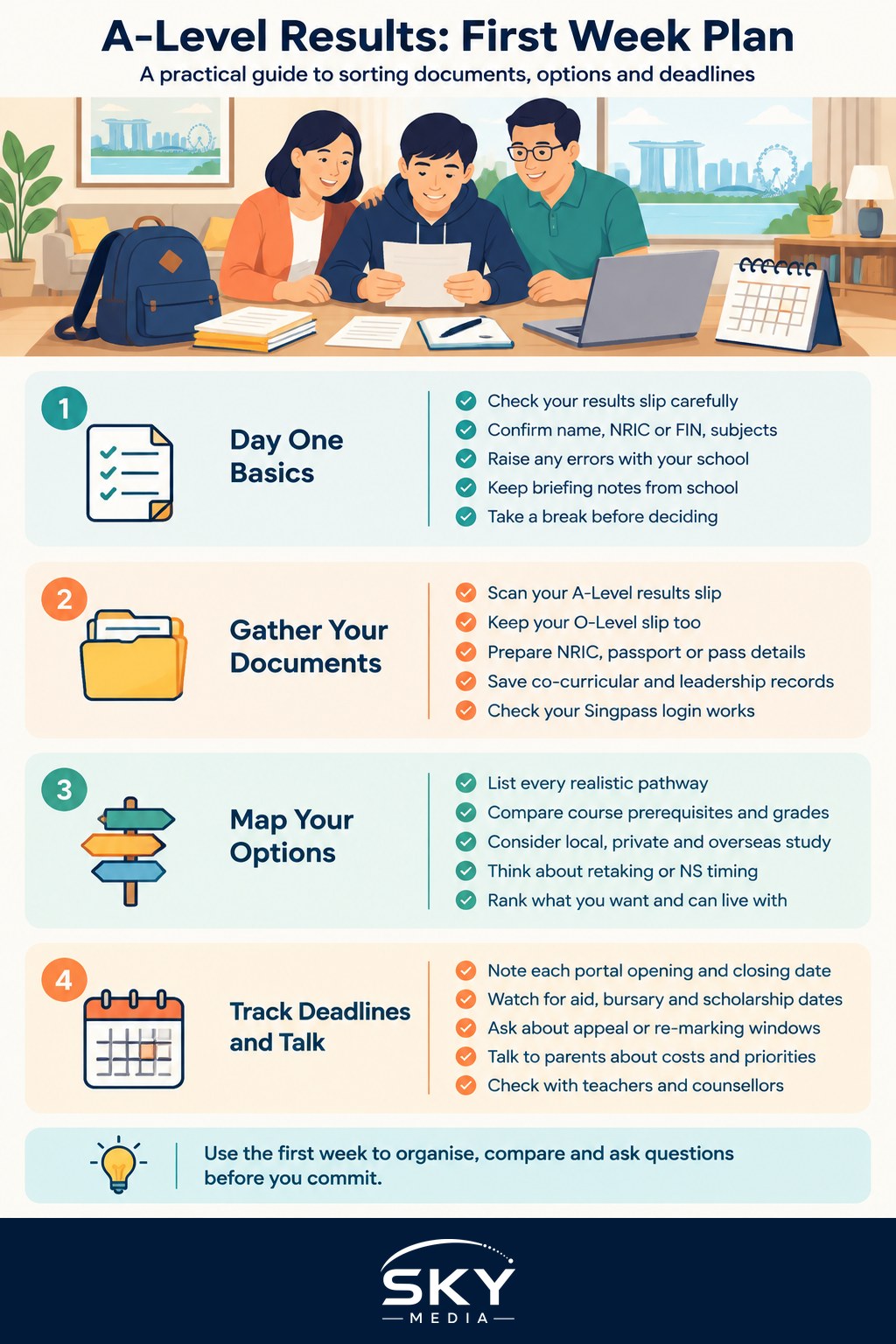
Day One: Collect, Check and Breathe
On the day itself, keep things simple.
- Collect your results slip and read it carefully. Check that your name, NRIC or FIN number and subjects are correct. If anything looks wrong, raise it with your school before you leave.
- Note what your school gives you. Schools often hand out briefing notes on university applications, financial aid and appeal procedures. Keep these together.
- Take a break before deciding anything. Strong emotions, good or bad, make it hard to think clearly. If results were disappointing, our guide on coping with disappointing exam results has practical ways to get through the first few days.
- Talk to your form teacher or a school counsellor if you are unsure about anything. They have seen many cohorts go through this and can tell you what usually happens next at your school.
Avoid posting your scores publicly or making promises to anyone on day one. You will have a clearer head in a day or two.
Days Two and Three: Gather Your Documents
Application portals move quickly once they open, and the most common source of stress is hunting for a document at the last minute. Build a single folder, both physical and digital, with the following:
- Your A-Level results slip and a clear scan of it
- Your O-Level results slip (some applications ask for it)
- NRIC or passport, and for international students, your pass details
- Records of co-curricular activities, leadership roles, competitions and community work
- Any portfolio, essays or work samples if you are considering design, architecture, media or similar courses
- Testimonials or contact details for teachers who could act as referees
- Your Singpass login working properly, since many official portals use it
Name your files clearly, for example “Results_A-Level_Scan.pdf”, and keep a backup in cloud storage. If you are applying to universities overseas, note that they may want certified copies or transcripts sent directly; check each institution’s instructions rather than assuming.
Days Three to Five: Lay Out Your Real Options
Once your documents are in order, write down every realistic option, not just your first choice. In Singapore, students after the A-Levels commonly consider:
- Autonomous universities such as NUS, NTU and SMU, plus SUSS, SIT and SUTD, each with its own application portal and course requirements
- Polytechnic diplomas, which some A-Level holders choose for a specific, hands-on field
- Private education institutions offering degree programmes, often in partnership with overseas universities
- Overseas universities, which have their own application cycles that may not line up with Singapore’s
- Retaking one or more subjects as a private candidate, if a particular course requires a grade you narrowly missed
- National Service first, which applies to most male Singapore citizens and permanent residents and affects your timeline anyway
For each option, look up the indicative entry grades or past admission profiles that universities publish, and compare them with your own results. These figures change every year and are a guide, not a guarantee, so treat them as a rough filter.
Here is a quick way to compare where you stand during the first week:
| Option | What to check this week | Who to ask |
|---|---|---|
| Local autonomous university | Course prerequisites, past admission profiles, application window, aptitude tests or interviews | University admissions pages, school counsellor |
| Polytechnic diploma | Whether A-Level holders can apply, intake timing, course fit | Polytechnic admissions pages |
| Private degree programme | Accreditation, partner university, total cost, CPE registration | Committee for Private Education (CPE) registry |
| Overseas university | Application cycle, document requirements, visa steps | The university’s international office |
| Retake a subject | Registration period for private candidates, subject rules | SEAB website and your school |
Rank your options in two lists: what you most want, and what you could live with. Most applications let you choose several courses, so a balanced list protects you from ending up with nothing.
Days Four to Six: Note Every Deadline
University application windows usually open around the time results are released and close within a few weeks. Each university runs its own timeline, and some courses add aptitude tests, interviews or portfolio submissions with separate dates.
Set this up in your phone calendar:
- The opening and closing date of each application portal you plan to use
- Any deadlines for financial aid, bursary or scholarship applications, which can close earlier than course applications
- Deadlines for appeals or re-marking requests if you are considering one (ask your school, since these windows are short)
- Registration periods for private candidates if you might retake a paper
Do not rely on what a friend says the deadline is. Dates can shift from year to year, so check each official site and note the date the page was updated.
Days Five to Seven: Have the Right Conversations
The first week is also when you need honest conversations, not just form filling.
With your parents or guardians. Talk about what matters to you in a course, not only the prestige of the name. Discuss money openly: tuition fees, living costs, whether a hall of residence is realistic, and whether you will look into tuition fee loans, bursaries or scholarships. If your parents find it hard to know how to help, they might find our piece on supporting a teen after a bad exam result useful, even if your result was simply mixed.
With teachers and counsellors. Ask whether your grades and interests point towards courses you may not have considered. Teachers often know which courses value particular subjects or co-curricular records.
With seniors and friends already in university. Ask about workload, class sizes, internships and what they wish they had known. Treat their views as one data point, since experiences vary widely.
With yourself. Spend twenty minutes writing down what you enjoyed most in JC or Millennia Institute, which subjects felt natural, and what kind of work you can picture doing. This helps when application forms ask for personal statements.
Common First-Week Mistakes to Avoid
- Applying to one course only. Spread your choices across different levels of competitiveness.
- Ignoring prerequisites. Some courses need specific subjects or a minimum grade in a particular paper. Check before you rank them.
- Leaving financial aid to later. Aid applications can have their own earlier deadlines.
- Deciding based on what friends choose. Their fit is not your fit.
- Panicking over one number. Universities often look at the whole application, including interviews, portfolios and co-curricular records, depending on the course.
If you are a younger sibling or parent reading this ahead of time, the logic is similar to our guide on how to read O-Level results and plan your next step: understand the slip, list options, then check deadlines.
A Simple Checklist for the Week
Before the week ends, aim to tick off:
- Results slip checked and scanned
- Document folder complete, with backups
- A ranked list of at least four to six course options
- All application, aid and appeal deadlines in your calendar
- One honest conversation with family about cost and priorities
- One conversation with a teacher or counsellor
A-Level results day is only the start of a short, busy season. If you treat the first week as a time to organise rather than to decide, you will make your choices with clearer information and far less stress. Always confirm current application rules, fees and dates with SEAB, MOE and each university directly, as these can change between years.
Frequently Asked Questions
What happens to my university plans if I serve National Service first? Most male citizens and permanent residents serve National Service before or around the time they start studies, so it shapes your timeline anyway. Check each university’s rules on deferment and application timing, and ask your school counsellor how others in your cohort handle it.
Can I apply to a polytechnic diploma after A-Levels? Some A-Level holders do, usually for a specific hands-on field. Whether you are eligible, when intakes open and how courses fit are set by each polytechnic, so check its admissions page. Compare it with the university route before deciding.
How do I check that a private degree programme is legitimate? Look at accreditation, the partner university, total cost and whether the institution is registered with the Committee for Private Education (CPE). Ask for the full fee breakdown in writing, and read refund terms before paying any deposit.
Should I apply for financial aid at the same time as university? Yes, keep an eye on this early because aid, bursary and scholarship deadlines can close earlier than course applications. Discuss tuition, living costs and loans openly with your family, and check each university’s financial aid page.
What if my grades are lower than the indicative entry range? Treat published ranges as a rough guide rather than a guarantee, since they change every year and universities may also consider interviews, portfolios and co-curricular records. Apply across different levels of competitiveness and speak to your counsellor about alternative routes.
Official sources: SEAB
Further reading: SEC Results Day: How to Collect Your Results and What to Bring · Retaking A-Levels in Singapore: Options and Planning · How to Appeal After A-Level Results in Singapore