

Bringing your household goods into a new country involves more than packing boxes and booking freight. Understanding the customs duties shipping singapore process is essential if you want your belongings released quickly and without unexpected charges. Singapore runs an efficient but strict clearance system, and getting the paperwork right the first time saves both money and delay. This guide explains the broad rules in plain terms, but always treat the official guidance from Singapore Customs as the final word, because regulations and rates can change.
How Import Clearance Works
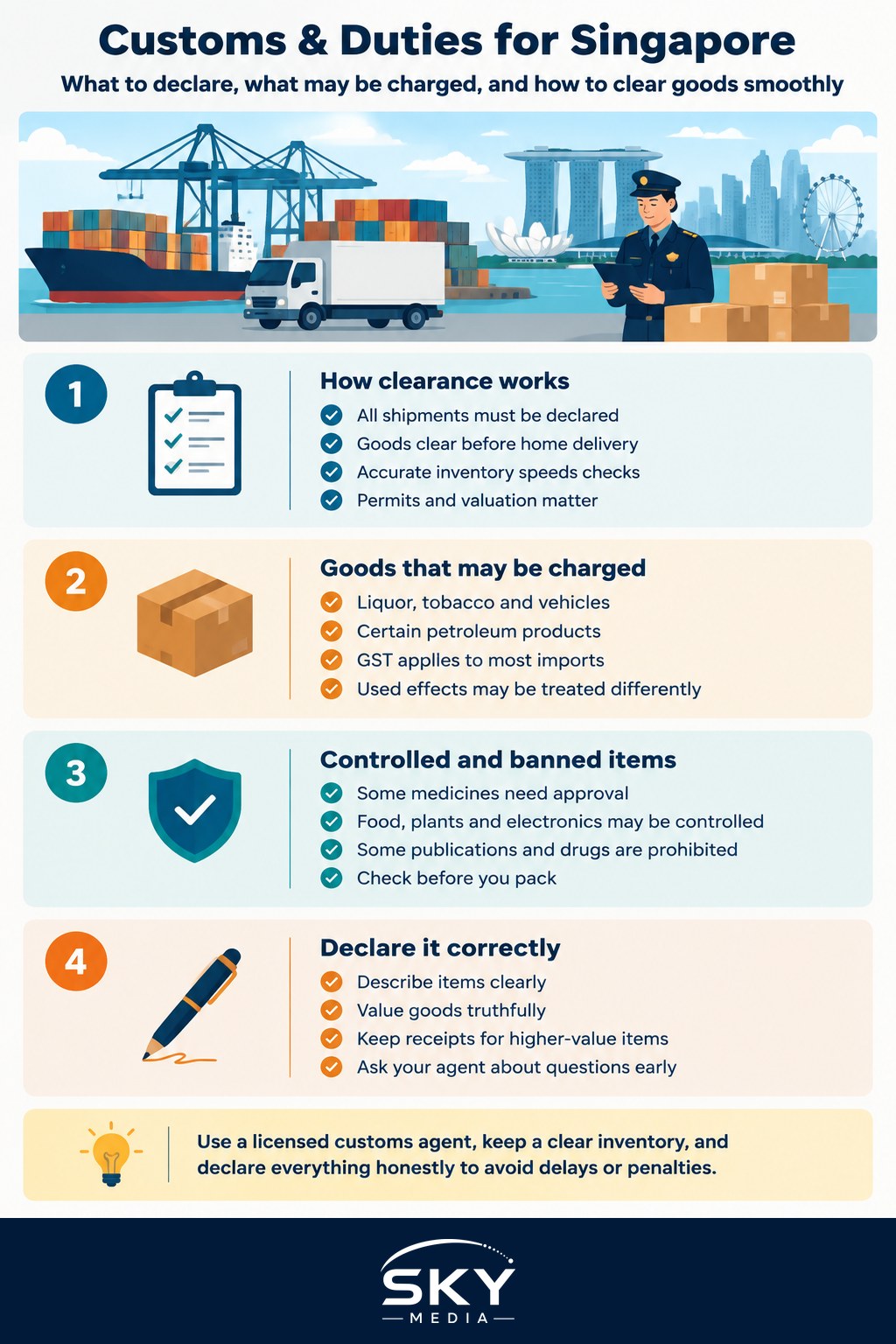
Every shipment entering Singapore must be declared. When your household goods arrive, whether by sea or air, they pass through customs clearance before they can be delivered to your home. The declaration covers what you are importing, its value, and whether any items are dutiable or controlled.
Most people moving to Singapore appoint a licensed customs agent or use the destination agent arranged by their international mover to handle this step. These professionals lodge the electronic permit through Singapore’s official trade system, present your inventory, and liaise with the authorities on your behalf. Doing this yourself is possible but rarely advisable for a first move, because errors in classification or valuation can lead to held shipments or penalties.
Your detailed packing inventory becomes a working document at this stage. Customs officers may inspect a container, so an accurate, itemised list that matches the contents of your cartons speeds everything along. Vague descriptions such as “miscellaneous items” invite closer scrutiny.
It also helps to understand the sequence. Your shipment arrives at the port or airport, the declaration and any permits are lodged, duties and GST where applicable are settled, and only then is the consignment released for delivery to your home. Each step depends on the one before it, so a missing document or an unpaid charge holds up everything that follows. Knowing this order lets you keep the process moving and question any delay sensibly.
Dutiable Goods and GST
Singapore keeps its list of dutiable goods deliberately short, but the categories that do attract duty are ones many people carry. The main dutiable products are intoxicating liquors, tobacco products, motor vehicles, and certain petroleum products. If your shipment contains wine, spirits, or cigarettes beyond any personal allowance, expect duty to apply, and be prepared to declare them honestly.
Separately from duty, Goods and Services Tax is charged on the import of most goods, calculated on their value. This applies broadly, not only to the dutiable categories above. Because both duty rates and the GST rate are set by the government and revised from time to time, this guide does not quote figures. Check the current rates directly with Singapore Customs or ask your licensed agent to confirm what your specific shipment will attract.
Used personal effects and household goods that you have owned and used for a reasonable period are often treated differently from brand-new purchases. Relief may be available in some circumstances, but eligibility depends on the rules in force and your particular situation, so confirm your standing before assuming anything is exempt.
The table below summarises the broad categories to keep in mind.
| Category | What it may include | Action to take |
|---|---|---|
| Dutiable goods | Liquor, tobacco, motor vehicles, petroleum | Declare and expect duty to apply |
| GST on imports | Most imported goods by value | Confirm current rate with Customs |
| Controlled items | Medicines, certain electronics, food, plants | Declare and obtain any required approval |
| Prohibited items | Restricted publications, weapons, certain products | Do not ship, seek advice if unsure |
| Used household effects | Furniture, clothing, personal belongings | Check whether relief conditions apply |
Controlled and Prohibited Items
Beyond duty, Singapore controls the import of many everyday things, and these rules catch people out more often than duty does. Controlled items require approval or a permit from the relevant government agency before they can enter. Common examples include certain medicines and supplements, some food products, plants and seeds, and particular electronics or telecommunications equipment.
If your shipment contains anything in a controlled category, it must be declared, and the necessary approval must be in place. A licensed agent can advise which agency governs a given item and help you obtain clearance. Never try to slip a controlled item through undeclared, as the consequences are serious.
Prohibited items are a separate matter. Some goods simply cannot be imported at all. These include items such as certain publications, controlled drugs, and various restricted products. Chewing gum is a well-known example of something subject to tight restriction. If you are unsure whether an item is prohibited or merely controlled, ask before you pack it. The safest approach is to leave anything questionable out of your shipment entirely and seek guidance.
Prescription medication deserves special care. If you take regular medicine, check the rules on bringing it in, carry your prescription and a doctor’s letter, and confirm whether prior approval is needed for the quantity you intend to import.
Getting the Declaration Right
Accuracy and honesty are the two principles that govern a smooth clearance. Declare everything, describe items clearly, and value your goods truthfully. Underdeclaring value to reduce GST or hiding dutiable goods is not worth the risk, because inspections do happen and penalties can be heavy.
A few habits help. Keep receipts or evidence of value for higher-worth items where you can. Make sure the inventory your mover prepares is thorough and legible, since it is the backbone of your declaration. Ask your agent in advance whether anything in your shipment is likely to raise questions so you can prepare the right documents rather than scrambling at the port.
Working with a licensed customs agent removes much of the guesswork. They know the current forms, the responsible agencies, and the way declarations are processed, and their fee is usually modest compared with the cost of a delayed or held shipment. Combined with an accurate inventory and honest declarations, professional help is the surest route to getting your belongings home without drama.
Explore more
- Shipping Belongings to Singapore
- Should You Ship Your Car
- Moving to Singapore Checklist
- What to Pack When Moving
Further reading: Shipping Goods Between China and Singapore