
Walk past almost any older shophouse street, wet market or HDB estate and you may spot a small altar with a smiling, white-bearded figure holding a gold ingot or a staff. That is very often Tua Pek Kong, one of the most widely worshipped deities in Chinese folk religion here. For anyone curious about Tua Pek Kong Singapore traditions, this guide explains who he is, how he became a guardian of Nanyang Chinese communities, where his temples are, and how a respectful visitor can take part.
Who Tua Pek Kong Is
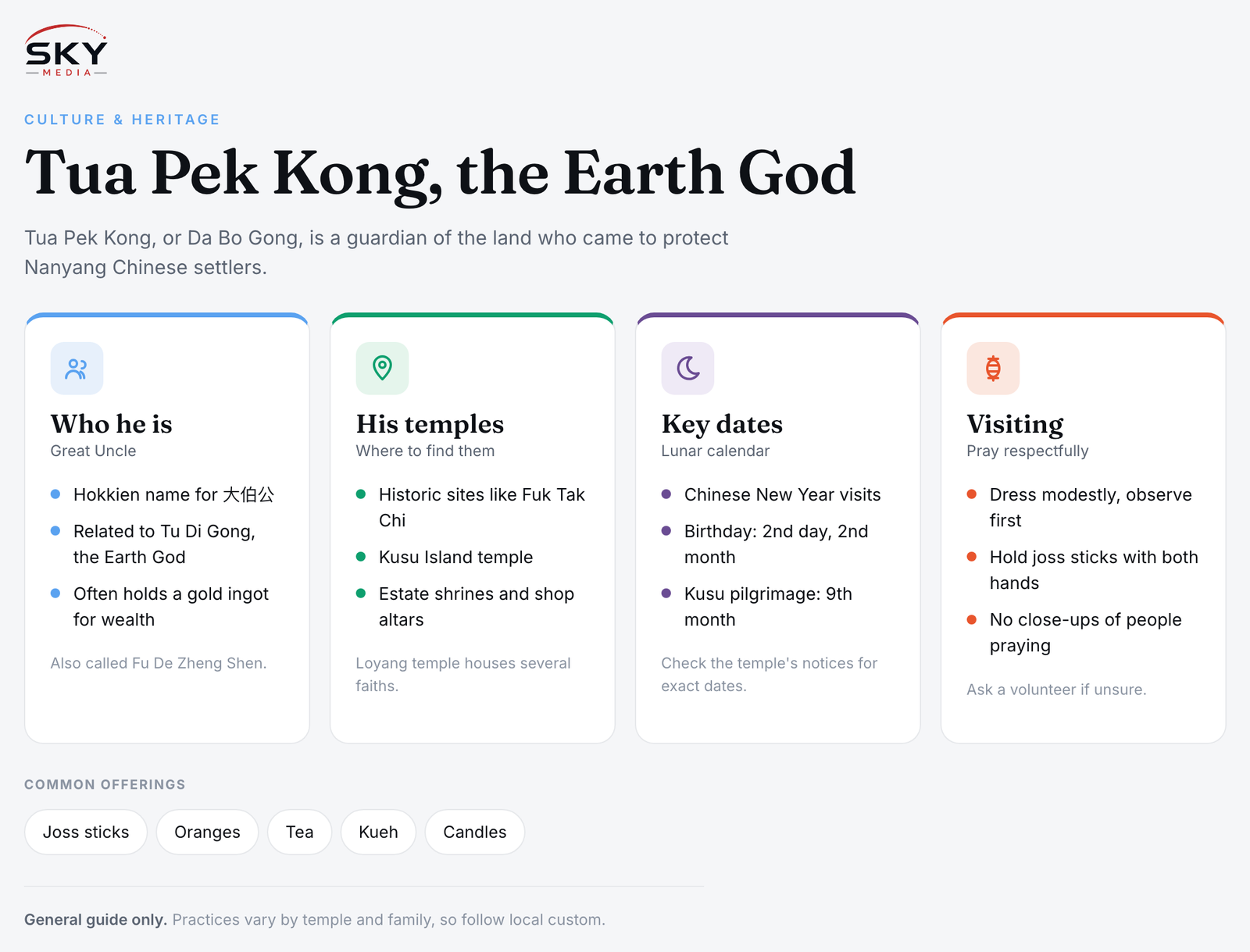
Tua Pek Kong is the Hokkien name for 大伯公 (Da Bo Gong in Mandarin), which loosely means “Great Uncle” or “Grand Old Man”. Teochew and Hakka speakers use similar names, and you may also see him called Fu De Zheng Shen (福德正神, the “Righteous God of Blessings and Virtue”) on temple signboards.
He is closely related to Tu Di Gong (土地公), the Earth God or “Lord of the Land” found across southern China and Taiwan. In traditional belief, an Earth God looks after a particular piece of land: a village, a street, a market or a building. He keeps the area peaceful, protects the people living on it and helps them prosper. That is why he so often holds a gold ingot, a symbol of wealth.
In Southeast Asia the figure took on a local character. Chinese migrants arriving by sea in the 18th and 19th centuries faced disease, danger and uncertain livelihoods. Worshipping a familiar protector of the land gave them comfort in a new place. Over time, Tua Pek Kong in the Nanyang (the Chinese term for Southeast Asia) came to be seen as a guardian of overseas Chinese settlers in particular. Origin stories vary by region and dialect group, so treat any single tale as one tradition among several.
How Tua Pek Kong Differs From Related Deities
It is easy to mix up the Earth God with other local guardian figures, especially since some temples house several of them together. This quick comparison helps.
| Deity | Origins | Typical appearance | Common offerings |
|---|---|---|---|
| Tua Pek Kong (Da Bo Gong) | Chinese Earth God, localised as guardian of Nanyang Chinese settlers | Elderly man with white beard, smiling, often holding a gold ingot or staff | Joss sticks, oranges, tea, cakes, candles |
| Tu Di Gong | Village and neighbourhood Earth God of southern China | Similar elderly figure, often in a small roadside shrine | Joss sticks, fruit, simple food |
| Datuk Kong | Malay-influenced local guardian spirit (keramat tradition) | Often depicted in Malay dress with a songkok or as a tiger | Usually no pork; items such as flowers, betel leaves, local cigarettes |
| Mazu | Sea goddess from Fujian, protector of seafarers | Female figure in imperial robes | Joss sticks, fruit, flowers |
If you want to go deeper into the Malay-Chinese guardian tradition, our guide to Datuk Kong and Malay-Chinese folk worship explains how that practice developed, and Mazu worship in Singapore covers the sea goddess who often shares altars with the Earth God.
Where You Will Find Tua Pek Kong Temples
Because an Earth God is tied to a place, Tua Pek Kong shrines are scattered across the island rather than concentrated in one district. You will typically come across them in a few kinds of settings.
- Historic waterfront temples. Some of the earliest Chinese temples in Singapore were built near the old shoreline, where newly arrived migrants gave thanks for a safe voyage. The former Fuk Tak Chi temple building on Telok Ayer Street, one of the oldest dedicated to the deity, is a well-known example of this heritage, and its preservation shows how central the Earth God was to early Chinatown life.
- Kusu Island. The small temple to Da Bo Gong on Kusu Island draws large numbers of devotees during the ninth lunar month, when many make an annual pilgrimage to pray for good fortune, health and family harmony. Ferry arrangements and access rules during the pilgrimage season are set each year, so check current details with the relevant authorities before planning a trip.
- Multi-faith and combined temples. In some places Tua Pek Kong shares a building with other deities, sometimes across faith traditions. The Loyang Tua Pek Kong Temple is the best-known example, with Taoist, Buddhist, Hindu and keramat altars under one roof.
- Neighbourhood and estate shrines. Many HDB estates, industrial areas and market clusters have their own small Tua Pek Kong temples, often relocated and consolidated over the decades as land was redeveloped. These are run by local temple committees and are busiest on festival days.
- Home and shop altars. Many shops and some homes keep a small Earth God altar, often placed low near the floor or entrance, as he is a deity of the ground and the premises.
Festivals and Key Dates in the Lunar Calendar
Tua Pek Kong is honoured throughout the year, but some dates draw particularly big crowds. Exact Gregorian dates shift each year, so check a lunar calendar or the temple’s own notices.
- Chinese New Year. In the days around the new year, families and business owners visit their neighbourhood temple to give thanks for the past year and pray for a smooth one ahead. Early morning visits on the first days of the year can be busy.
- The Earth God’s birthday. Widely celebrated on the second day of the second lunar month. For many business owners this date also marks the first “ya” (頭牙), a traditional thanksgiving to the Earth God for a prosperous start to the year. Temples may hold getai or Chinese opera performances, and devotees bring generous offerings.
- The first and fifteenth of each lunar month. Many worshippers make regular offerings on these days, so temples are livelier than usual.
- The ninth lunar month. This is the Kusu Island pilgrimage season.
Practices vary widely from temple to temple and family to family.
How to Visit and Pray Respectfully
Tua Pek Kong temples are generally welcoming to visitors, including those who are not followers. A few simple habits help you fit in comfortably. Our wider guide to temple worship etiquette for newcomers covers the basics in more detail.
- Dress modestly. Covered shoulders and knees are a safe choice, though smaller neighbourhood temples are often relaxed.
- Enter quietly and observe first. Many temples have a set order in which devotees pray to each altar, often starting with the Jade Emperor or Heaven altar near the entrance. If you are unsure, watch what others do or ask a temple volunteer.
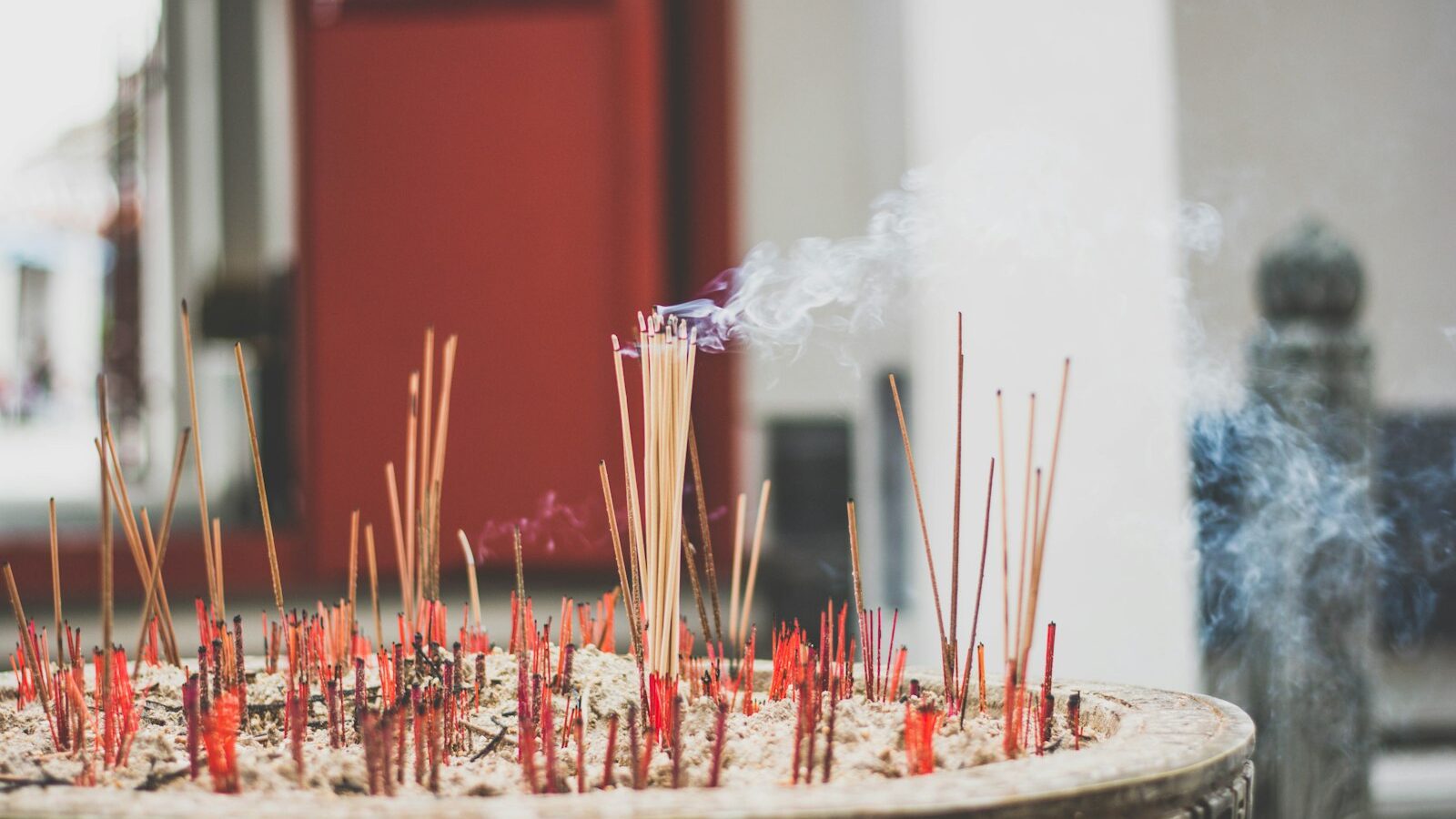
- Joss sticks. If you wish to offer incense, take joss sticks from the temple counter, light them from the provided flame, hold them with both hands, bow, and place them in the urn. Some temples ask for a small donation; follow the posted signs.
- Offerings. Common offerings include oranges, tea, kueh, biscuits and candles. Many people bring them home afterwards to share, since food blessed in the temple is considered auspicious.
- Divination blocks and fortune sticks. You may see devotees dropping a pair of crescent-shaped wooden blocks or shaking a cylinder of numbered sticks. These are personal practices; do not handle them unless you intend to use them, and ask a volunteer to explain the process if you are interested.
- Photography. Photographing the building is usually fine, but avoid taking close-up shots of people praying, and look for signs asking visitors not to photograph the altars.
Why the Earth God Still Matters Today
Even in a modern, highly urban Singapore, Tua Pek Kong remains part of everyday life. Shopkeepers light incense at the start of the business day, older residents gather at their estate temple, and festival performances turn void decks and temple courtyards into community spaces. For many families the Earth God represents something simple and practical: a wish for a safe home, steady work and good neighbours.
Explore more: Loyang Tua Pek Kong Temple · Datuk Kong and Malay-Chinese folk worship · Temple worship etiquette for newcomers
Further reading: Blessing a New Car or Home at a Temple in Singapore