

Discovering that your child has threadworms can feel a bit unsettling, but here is the reassuring headline. Threadworms singapore families deal with are extremely common, especially in young children, and they are treatable. They are not a sign of a dirty home or poor parenting, and almost every child will encounter them at some point. With a calm approach, the right advice from a doctor or pharmacist, and some simple hygiene, you can clear them and reduce the chance they come back. This is general information only, not medical advice.
What Threadworms Are and How Children Get Them
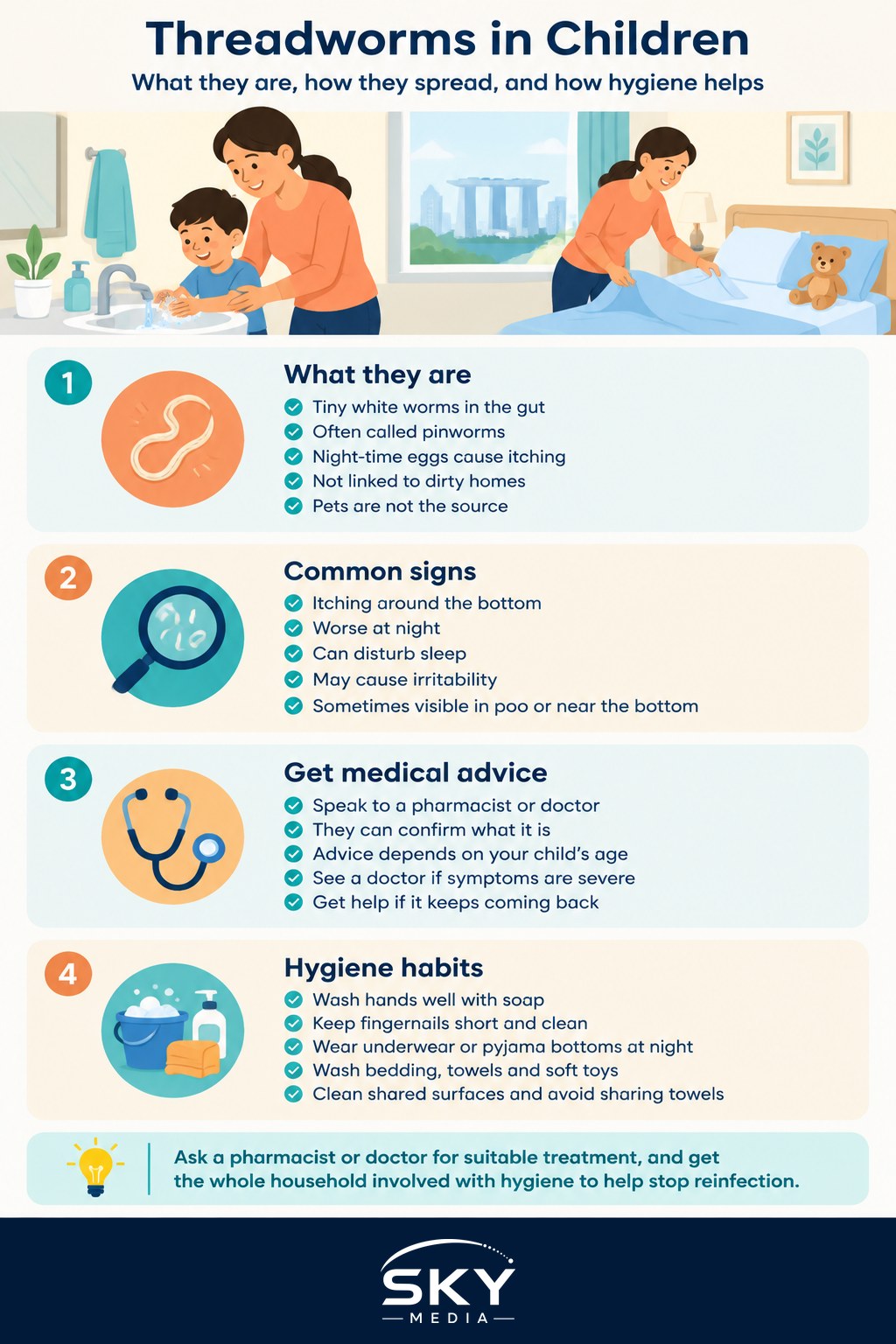
Threadworms, sometimes called pinworms, are tiny white worms, roughly the length of a staple, that live in the gut. At night, the female worms move to the area around the bottom to lay their eggs, which is what causes the classic itching. The eggs are microscopic and sticky, and this is the key to understanding how they spread.
When a child scratches an itchy bottom, eggs get onto their fingers and under their nails. From there, the eggs travel to anything the child touches, such as toys, bedding, towels, taps, and food, and can then be swallowed by the same child or by others, starting the cycle again. Eggs can survive on surfaces for a while, which is why threadworms spread so easily among children who play close together and among family members at home. Pets are not the source.
Because of how they spread, threadworms are especially common among preschool and primary-age children, who are still learning thorough handwashing and who play closely together. Sharing a home, bathrooms, and beds means other family members can catch them too, which is why treatment and hygiene usually involve the whole household.
Signs to Look For and When to Get Advice
The most common sign is itching around the bottom, particularly at night when the worms are active. This can disturb sleep and make a child restless or irritable in the evenings. In girls, itching around the genital area can also occur.
Sometimes parents actually see the worms. You might spot tiny white threads that look like small pieces of cotton in your child’s poo, or around the bottom, often at night or first thing in the morning. Seeing them can be startling, but it simply confirms what is going on and points you towards treatment.
Threadworms are usually more of a nuisance than a danger, and they rarely cause serious harm. Even so, the right step is to speak to a pharmacist or doctor, who can confirm what you are dealing with and advise on suitable treatment for your child’s age. A pharmacist can guide you on what is appropriate, and a doctor can help if you are unsure, if your child is very young, if symptoms are severe or unusual, or if the problem keeps returning despite treatment. We are deliberately not naming medicines or doses here, because the safe and correct choice depends on your child and should come from a professional. Follow their instructions carefully, including any advice about treating the whole household.
If your child has tummy pain, weight loss, or symptoms that seem out of proportion, or if you are worried for any reason, see a doctor rather than assuming it is only threadworms. For persistent, severe, or worrying symptoms, always consult a doctor.
Hygiene to Clear Them and Stop the Spread
Alongside any treatment your pharmacist or doctor recommends, good hygiene is what breaks the cycle and prevents reinfection. The aim is simple, which is to remove eggs and stop them being swallowed again. A concentrated hygiene effort for a couple of weeks makes a real difference.
- Encourage thorough handwashing with soap, especially after using the toilet, after scratching, and before eating.
- Keep your child’s fingernails short and clean, and gently discourage nail-biting and scratching.
- Have your child wear underwear or pyjama bottoms at night to reduce scratching and egg spread, and change them each morning.
- Wash bedding, towels, sleepwear, and soft toys, and vacuum bedrooms to lift stray eggs.
- Encourage a morning shower or wash of the bottom area to remove eggs laid overnight.
- Avoid sharing towels and flannels within the household during this time.
- Wipe down commonly touched surfaces such as taps, toilet seats, and door handles.
Because eggs are so easy to pass around, treating and cleaning as a whole household at the same time is often the most effective approach, so ask your doctor or pharmacist about this. Keep up the good handwashing habits afterwards, since these help prevent many common childhood infections, not just threadworms.
Building healthy routines at home pays off well beyond this one issue. For more on keeping little ones well and knowing when to seek help, you may find our guides on caring for a sick child at home and common baby illnesses and when to worry helpful, along with our overview of giving children medicine safely whenever any treatment is involved.
Threadworms are common, treatable, and nothing to feel embarrassed about. Speak to a pharmacist or doctor for the right treatment, follow the instructions, and pair it with a good hygiene push across the household. See a doctor for diagnosis and treatment or if symptoms persist or worry you, and call 995 or go to A&E only for a genuine emergency.
Official sources: HealthHub
Further reading: Dealing With Head Lice