

If you have recently moved to Singapore, Deepavali can be your first close look at Hindu festivals. You will see shrines in shopfronts in Little India, framed pictures of deities at your colleagues’ desks, and decorations featuring an elephant-headed god and a goddess seated on a lotus. This guide to the Deepavali gods Lakshmi, Ganesha and Rama, plus Krishna, whose story is especially important to Tamil Hindus here, explains who they are and why they matter on the Festival of Lights.
Hinduism is a diverse tradition with many regional practices, so families honour different deities in different ways. What follows is a friendly introduction for newcomers, not a complete theology. If you want to go deeper, temple priests and Hindu friends are usually happy to share their own family’s understanding.
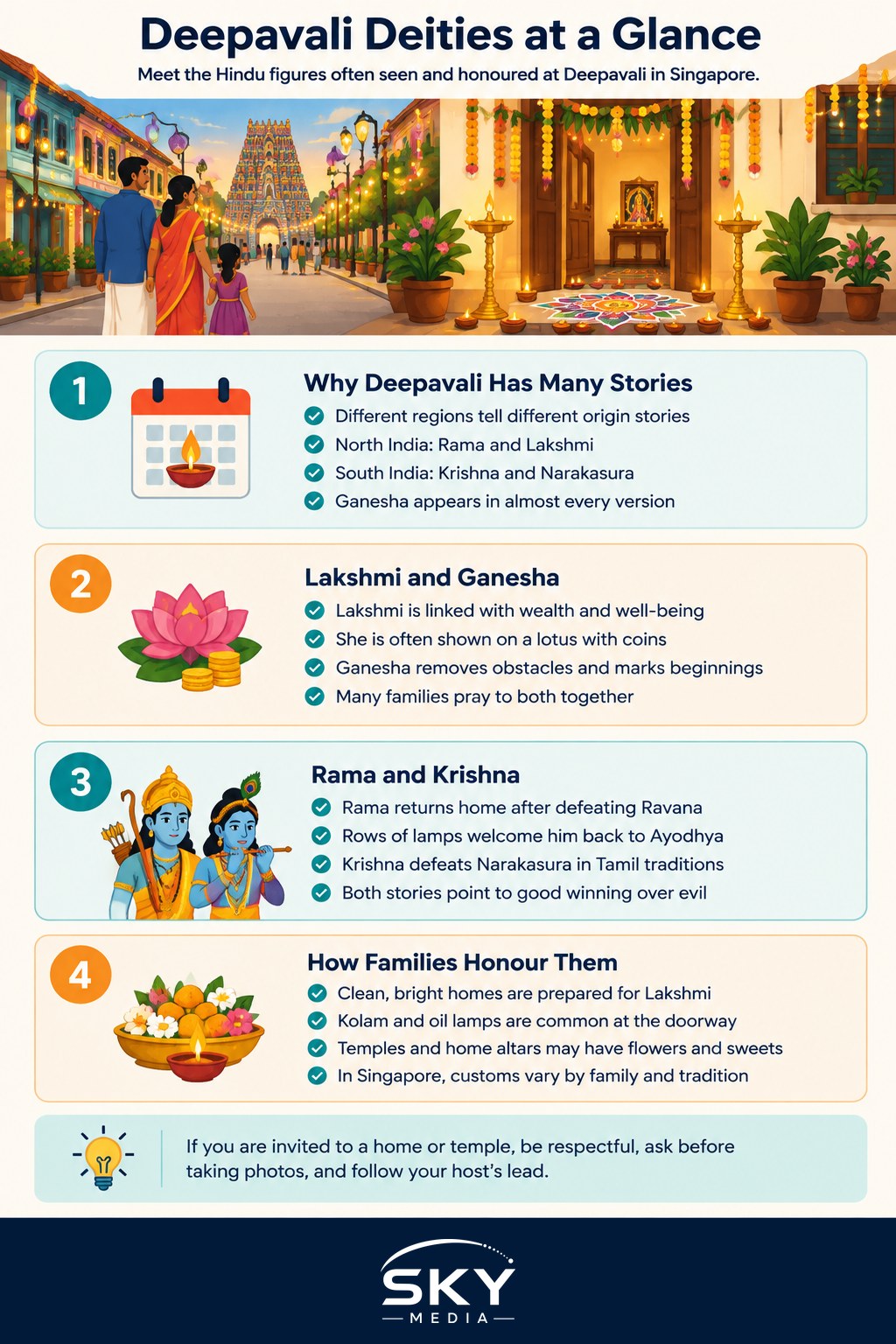
Why One Festival Has Several Stories
A common surprise for newcomers is that Deepavali does not have a single origin story. Different regions of India, and the communities descended from them, emphasise different events:
- In much of North India, Deepavali (often called Diwali there) celebrates Lord Rama’s return home after defeating the demon king Ravana, and the evening is devoted to prayers to Goddess Lakshmi.
- In much of South India, including Tamil Nadu, from where many Singapore Hindus trace their roots, the focus is Lord Krishna’s victory over the demon Narakasura.
- Ganesha appears in almost every version, because he is traditionally honoured at the start of any important undertaking or prayer.
What unites the stories is the central theme: light over darkness, good over evil, and knowledge over ignorance. In Singapore, Deepavali is a public holiday and is observed mainly according to the Tamil calendar, but you will meet families who follow North Indian, Sri Lankan and other customs too. For a broader view of the festival itself, read Deepavali in Singapore, Explained.
Lakshmi: Goddess of Prosperity and Good Fortune
Lakshmi is the goddess of wealth, prosperity, beauty and well-being. She is the consort of Lord Vishnu, one of the principal gods of Hinduism.
How to recognise her: She is usually shown seated or standing on a pink lotus flower, often with four arms, sometimes holding lotuses, with gold coins flowing from one hand. Elephants are frequently pictured beside her, showering water.
Why she matters at Deepavali: Many families believe Lakshmi visits homes that are clean, bright and welcoming on Deepavali night. This is one reason households clean thoroughly before the festival, draw a kolam (a decorative pattern of rice flour or coloured powder) at the doorstep, and light oil lamps. In North Indian traditions, the main evening prayer is a Lakshmi puja (worship ceremony), and business owners may pray for a prosperous year ahead.
It helps to know that “prosperity” here is understood broadly. It includes material comfort, but also health, harmony and spiritual well-being.
Ganesha: Remover of Obstacles
Ganesha (also called Ganapati or Vinayagar in Tamil) is perhaps the most recognisable Hindu deity for newcomers.
How to recognise him: He has an elephant’s head with one broken tusk, a round belly, and often four arms. He is commonly shown with a sweet in one hand (a dumpling called modak or kozhukattai) and a small mouse at his feet, which is his vehicle.
Why he matters at Deepavali: Ganesha is the remover of obstacles and the lord of beginnings. Hindus often pray to him first before any other deity or before starting something new, whether that is a business, a journey or a festival. On Deepavali, many families pray to Ganesha and Lakshmi together, asking for a year that is both free of obstacles and prosperous. You will often see the two side by side in pictures, statues and festive decorations.
In Singapore you will notice small Ganesha shrines at temple entrances, in homes and even in shops, reflecting how central he is to everyday devotion.
Rama and Krishna: The Heroes Behind the Lights
Lord Rama is the hero of the Ramayana, one of Hinduism’s great epics. He is regarded as an avatar (earthly form) of Vishnu and is seen as the ideal of a righteous ruler, son and husband. After 14 years of exile and a war to rescue his wife Sita from Ravana, Rama returned to his kingdom of Ayodhya. In the story, the people lit rows of lamps to welcome him home, and that image of a city glowing with light is one of the best-known explanations of Deepavali.
Lord Krishna is another avatar of Vishnu and the central figure in the story most Tamil Hindus associate with Deepavali. Krishna, often with his wife Satyabhama, defeated Narakasura, a tyrant who had terrorised people. In many versions, Narakasura asked as he died that the day be celebrated with light and joy. This story explains the pre-dawn oil bath many Tamil families take on Deepavali morning, when it is believed the waters of the sacred river Ganga are present in all water.
You do not need to know every detail. The key idea is that Deepavali celebrates the triumph of goodness, and different communities tell that story through different heroes.
The Deities at a Glance
| Deity | Main role | How to recognise them | Link to Deepavali |
|---|---|---|---|
| Lakshmi | Goddess of wealth, prosperity and well-being | Seated on a lotus, gold coins, often with elephants | Welcomed into clean, lamp-lit homes; Lakshmi puja in the evening |
| Ganesha | Remover of obstacles, lord of beginnings | Elephant head, round belly, sweet in hand, mouse at feet | Prayed to first, often alongside Lakshmi for a good year |
| Rama | Righteous king, hero of the Ramayana | Holds a bow, often shown with Sita, Lakshmana and Hanuman | His return to Ayodhya was celebrated with rows of lamps |
| Krishna | Avatar of Vishnu, protector | Blue skin, peacock feather, flute | His defeat of Narakasura is the story most Tamil Hindus mark |
How the Deities Are Honoured in Singapore
On Deepavali you may see some of these practices, though every household is different:
- Home altars decorated with fresh flowers, especially jasmine and marigold, plus oil lamps, fruit and sweets offered before images of the family’s deities.
- Temple visits on Deepavali morning, when temples are busy with families in new clothes. Different temples are dedicated to different deities; some centre on Vishnu and his avatars, others on Shiva, the goddess, or Murugan. Our guide to Hindu temples of Singapore introduces several.
- Sweets as offerings. Many festive sweets are first offered at the altar before being shared with family and guests.
- Decorations in Little India featuring deities, peacocks, lamps and lotus motifs during the street light-up.
Etiquette Tips for Newcomers
If a colleague or neighbour invites you to their home or to a temple, a few gentle pointers will help:
- Be respectful around altars. Do not touch statues, images or offerings unless invited. Avoid pointing your feet towards the altar if you are seated on the floor.
- Remove shoes before entering a temple, and often before entering a home.
- Dress modestly for temple visits, covering shoulders and knees.
- Ask before photographing people at prayer or inside a temple’s inner areas, and follow any signs.
- Accept food or prasadam (blessed food) with your right hand.
- Questions are welcome. It is generally fine to ask your host about the deities in their home. Most people appreciate genuine curiosity.
If your host takes you to a temple, read Praying at a Hindu Temple in Singapore beforehand so you know what to expect inside.
A Starting Point, Not the Final Word
Knowing who Lakshmi, Ganesha, Rama and Krishna are will help you appreciate what you see around you each Deepavali, from the lamps on HDB corridors to the decorations along Serangoon Road. Understanding will deepen year by year as you join celebrations and hear the stories told by the families who live them.
Explore more: Deepavali in Singapore, Explained · Hindu Temples of Singapore · Praying at a Hindu Temple in Singapore
Frequently Asked Questions
Why do some families pray to Lakshmi and others focus on Krishna at Deepavali? Different regions emphasise different stories. Much of North India honours Rama’s return and Lakshmi, while much of South India, including Tamil Nadu, focuses on Krishna’s victory over Narakasura. Singapore households often blend elements of both, so customs vary from family to family.
Why is Ganesha prayed to first before other deities? He is the remover of obstacles and lord of beginnings, so Hindus often pray to him before any other deity or before starting something new, whether a business, journey or festival. On Deepavali he is often honoured alongside Lakshmi.
Why do families clean the house thoroughly before Deepavali? Many believe Lakshmi visits homes that are clean, bright and welcoming on Deepavali night. Families also draw a kolam at the doorstep and light oil lamps. Prosperity here is understood broadly, including health, harmony and well-being.
How can I tell Krishna and Rama apart in pictures? Krishna is usually shown with blue skin, a peacock feather and a flute, while Rama holds a bow and is often shown with Sita, Lakshmana and Hanuman. Both are regarded as avatars of Vishnu.
Is it okay for a non-Hindu to attend a Deepavali prayer at a friend’s home? Usually yes, as respectful guests are welcome and questions are generally appreciated. Do not touch statues or offerings unless invited, remove your shoes and follow your host’s lead. Accept prasadam with your right hand.
Further reading: Deepavali Morning Rituals: Oil Bath, Prayers and Temple Visits Explained