

If you have been learning French for a while, a recognised certificate is a good way to prove your level to universities, employers or immigration offices. Sitting the DELF exam in Singapore is straightforward once you understand how the levels work, where to register and what each paper expects. This guide is for learners who already have some French and want to turn it into a qualification, not for absolute beginners choosing a first course.
What the DELF and DALF Actually Are
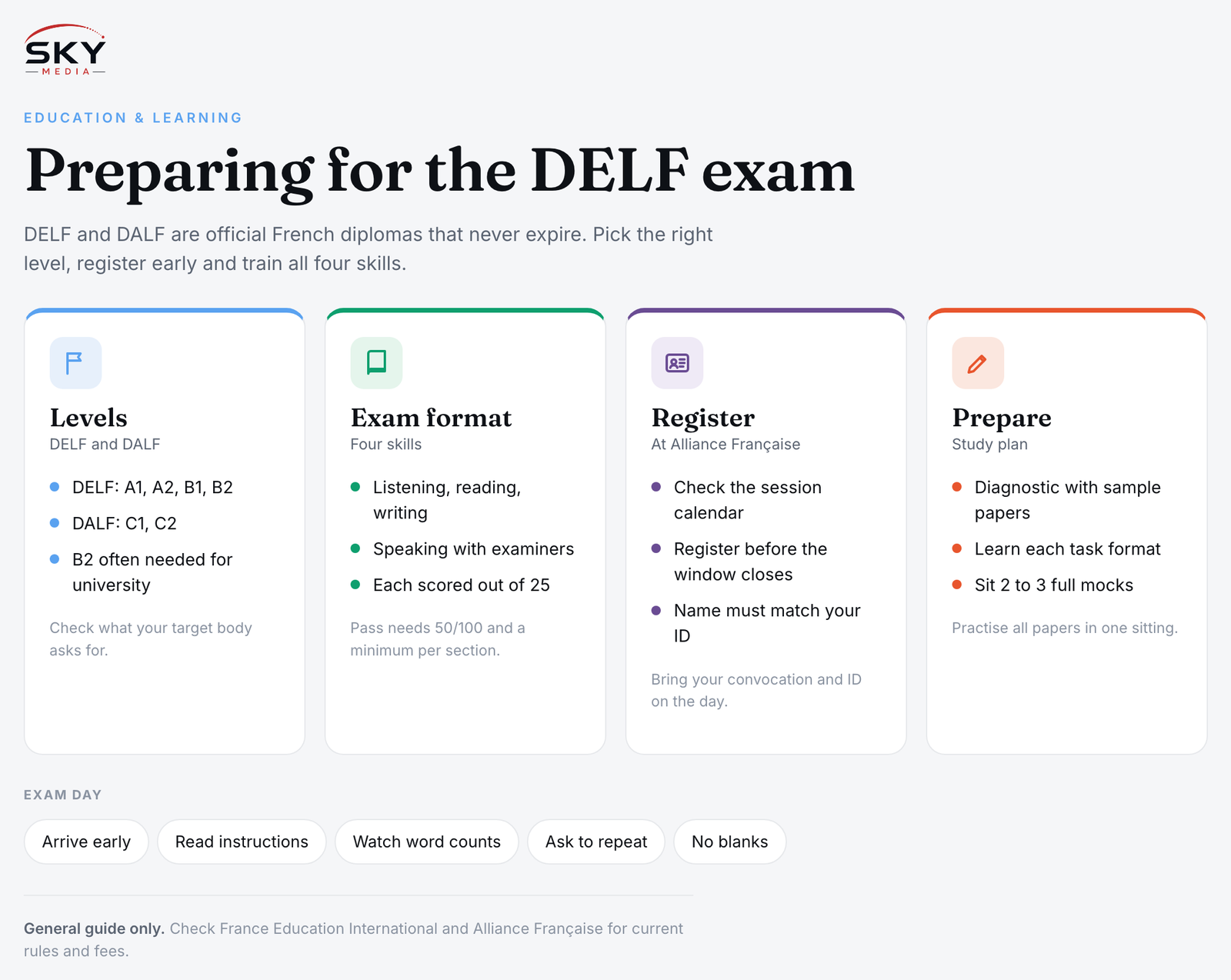
The DELF (Diplôme d’études en langue française) and DALF (Diplôme approfondi de langue française) are official French-language diplomas issued by the French Ministry of Education and administered internationally by France Education International. They are aligned to the Common European Framework of Reference for Languages (CEFR), the six-level scale used across Europe.
- DELF covers levels A1, A2, B1 and B2.
- DALF covers the advanced levels C1 and C2.
Each level is a separate exam and a separate diploma. You do not have to start at A1; you can register for whichever level matches your ability. The diplomas do not expire, which sets them apart from some other language tests whose scores are only valid for a limited period.
There are also versions for different age groups, such as DELF Prim for younger children and DELF Junior for teenagers. The levels and diploma are equivalent, but the topics are adapted to the age group. Adults usually sit the general “tout public” version.
Choosing the Right Level
Picking the right level is the most important decision. Too low and the diploma will not help you; too high and you risk failing.
| Level | Roughly what you can do | Common reasons people take it |
|---|---|---|
| A1 / A2 | Handle simple everyday exchanges, short texts and basic personal topics | Personal milestone, early motivation, some school or family requirements |
| B1 | Cope with most travel and work situations, give opinions, write a structured letter | Demonstrating working French, some visa or job applications |
| B2 | Argue a point, follow complex discussions and write a reasoned essay | Commonly required for admission to French-taught university programmes |
| C1 / C2 (DALF) | Use French fluently and precisely in academic and professional settings | Academic research, translation, high-level professional roles |
Requirements vary by institution and change over time, so always check what level the university, employer or authority you are applying to actually asks for. Some bodies ask for the TCF (Test de connaissance du français) instead, which is a single test that gives a level score rather than a pass or fail diploma. Make sure you are preparing for the right test.
How the DELF Exam Is Structured
Every DELF and DALF level tests four skills:
- Listening comprehension (compréhension de l’oral): you listen to recordings and answer questions.
- Reading comprehension (compréhension des écrits): you read texts and answer questions.
- Written production (production écrite): you write one or more texts, such as a letter, email, article or argumentative essay depending on the level.
- Spoken production and interaction (production orale): a face-to-face exam with examiners, often after a preparation period at higher levels.
Each skill is scored out of 25, giving a total out of 100. To pass, you generally need at least 50 out of 100 overall and a minimum score in each of the four sections. That minimum means you cannot simply ignore your weakest skill and make up for it elsewhere. Check the current scoring rules on the France Education International website or with the exam centre.
The listening, reading and writing papers are usually taken together in one sitting, while the speaking exam is often scheduled separately, sometimes on a different day.
Registering for the DELF in Singapore
In Singapore, the Alliance Française de Singapour is the main recognised centre for DELF and DALF exams. Registration generally works like this:
- Check the session calendar. Exam sessions are held a few times a year, but dates and levels offered vary. Look at the Alliance Française website for the current schedule.
- Note the registration window. Registration usually closes several weeks before the exam date, and popular sessions can fill up. Register early.
- Prepare identification. You will need valid ID, and the name you register with will appear on your diploma, so make sure it matches your passport or NRIC exactly.
- Pay the exam fee. Fees differ by level and are set by the centre. Check the current fee when you register and read the refund and transfer policy.
- Watch for your convocation. You will receive an official notice with your exam time and venue. Bring it and your ID on the day.
Results are typically released some weeks after the exam, and the physical diploma follows later as it is issued from France. Ask the centre how and when to collect it.
If you have taken other language exams, the process will feel familiar. Our guides to preparing for the JLPT Japanese exam and the TOPIK Korean exam follow a similar pattern if you are juggling more than one language.
A Preparation Plan That Works
Most learners need several months of focused preparation for a new level, even if they have been taking general French classes. A practical approach:
Step 1: Take a Diagnostic Test
Use official sample papers, which France Education International publishes for each level, to see where you stand. Time yourself and mark your answers honestly. This tells you whether to aim for B1 or B2, for example, and which skill needs most work.
Step 2: Learn the Exam Formats
Each level has specific task types. At B2, for example, the written paper usually asks for an argumentative text, and the speaking exam involves defending a viewpoint on a short document. Knowing the expected format, length and register saves you marks.
Step 3: Build Each Skill Deliberately
- Listening: French radio, podcasts and news broadcasts with transcripts. Start with slower content and work up to natural speed.
- Reading: Newspaper articles, opinion columns and magazine features. Summarise each article in a few sentences.
- Writing: Write regularly under timed conditions and get feedback from a teacher or tutor. Learn useful connectors for structuring arguments.
- Speaking: Practise speaking for a few minutes on a topic without notes. Record yourself, then listen for hesitations and repeated words.
Step 4: Consider a Prep Course
The Alliance Française and some private tutors run DELF-specific preparation classes. These focus on exam technique rather than general learning. When comparing options, ask about class size, how many mock exams are included, whether teachers are trained examiners, and what happens if you miss a class.
Step 5: Sit Full Mock Exams
In the final weeks, sit at least two or three full mocks under exam conditions. Practise managing time across all three written papers in one sitting, as fatigue is real.
Exam Day Tips
- Arrive early with your ID and convocation.
- Bring the stationery allowed and nothing that is not.
- Read every instruction carefully, especially word counts for writing tasks.
- In the speaking exam, it is fine to ask the examiner to repeat a question. Keep talking, self-correct calmly and give examples.
- Do not leave answers blank; partial answers can still earn marks.
Exam nerves are normal. Our guide to preparing for oral exams and presentations has more tips on staying composed when speaking under pressure.
After You Pass
A DELF or DALF diploma is a lasting proof of your level. Add it to your CV and LinkedIn with the exact level, keep the original diploma safe, and make certified copies if universities or employers request them. Many learners use the momentum to aim for the next level within a year or two, while their study habits are fresh.
Whether you need B2 for university or simply want the satisfaction of an official certificate, preparing for the DELF exam in Singapore rewards steady, structured practice across all four skills.
Further reading: Learning French in Singapore: A Beginner’s Guide · Preparing for Chinese Proficiency Exams (HSK) · Cambridge English Exams for Kids in Singapore: YLE, KET and PET