

Every company decision needs a paper trail. Opening a bank account, appointing a company secretary, approving the annual accounts or changing the registered address are all decisions the board makes, and the formal record of each one is a directors’ resolution. If you run a small private company, understanding how a directors resolution in Singapore is passed, signed and stored will save you trouble with banks, auditors and ACRA (the Accounting and Corporate Regulatory Authority, which registers companies).
This guide covers the two main ways directors make decisions, how to sign and keep the records, and common mistakes. It is general information, not legal advice. Your company’s constitution and the Companies Act set the actual rules, so check both, and speak to your company secretary or a lawyer for anything unusual.
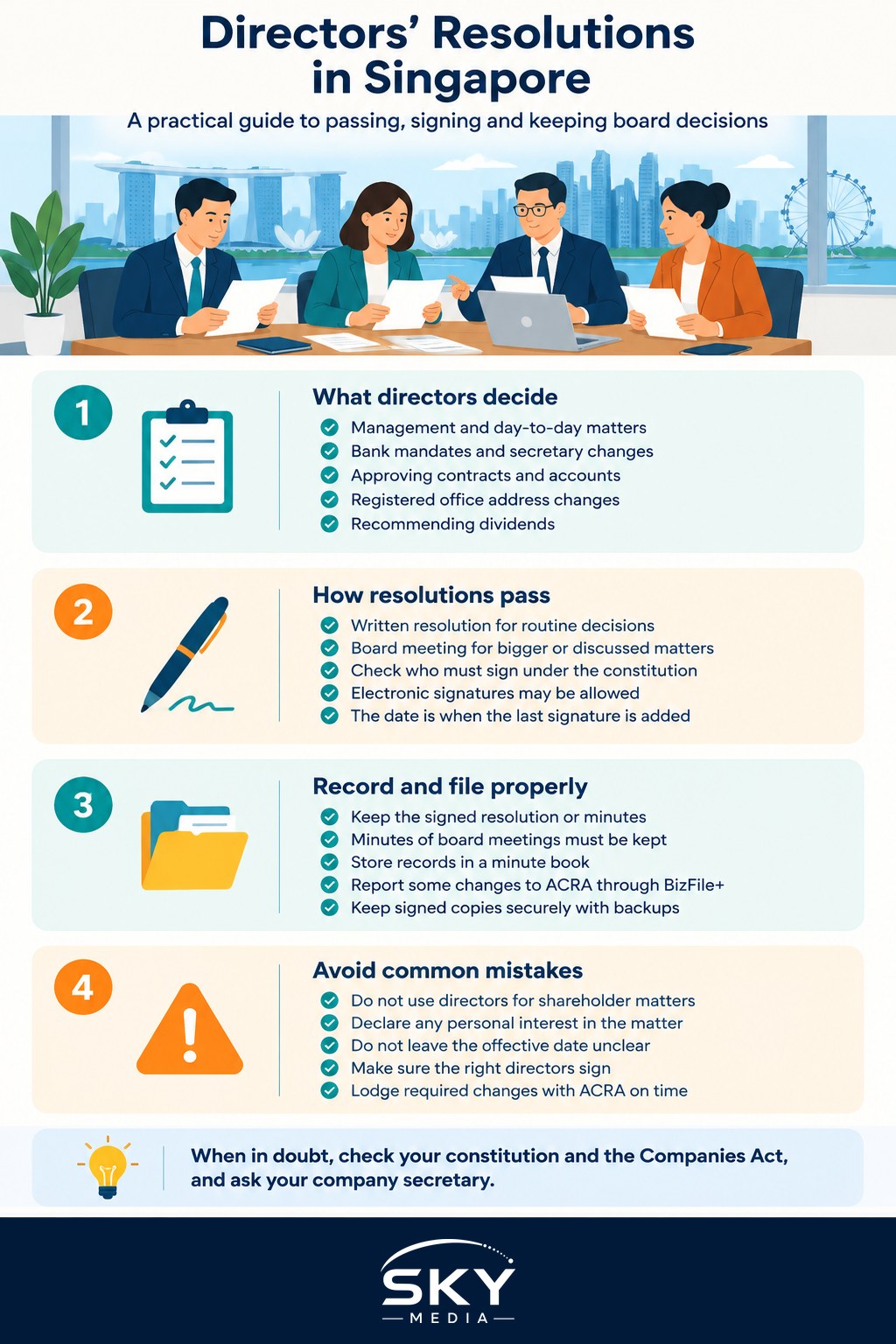
Directors’ Decisions vs Shareholders’ Decisions
A company has two decision-making bodies. Directors manage the business day to day. Shareholders own the company and decide the big structural questions. Mixing them up is the most common mistake founders make.
- Directors’ resolutions cover management matters: opening or changing bank mandates, appointing or removing the company secretary, approving contracts, approving the financial statements to be presented to shareholders, changing the registered office address, and recommending dividends.
- Shareholders’ resolutions cover matters the Companies Act or the constitution reserves for members, such as changing the company name, amending the constitution, and certain share issues. These are passed at a general meeting or by written resolution of members.
Some actions need both. For example, directors may resolve to allot new shares, but shareholder approval is generally also needed for directors to have that authority. When in doubt, check the constitution and ask your company secretary which body must approve.
Two Ways to Pass a Directors’ Resolution
Directors can decide in one of two ways, depending on what the constitution allows.
Resolution in writing
Most small companies use written resolutions, sometimes called directors’ resolutions in writing or circular resolutions. A document setting out the decision is circulated to the directors, and it takes effect once the required directors have signed. Points to know:
- Who must sign. The constitution sets the requirement. Some constitutions require all directors entitled to vote to sign, while others allow a specified majority. Check yours before you rely on fewer signatures.
- Counterparts. Directors can usually sign separate copies of the same document, which together form one resolution.
- Electronic signing. Many companies now sign resolutions electronically. Check that your constitution permits this and that the bank or other party receiving the resolution will accept it.
- Date. The resolution generally takes effect when the last required signature is added, so record the date clearly.
Board meeting
For bigger decisions, or where directors need to discuss, a board meeting is better. To be valid:
- Notice. Directors must receive notice of the meeting as required by the constitution.
- Quorum. A minimum number of directors must be present. The constitution sets the quorum, and the meeting cannot validly decide anything without it.
- Voting. Decisions are usually passed by a majority of votes, and the chairperson may have a casting vote if the constitution says so.
- Virtual attendance. Meetings by video call are common, but confirm that your constitution allows directors to participate this way.
- Minutes. The Companies Act requires minutes of directors’ meetings to be kept. The chairperson usually signs them as a true record.
Sole director companies
Many Singapore companies have only one director. In that case the director makes decisions by recording them in writing and signing. It still matters to document each decision properly, because banks and auditors will ask for the signed resolution.
Written Resolution vs Board Meeting at a Glance
| Feature | Resolution in writing | Board meeting |
|---|---|---|
| Best for | Routine, uncontroversial decisions | Complex decisions needing discussion |
| How it passes | Signed by the directors required under the constitution | Majority vote with a quorum present |
| Speed | Fast, can be signed remotely | Needs notice and a scheduled time |
| Record kept | The signed resolution itself | Minutes signed by the chairperson |
| Risk to watch | Missing a required signature | Meeting not properly convened or no quorum |
Conflicts of Interest and Directors’ Duties
Directors must act honestly and in the best interests of the company. If a director has a personal interest in a transaction, such as the company contracting with a business they own, the Companies Act requires them to declare the nature of that interest to the board. Your constitution may also limit whether they can vote on that matter or count towards the quorum.
Good practice:
- Record any declaration of interest in the minutes or the resolution.
- Make sure the interested director’s vote is handled as the constitution requires.
- Keep supporting documents, such as quotes or valuations, with the resolution.
If you act as a nominee director or rely on one, our guide to nominee director duties and risks explains why “just signing” is never a safe habit. Directors who approve decisions without proper thought can face personal exposure, as covered in our article on wrongful trading for company directors.
Step by Step: Preparing a Written Resolution
- Check authority. Confirm the decision is one for directors, not shareholders, and that the constitution allows written resolutions.
- Draft clearly. Include the company name and registration number (UEN), a title, the date, and each resolution written as “RESOLVED THAT…”. Be specific, for example naming the bank, account type and authorised signatories.
- Attach supporting documents. Financial statements, contracts or forms the resolution approves.
- Circulate and collect signatures. Track who has signed and when.
- File where required. Some decisions must be reported to ACRA through BizFile+ within a set period, such as a change of registered address or of company officers. Check ACRA’s website for which events need lodging and the current deadlines.
- Store the original. Keep it in the company’s minute book or secure digital records.
Record Keeping That Holds Up
Directors’ resolutions and minutes form part of the company’s statutory records. Keep them organised so they can be found quickly by an auditor, a bank, an investor doing due diligence, or IRAS if a tax question arises.
- Keep a minute book, physical or digital, with resolutions in date order.
- Number each resolution for easy reference.
- Store signed copies securely, with backups if digital.
- Check retention periods. The Companies Act and tax rules set how long records must be kept. Confirm current periods with ACRA and IRAS, and do not discard old records without checking.
- Let your company secretary help. Every Singapore company must appoint a qualified company secretary, and maintaining these records is usually part of their role.
Common Mistakes to Avoid
- Using a directors’ resolution for a decision that needs shareholder approval.
- Forgetting that a recently appointed director must also sign.
- Leaving the effective date blank or unclear.
- Approving a related-party deal without recording the declaration of interest.
- Making a change, such as a new address, without the required ACRA lodgement.
Handled properly, directors’ resolutions are quick to prepare and give your company a clean, defensible record. If you are adding or removing a board member soon, see appointing or removing a company director in Singapore for the steps involved.
Frequently Asked Questions
Can a company secretary sign a resolution on behalf of the directors? No. A directors’ resolution is the directors’ decision, so the directors themselves must sign. A company secretary usually drafts the paperwork, circulates it, files what needs filing and keeps the records. They can certify copies where required, but they cannot substitute for a director’s signature.
What happens if the directors cannot agree on a decision? Check the constitution first, since it may give the chairperson a casting vote or set how deadlocks are handled. If the disagreement continues, shareholders may have to step in, depending on the issue. A lawyer can advise on options such as mediation or restructuring the board.
Does my bank need a certified true copy of the resolution? Often it does, and many banks also supply their own resolution templates for opening or changing accounts. A director or the company secretary usually certifies the copy. Ask the bank what form it requires before you prepare documents, to avoid redoing them.
Can a director who is away sign through a proxy or someone else? Generally no. Directors owe personal duties and cannot normally hand their vote to someone else, although an alternate director may be possible if the constitution allows it. A written resolution can often be signed remotely or electronically, so check the constitution.
Can I backdate a directors’ resolution? You should not. A resolution takes effect from when it is properly passed, and backdating can mislead banks, auditors and regulators. If a decision was made without paperwork, directors can pass a new resolution ratifying it with the true date. Ask your company secretary or lawyer.
Official sources: ACRA
Further reading: Director’s Fees in Singapore: Approval, Tax and CPF