

Your company has had a good year and the shareholders, possibly just you, want to take some profit out. Paying a dividend is a common way to do that, but it is a formal corporate act, not just a bank transfer. If you want to declare dividends in a private company in Singapore, you need to follow the Companies Act, your company’s constitution and proper paperwork.
This guide walks through the declaration process step by step. If you are still deciding whether to pay yourself through salary or dividends, read paying yourself: salary vs dividends first. This is general information, not legal or tax advice. Your company secretary, accountant or lawyer can confirm what applies to your company.
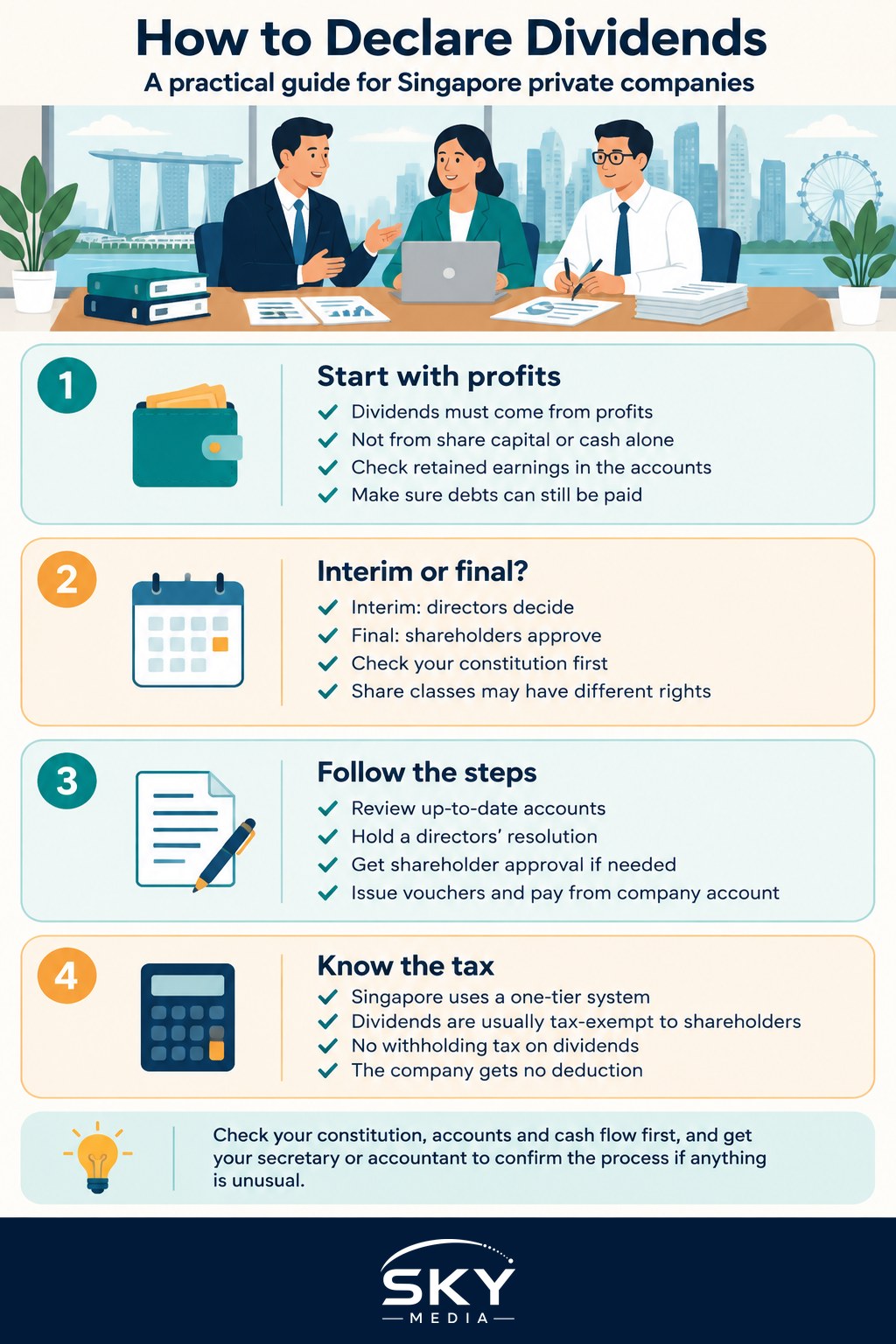
The Ground Rules: Profits and Solvency
Dividends must come out of profits. Under the Companies Act, a company can only pay dividends out of its profits. It cannot pay them out of share capital. In practice, that means looking at accumulated profits (retained earnings) shown in the company’s accounts, not just this month’s bank balance. A company can have plenty of cash and still not have distributable profits, for example if it has carried-forward losses.
Directors should check the company can afford it. Even where profits exist, directors owe duties to act in the company’s interests, and must consider creditors where the company is in financial difficulty. Before recommending or approving a dividend, directors should be satisfied that the company can still pay its debts as they fall due afterwards, including upcoming tax, rent, salaries and supplier bills.
The consequences of getting this wrong can be serious. Directors who knowingly allow a dividend to be paid other than out of profits may face personal liability. If you are not sure whether the company has distributable profits, get the latest management accounts reviewed by your accountant before going further.
Interim vs Final Dividends
Most Singapore private companies follow a constitution based on the model constitution, which usually distinguishes between two kinds of dividend. Always check your own constitution, as it may differ.
| Feature | Interim dividend | Final dividend |
|---|---|---|
| Who decides | Directors, by directors’ resolution | Shareholders, by ordinary resolution, usually on the directors’ recommendation |
| When it is paid | During the financial year, before final accounts | After the financial year, once the accounts are prepared |
| Based on | Interim or management accounts | The year’s financial statements |
| Can it be changed before payment | Directors can generally revisit it before payment | Once declared, it usually becomes a debt owed to shareholders |
| Typical use | Paying out profits mid-year | Distributing the year’s profits after closing the books |
Under the typical model wording, shareholders cannot declare a final dividend larger than the amount the directors recommend. This keeps the people who manage the company’s finances in control of how much is paid out.
Step by Step: How to Declare Dividends
1. Review the accounts. Prepare up-to-date management accounts (for an interim dividend) or the year’s financial statements (for a final dividend). Confirm the amount of accumulated profits available.
2. Check the constitution and share classes. Look at your constitution’s dividend clauses and any rights attached to different share classes, such as preference shares. Dividends are normally paid in proportion to shareholdings within each class, unless the constitution provides otherwise. Recent changes to the share structure, such as a share transfer or a new share issue, affect who is entitled.
3. Hold a directors’ meeting or pass a written resolution. For an interim dividend, the directors resolve to pay it, stating the amount per share, the record date (who holds shares on that date) and the payment date. For a final dividend, the directors resolve to recommend it to shareholders. Private companies commonly use written resolutions signed by all directors instead of holding a physical meeting, if the constitution allows it.
4. Get shareholder approval for a final dividend. A final dividend is usually declared by ordinary resolution of shareholders, either at an AGM or by written resolution. Many private companies can dispense with holding AGMs; see AGM rules and exemptions for private companies for when that applies.
5. Record everything. Keep signed resolutions or minutes in the company’s minute book. Your company secretary can check whether any related filing or update is needed.
6. Issue dividend vouchers. A dividend voucher (or dividend statement) for each shareholder records the company name, date, shareholder’s name, number of shares, dividend per share and total paid. It is good practice and helps shareholders keep their own records.
7. Pay the dividend. Transfer the money from the company account to each shareholder on the payment date. Pay from the company’s bank account, not personal accounts, and keep a clear audit trail.
8. Reflect it in the accounts. The accountant records the dividend in the company’s books and it is disclosed in the financial statements for the year.
How Dividends Are Taxed: The One-Tier System
Singapore uses a one-tier corporate tax system. The company pays corporate income tax on its chargeable income, and dividends paid out of those taxed profits are tax-exempt in the hands of shareholders. In practice, that means:
- Shareholders do not usually need to declare one-tier dividends from Singapore companies as taxable income.
- Singapore does not impose withholding tax on dividends, including dividends paid to non-resident shareholders.
- The company does not get a tax deduction for dividends paid, because dividends are a distribution of after-tax profit, not a business expense.
Foreign shareholders may still be taxed on dividends in their home country, depending on local rules and any tax treaty. Check the latest position with IRAS and a tax adviser, especially if you have overseas shareholders.
Common Mistakes to Avoid
- Treating withdrawals as dividends without paperwork. Taking money out and calling it a dividend later invites problems. Without resolutions, payments may instead look like loans to directors or unexplained withdrawals.
- Paying from cash instead of profits. Cash in the bank is not the test. Distributable profits are.
- Ignoring upcoming liabilities. Paying out everything just before a large tax bill or lease renewal can leave the company short.
- Paying unequally without proper authority. Paying one shareholder more per share than another in the same class, without a basis in the constitution, can cause disputes.
- Forgetting share class rights. Preference shareholders may be entitled to be paid first.
Getting Help
For a small owner-managed company, declaring a dividend is usually straightforward once the accounts are in order. Your corporate secretarial provider can prepare the resolutions and vouchers, and your accountant can confirm the profit position. For anything unusual, such as dividends in specie (paid in assets rather than cash), multiple share classes or a company with losses in its group, get professional advice. ACRA and IRAS websites are the official starting points for the current rules.
Frequently Asked Questions
Can a one-person company declare dividends to its sole shareholder? Yes, as long as the company has distributable profits, but the formalities still apply. The sole director records a resolution, and where a final dividend is involved the shareholder approves it. Keep the paperwork and a dividend voucher even if both roles are held by the same person.
Can a Singapore company pay dividends if it has accumulated losses? Generally no, because dividends can only come from profits, not share capital. Cash in the bank does not change that. If the company has carried-forward losses, ask your accountant to confirm whether any distributable profits exist.
How often can a private company pay dividends? There is no fixed rule in the article’s framework, and your constitution is the first place to check. Directors can pay interim dividends during the year when accounts support it, and shareholders can approve a final dividend after year-end.
What is the difference between a dividend and a director’s loan? A dividend is a formal distribution of profit approved by resolution, while a loan is money the company expects to be repaid. Withdrawing cash without paperwork can look like an unexplained withdrawal or a director’s loan, so document the nature of every payment.
Are dividends from my Singapore company taxed for overseas shareholders? Singapore does not impose withholding tax on dividends, including those paid to non-resident shareholders. The shareholder’s home country may still tax them depending on local rules and any tax treaty. Check with IRAS and a tax adviser.
Official sources: ACRA
Further reading: How a Singapore Private Company Can Buy Back Its Own Shares · Amalgamating Two Singapore Companies: How It Works