

When the haze rolls in and every shop seems to run out of purifiers at once, a home-built filter fan can be a useful stopgap. This DIY air purifier haze guide walks you through the simple box fan and filter design that many households and schools around the world have used, how to adapt it to the fans and filters you can actually find in Singapore, and, just as importantly, where it falls short of a proper purifier.
If you have the budget and the shop has stock, a tested HEPA purifier sized for your room is the more reliable choice; our guide to air purifiers for haze and allergies covers how to choose one. This article is for the budget, the backup bedroom, or the week when everything is sold out.
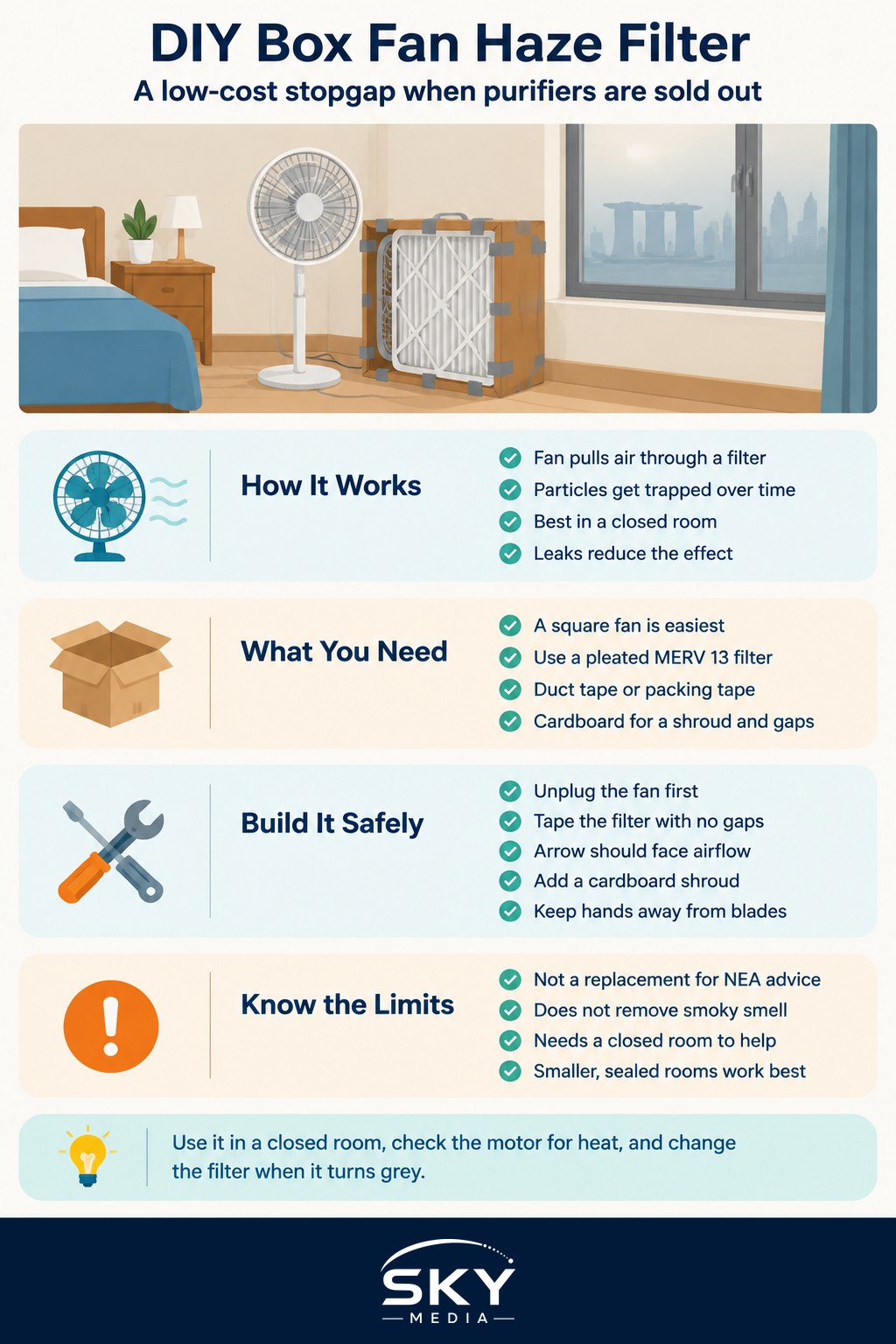
How a Filter Fan Actually Cleans the Air
Haze is mostly fine particles, the PM2.5 that the National Environment Agency (NEA) reports alongside the Pollutant Standards Index (PSI). They slip past window screens and door gaps, but a good pleated filter can trap a large share of them.
A DIY purifier works on a simple idea: a fan moves a lot of air, and a filter taped to the fan catches particles on the way through. Run it in a closed room and, over time, the same air passes through the filter again and again, so particle levels inside the room drop.
Two things decide how well it works.
- Filter quality. Pleated filters rated MERV 13 (a common American rating for furnace and air conditioning filters) or similar are often recommended for fine particles. Thin fibre mesh or a kitchen hood filter will catch dust but not much PM2.5.
- Air sealing. Air takes the easiest path. If there are gaps between the filter and the fan, a lot of unfiltered air leaks around the edges and the unit does far less than it looks like it should.
What You Need and Where to Find It in Singapore
The classic version uses a square box fan, which is common in the United States but less so here. You can still build a working unit with what is available locally.
- A fan. A square box fan is ideal because filters sit flat against it. Without one, a sturdy desk fan or a square ventilation fan can work if you build a cardboard frame to hold the filter. Pedestal fans with round grilles are harder to seal.
- One or more pleated filters. Look for filters labelled MERV 13, or a stated rating for fine particles, in a size that matches your fan face. In Singapore these are usually sold online or through air conditioning and hardware suppliers, and availability and prices change, especially during haze season. Buy before the haze arrives if you can.
- Strong tape. Duct tape or packing tape for sealing edges.
- Cardboard. A clean, flat box for a shroud and for blocking gaps.
Check the airflow arrow printed on each filter. It must point in the direction the air travels.
Building It, Step by Step
There are two common builds. The single filter version is quickest. The cube version, often called a Corsi-Rosenthal box after the people who popularised it, uses four or five filters and moves more clean air.
Single filter build
- Unplug the fan. Never build or adjust it while it is connected.
- Decide which side air enters. Most builders put the filter on the intake side (the back), so the fan pulls air through it. This keeps the filter pressed against the fan and reduces leaks.
- Line the filter up with the airflow arrow pointing towards the fan.
- Tape all four edges so there are no gaps. Run your hand around the seam with the fan on later to feel for leaks.
- Cut a square of cardboard with a circular hole the size of the fan blades and tape it to the front. This shroud reduces air being pushed back out of the corners, which can noticeably improve performance.
Cube build
- Stand four filters on edge to form the four walls of a box, arrows pointing inwards.
- Tape every seam tightly.
- Use a fifth filter or a flat piece of cardboard as the base.
- Place the fan on top, blowing upwards and out, so it pulls air in through all four walls.
- Tape the fan to the filters and add a cardboard shroud around the fan blades.
More filter area means air moves through each filter more slowly and more of it gets cleaned, which is why the cube tends to outperform the single filter version.
DIY Unit Versus a Store-Bought HEPA Purifier
A homemade unit can be surprisingly effective, but it is a different kind of tool.
| Factor | DIY box fan purifier | Store-bought HEPA purifier |
|---|---|---|
| Upfront cost | Lower, mainly a fan and filters | Higher, varies widely by model |
| Tested performance | Not certified, real output depends on your build | Usually lists a tested clean air delivery rate (CADR) and room size |
| Noise | Often loud on the speeds that work well | Quieter sleep and low modes common |
| Safety features | None beyond the fan’s own | Designed and tested as one appliance |
| Looks and footprint | Bulky, taped cardboard and filters | Compact, designed for living spaces |
| Odours and gases | Particle filters do little for smell | Some models add carbon filters for odours |
The honest summary: a well-sealed DIY unit can cut fine particles in a small closed room, but you cannot know exactly how much without a monitor, and it does nothing for the smoky smell unless you add activated carbon. If you are weighing cheaper store-bought options too, see how to buy a used air purifier in Singapore.
Using It Safely and Getting the Most From It
A fan with filters taped to it is still an electrical appliance working harder than it was designed to. Treat it with care.
- Watch the motor. Filters add resistance. Touch the motor housing after an hour of use; if it feels very hot, smells of burning, or the fan slows noticeably, switch off and unplug it. Fans with thermal cut-off protection are a safer base.
- Do not leave it running unattended for long periods until you are confident it runs cool, and keep it away from curtains, beds and anything that could block the intake.
- Use a proper socket. Avoid daisy-chained extension cords.
- Keep children and pets away from the blades and the tape, and never let the cardboard touch the moving parts.
- Close the room. Shut windows and doors. A filter fan in an open living room with the windows open will barely make a difference.
- Create one clean air room. Rather than trying to clean the whole flat, focus on the bedroom where the most vulnerable family members sleep.
- Change filters when they turn grey. Haze loads filters quickly. A clogged filter moves less air and makes the motor work harder. Bag used filters before throwing them out to avoid shaking dust back into the room.
A low-cost particle monitor shows whether your build is working: compare readings before and after an hour with the room closed.
Knowing the Limits
A DIY unit is a sensible budget measure, not a medical device. Keep these points in mind:
- It does not replace following NEA health advisories. Check the current PSI and advice through NEA and the official haze updates before planning outdoor activities.
- People with asthma, heart or lung conditions, pregnant women, young children and older adults may need more protection. Follow your doctor’s advice rather than relying on a homemade filter.
- Particle filters do not remove gases. If the smell of smoke is strong, you will still smell it.
- Ionisers, ozone generators and “fragrance” add-ons are not a fix for haze and can irritate the lungs. Keep the design simple.
For a wider look at why the haze happens and when it tends to hit, read Haze Season in Singapore, Explained.
Explore more: The Haze and What You Can Do
Further reading: Should You Run the Aircon During the Haze?