
When you renovate an HDB flat or condo, one of the earliest decisions your designer or contractor will ask about is ceiling lighting. The debate usually comes down to downlights vs track lights, with pendants as the statement option. Each fixture type affects not only how a room looks but also how much ceiling work you need, what it costs and how easy it is to change later.
This guide compares the three types side by side, so you can decide room by room instead of defaulting to whatever the last showflat had. For the bigger picture of layering light across your home, see our guide to home decor and lighting.
Downlights: Clean, Even and Built In
Downlights are small fixtures recessed into the ceiling so that only a flat or slightly sunken trim shows. They give a clean, minimal look and spread light evenly across a room.
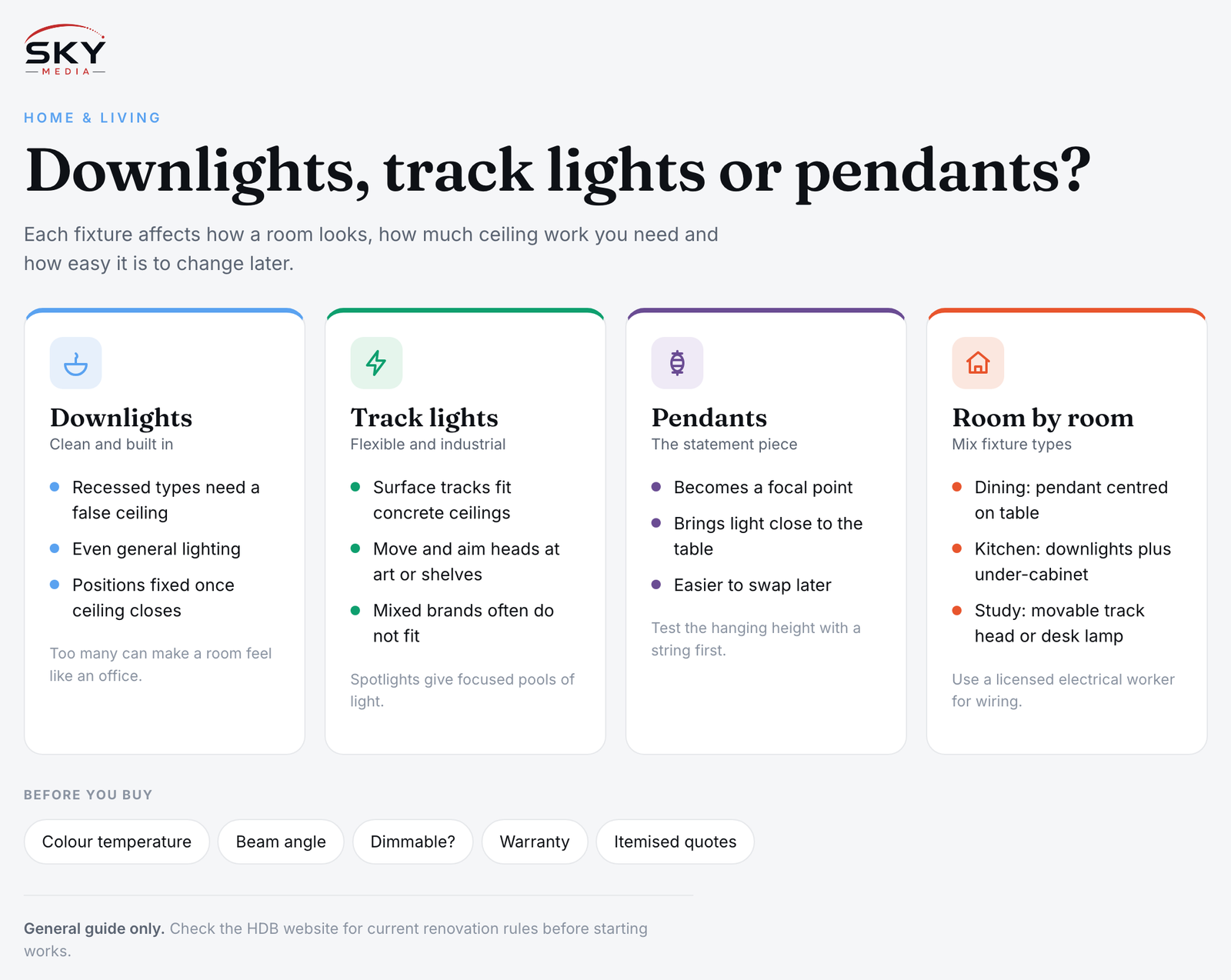
What they need. Recessed downlights need space above the ceiling surface, which in most Singapore homes means a false ceiling, often a plasterboard drop ceiling. HDB and many condo ceilings are concrete slabs, so you generally cannot cut holes straight into the slab. Surface-mounted downlights exist that sit on the ceiling instead, but they look chunkier. If you are weighing up a false ceiling anyway, our false ceiling ideas and guide covers the options.
Pros
– Very tidy look that suits modern and minimalist interiors.
– Good, even general lighting when spaced well.
– Integrates neatly with cove lighting and a false ceiling.
Cons
– The false ceiling adds cost and lowers ceiling height slightly.
– Positions are fixed once the ceiling is closed up.
– Too many downlights can make a room feel like an office, and poor spacing creates a “Swiss cheese” ceiling.
Tips. Ask about colour temperature (warm white for living and bedrooms, neutral white for kitchens and study areas), beam angle and whether the fixture is dimmable. Integrated LED downlights cannot have their bulb swapped, while those with replaceable lamps can, so ask which you are getting.
Track Lights: Flexible and Industrial
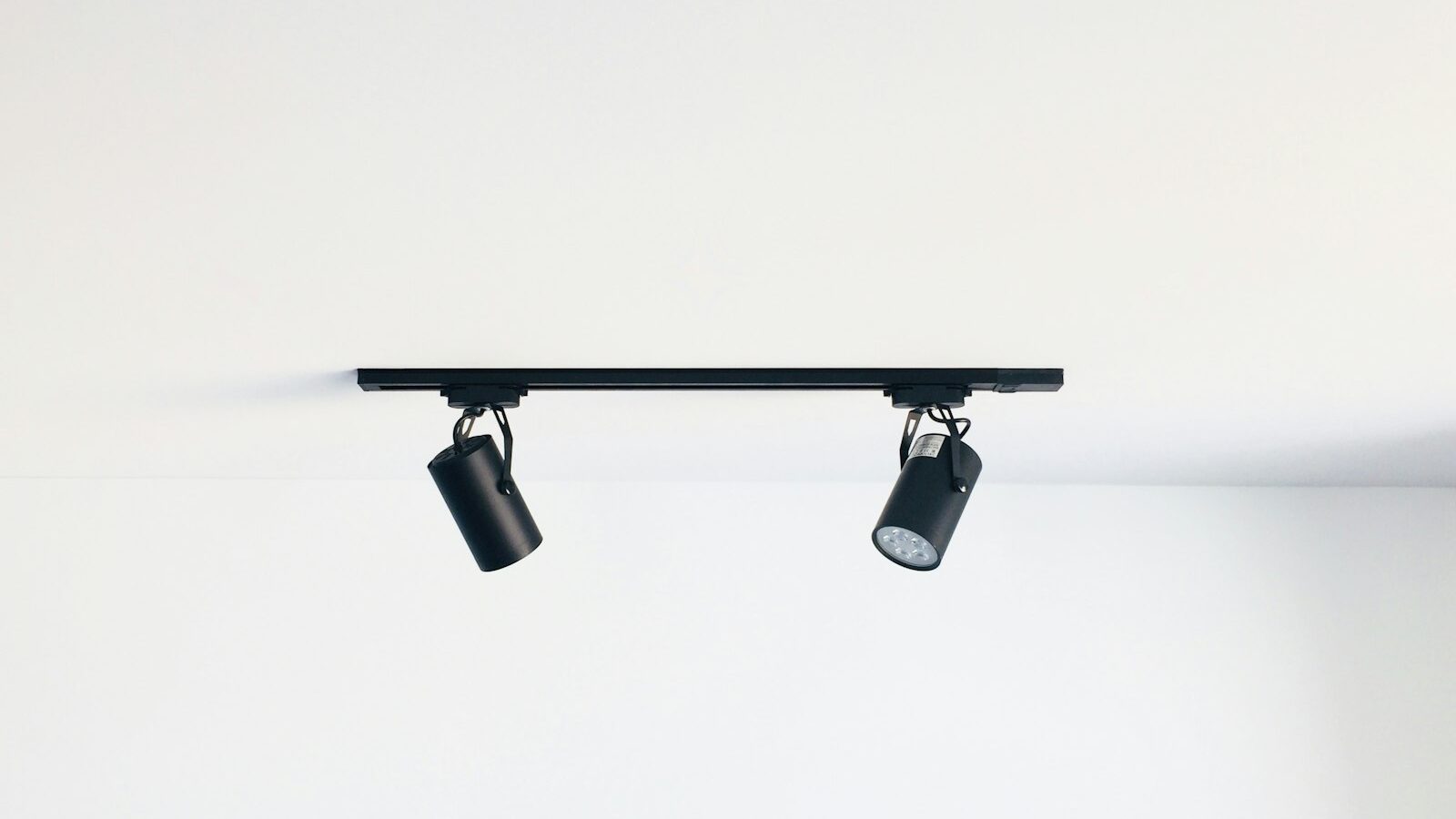
Track lighting uses a metal rail mounted on the ceiling, with spotlight heads that clip on and can be moved and angled. Some newer systems are magnetic tracks, slim profiles with interchangeable modules such as spotlights and linear bars.
What they need. Standard tracks can be surface mounted directly onto a concrete ceiling, so you may avoid a false ceiling altogether. Recessed and magnetic track systems often need a false ceiling or a channel to sit flush.
Pros
– Flexible: move and aim heads to light artwork, shelves or a dining table.
– Works without a false ceiling, keeping ceiling height and saving on carpentry.
– Suits industrial, Scandinavian and modern styles.
Cons
– Spotlights give focused pools of light, so you may need more heads, or a mix of fixtures, for even general lighting.
– Visible rails do not suit every look.
– Dust collects on heads and rails, so plan to wipe them regularly.
Tips. Measure how much track you need before buying, and check that heads and track are from compatible systems. Mixed brands often do not fit.
Pendants: The Statement Piece
Pendants hang down from the ceiling on a cord, chain or rod. They range from a single large shade over a dining table to a row of small pendants over a kitchen island.
What they need. A ceiling point and a fixing strong enough for the weight. Pendants can go on a concrete ceiling or a false ceiling, but heavy fixtures on plasterboard need proper support. Ask your contractor.
Pros
– Adds personality and becomes a focal point.
– Brings light closer to where you need it, such as the dining table.
– Easier to swap later than a recessed system.
Cons
– Rarely enough as the only light source in a living room.
– Low-hanging pendants can be a head hazard in walkways.
– Fabric and open shades gather dust and, near the kitchen, grease.
Tips. Over a dining table, many people hang the pendant so it clears standing heads but sits comfortably above seated eye level. Test the height with a string before the electrician fixes it.
Side-by-Side Comparison
| Factor | Downlights | Track lights | Pendants |
|---|---|---|---|
| False ceiling needed | Usually, for recessed types | No, for surface tracks | No, but heavy fixtures need solid fixing |
| Relative upfront cost | Moderate to high, mainly due to ceiling works | Moderate, depends on number of heads | Wide range, from budget to designer pieces |
| Look | Clean, minimal, invisible | Industrial, flexible, visible | Decorative, focal point |
| Best use | General lighting in living rooms, corridors, bedrooms | Accent lighting, rentals, rooms without false ceiling | Dining tables, kitchen islands, feature corners |
| Ease of changing later | Hard once ceiling is closed | Easy to move heads | Fairly easy to swap the fixture |
Costs vary widely between brands, contractors and specifications. Get itemised quotes for the fixtures, wiring and any ceiling works, and compare like for like.
Matching Fixtures to Rooms in a Typical Flat
Most homes look best with a mix rather than a single fixture type everywhere.
- Living room. Downlights or a surface track for general light, plus a floor lamp or cove lighting for warmth.
- Dining area. A pendant or a cluster of pendants over the table, centred on the table rather than the room.
- Kitchen. Bright, even downlights or a linear track, plus under-cabinet lighting so you are not working in your own shadow.
- Bedrooms. Fewer, warmer downlights or a simple ceiling fixture, with bedside lamps. If you have a ceiling fan, plan the light positions around it; see ceiling fans and home cooling.
- Corridors. Well-spaced downlights or a slim track.
- Study or work corner. A movable track head or a desk lamp aimed at your workspace.
Electrical Work and Practical Checks
- Use a licensed electrical worker for new points, wiring and switch changes. For HDB flats, renovation works must follow HDB guidelines, and your contractor should know what needs approval. Check the HDB website for current renovation rules.
- Plan switching early: separate switches or dimmers for each lighting layer give you more control.
- Ask for the fixtures’ warranty terms and whether replacement parts will be available.
- Think about maintenance. Can you reach the fixture with a normal ladder to clean it or change a part?
Choosing between downlights, track lights and pendants is less about picking a winner and more about matching each to the job in each room. Decide what each space needs, check what your ceiling can support, and you will end up with lighting that looks good and works for daily life.
Frequently Asked Questions
How many downlights does a room need? There is no single number, because it depends on room size, ceiling height, brightness of the fittings and what the room is used for. Spacing them evenly and mixing them with other light sources usually works better than adding more. Ask your designer or electrician to plan a layout and check it against your needs.
What lighting works best in a rental flat where I cannot cut the ceiling? Surface-mounted options suit rentals best, such as plug-in pendants, floor and table lamps, or surface tracks if the landlord approves. Avoid anything that needs drilling or rewiring without permission. Check your tenancy agreement before changing fixtures.
Do I need HDB approval to change my ceiling lights? Simply swapping a fitting is different from adding new points, wiring or a false ceiling. Renovation works must follow HDB’s guidelines, and a licensed electrician should handle new wiring. Check HDB’s website for what needs approval and ask your contractor.
How can I avoid glare from downlights in a bedroom? Choose warm white with a wider beam, fit fewer fixtures and consider dimmers or recessed trims that hide the bulb. Avoid placing a downlight directly over the bed where it shines in your eyes when lying down. Layer with bedside lamps for softer lighting at night.
Further reading: Warm White vs Cool White vs Daylight: Choosing Light Colour for Your Home · How to Choose LED Strip Lights for Cabinets and Coves