
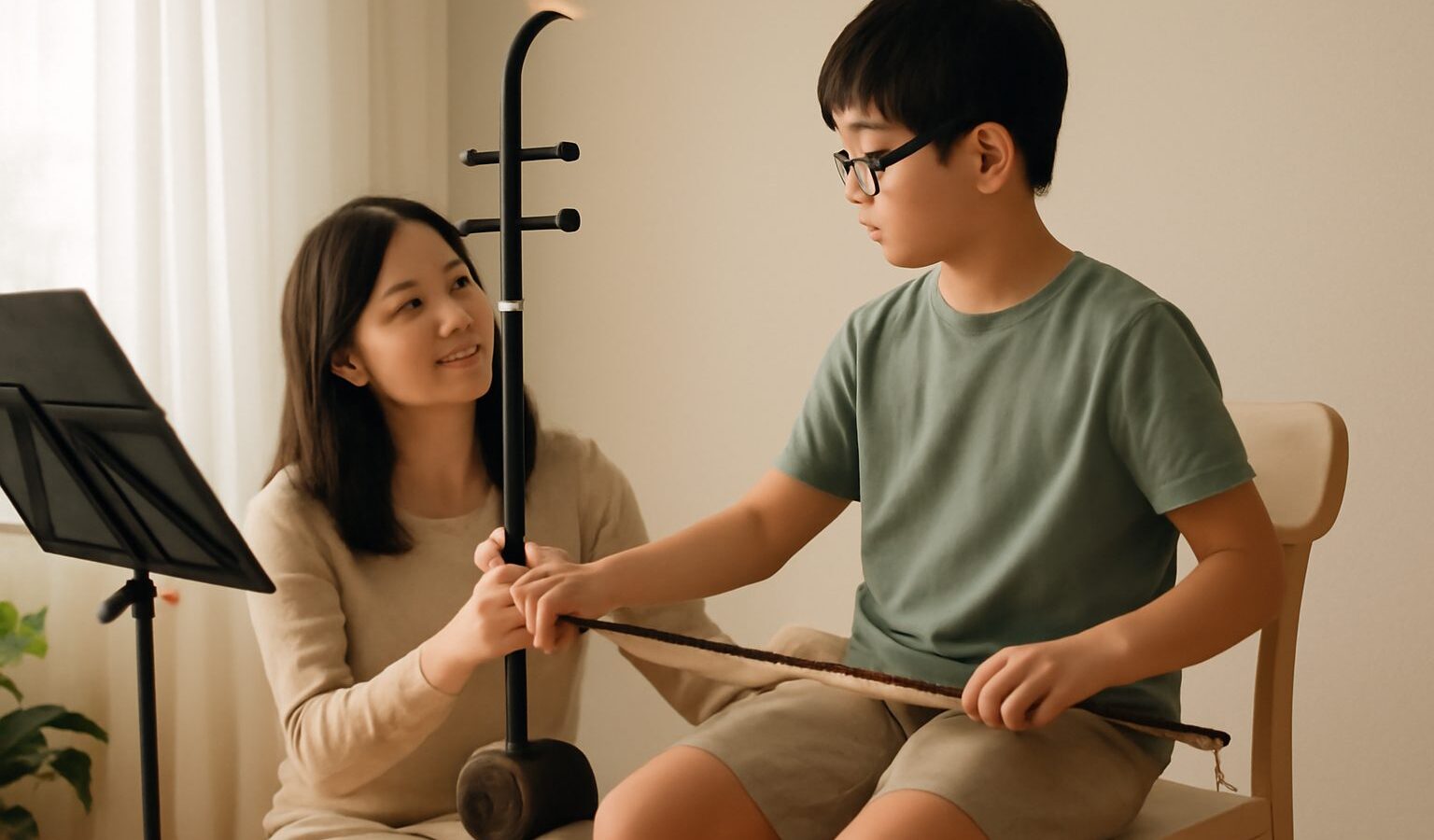
The erhu, the two-stringed Chinese fiddle with its haunting, voice-like tone, has a loyal following in Singapore. If you grew up in China you may remember hearing it in school performances, on television or in a park in the evening. Here, you will find it in community centres, school Chinese orchestras and private studios. This guide to erhu lessons Singapore options explains how classes are usually organised, how to choose a teacher for an adult or a child, and what to sort out before the first lesson.
If you want background on the instrument itself, its history and the basic technique, read our companion piece on learning the erhu. This article focuses on the practical side: finding and getting the most out of lessons.

Where Erhu Lessons Are Taught in Singapore
Erhu teaching in Singapore is spread across several kinds of providers. Each suits a different kind of learner.
- Community centres and clubs. Many community centres under the People’s Association run Chinese instrument classes, sometimes including erhu, as part of their course listings. These tend to be group classes for adults or seniors, often in the evening or on weekends. You can search for courses on the official People’s Association platform and filter by your neighbourhood.
- Private music schools. Some music schools that mainly teach piano or violin also offer Chinese instruments. Others specialise in Chinese music and teach erhu alongside guzheng, pipa and dizi.
- Independent teachers. Many erhu players teach one-to-one from home, at the student’s home or online. Some are performers with local Chinese orchestras; others trained at conservatories in China or Singapore.
- School Chinese orchestras. Many primary and secondary schools have a Chinese orchestra as a co-curricular activity (CCA). Children who join usually receive group instruction from instructors engaged by the school. This is a common first contact with the erhu for local children.
- Amateur ensembles. Community Chinese orchestras and interest groups sometimes run beginner sections or can recommend teachers. Our guide to joining a Chinese music group covers that path in more detail.
For newcomers from mainland China, the main difference from home is scale. Large cities in China often have dedicated youth palaces or district cultural centres with many erhu classes. Singapore’s offering is smaller and more scattered, so expect to ask around, compare and sometimes travel a little further.
Group Classes, Private Lessons or Online: Comparing Formats
The right format depends on age, goals and budget. Fees vary widely between providers and change over time, so ask each one for its current rates and what is included.
| Format | Best suited to | Strengths | Things to check |
|---|---|---|---|
| Group class at a community centre | Adult beginners, retirees, casual learners | Social, structured term, low commitment | Class size, whether instruments are provided, level of the class |
| Private one-to-one lesson | Children, exam candidates, serious adults | Personal correction of posture and bowing, flexible pace | Teacher’s background, lesson length, make-up policy |
| School Chinese orchestra CCA | Primary and secondary students | Ensemble experience, performances, peer motivation | Selection process, practice schedule, whether private lessons are also expected |
| Online lessons | Busy adults, learners already past the basics | No travel, wider choice of teachers including overseas | Camera angle for bow and hand checks, time zone, stable internet |
Many learners combine formats. A child might join the school orchestra and add a private lesson for technique, while an adult might start in a community class and switch to a private teacher after a year.
How to Choose an Erhu Teacher
The erhu is unforgiving in the early months. Intonation depends entirely on finger placement, since there is no fingerboard, and the bow is threaded between the two strings. Early habits stick, so the teacher matters.
When you speak to a teacher, ask about:
- Training and performing experience. Where they studied, whether they perform with an ensemble, and how long they have taught beginners.
- Experience with your age group. Teaching a seven-year-old is very different from teaching a fifty-year-old. Ask how they adapt lessons.
- Language of instruction. Many teachers teach in Mandarin, which is convenient for China newcomers. If your child is more comfortable in English, ask whether the teacher can explain in both.
- Notation. Erhu music is commonly written in jianpu, the numbered notation familiar to many people from China. Some teachers also use staff notation. Children already learning piano may prefer a teacher who can bridge both.
- Lesson structure. A good teacher will usually cover posture, bow hold, open strings and simple scales before tunes, and will set clear practice tasks.
- Trial lesson. Ask whether a trial is possible so you can see the teaching style before committing to a term.
Parents already familiar with Western music grading can read our guide to music lessons and ABRSM exams for children for comparison. Chinese instrument grading works differently, as explained below.
Getting an Erhu: Renting, Borrowing or Buying
Do not rush to buy an expensive instrument. Beginners can usually start in one of these ways:
- Use a provided instrument. Some community classes and school orchestras lend erhu to students, at least at the start. Ask before you buy.
- Borrow or rent. Some music shops and schools rent instruments. This is useful for children who may lose interest.
- Buy a student instrument. When you are sure you will continue, ask your teacher to help choose a student-grade erhu. Teachers can spot problems with the snakeskin or synthetic skin, the pegs and the bow that a beginner would miss.
If you are moving from China, you may consider bringing an erhu with you. Some erhu use python skin on the sound box, and wildlife trade rules can apply to animal-derived materials. Check the current requirements with the National Parks Board (NParks) before bringing or shipping one in, and keep any certificate that came with the instrument. Many modern student erhu use synthetic skin, which avoids this issue.
Humidity is the other local factor. Singapore’s damp air can affect the skin, the bow hair and the wooden pegs. Store the instrument in its case, away from direct aircon vents and windows, and ask your teacher how to look after it.
Graded Exams and Performance Goals
Some learners, especially children, like having a clear goal. Graded examinations for Chinese instruments are run in Singapore by local organisers, some in partnership with conservatories in China. The syllabus, grade structure and recognition differ from Western exam boards. If exams matter to you, ask your teacher which system they prepare students for and check the details directly with the organiser.
Exams are not the only path. Many adults learn simply to play favourite folk songs, and many children stay motivated through concerts with their school or community orchestra. Annual events around Chinese New Year and the Mid-Autumn Festival often feature community ensembles, which gives learners something to work towards.
Tips for Adults and Children Starting Out
For adults:
- Short daily practice works better than one long weekend session. Fifteen to twenty minutes is a realistic start.
- Record yourself on your phone. Intonation problems are easier to hear on playback.
- Be patient with the bow arm. Many adults find the pushing and pulling motion harder than the left hand.
- Joining a group, even informally, keeps motivation up after the first excitement fades.
For children:
- Sit with younger children during practice at first, especially to check posture.
- Agree on a regular practice time that fits around homework and CCA.
- Let them play pieces they recognise, such as songs from cartoons or festivals, alongside exercises.
- If your child is in a school Chinese orchestra, ask the instructor whether extra private lessons are needed or simply helpful.
For families settling in from China, erhu lessons can be a meaningful way to keep a cultural link while children grow up in Singapore. Many Singaporean families share the same interest, so it is also a friendly way to meet people.
Explore more: learning the erhu, joining a Chinese music group and music lessons and ABRSM exams for children.
Frequently Asked Questions
How hard is the erhu for an adult with no music background? It is challenging at first, because there are no frets, so you must learn pitch by finger placement and also control the bow. Many adults find the bow arm harder than the left hand. Steady, short practice and a patient teacher make early progress much smoother.
What is the youngest age a child can start learning the erhu? There is no single age, as it depends on the child’s size, attention span and hand strength. Some teachers prefer to wait until a child can hold the instrument and bow comfortably. Ask the teacher for a trial lesson and an honest assessment.
Can I learn the erhu from online videos instead of a teacher? Videos can help with practice, but a teacher is strongly recommended for beginners. Posture, bow hold and intonation habits form early, and a teacher can correct them. If you try videos first, consider a few lessons to check your technique.
What accessories do I need besides the erhu itself? Beginners usually need rosin for the bow, a spare set of strings, a soft cloth and a case. Some also use a stand and a small cushion for sitting. Ask your teacher what to buy, as they can recommend suitable items for your instrument.
Why does my erhu sound scratchy, and how can I fix it? A scratchy tone is common early on and often comes from bow pressure, speed or contact point, or from too little or too much rosin. Ask your teacher to check your bow technique and the instrument itself, since humidity and a worn skin or strings can also affect the sound.