
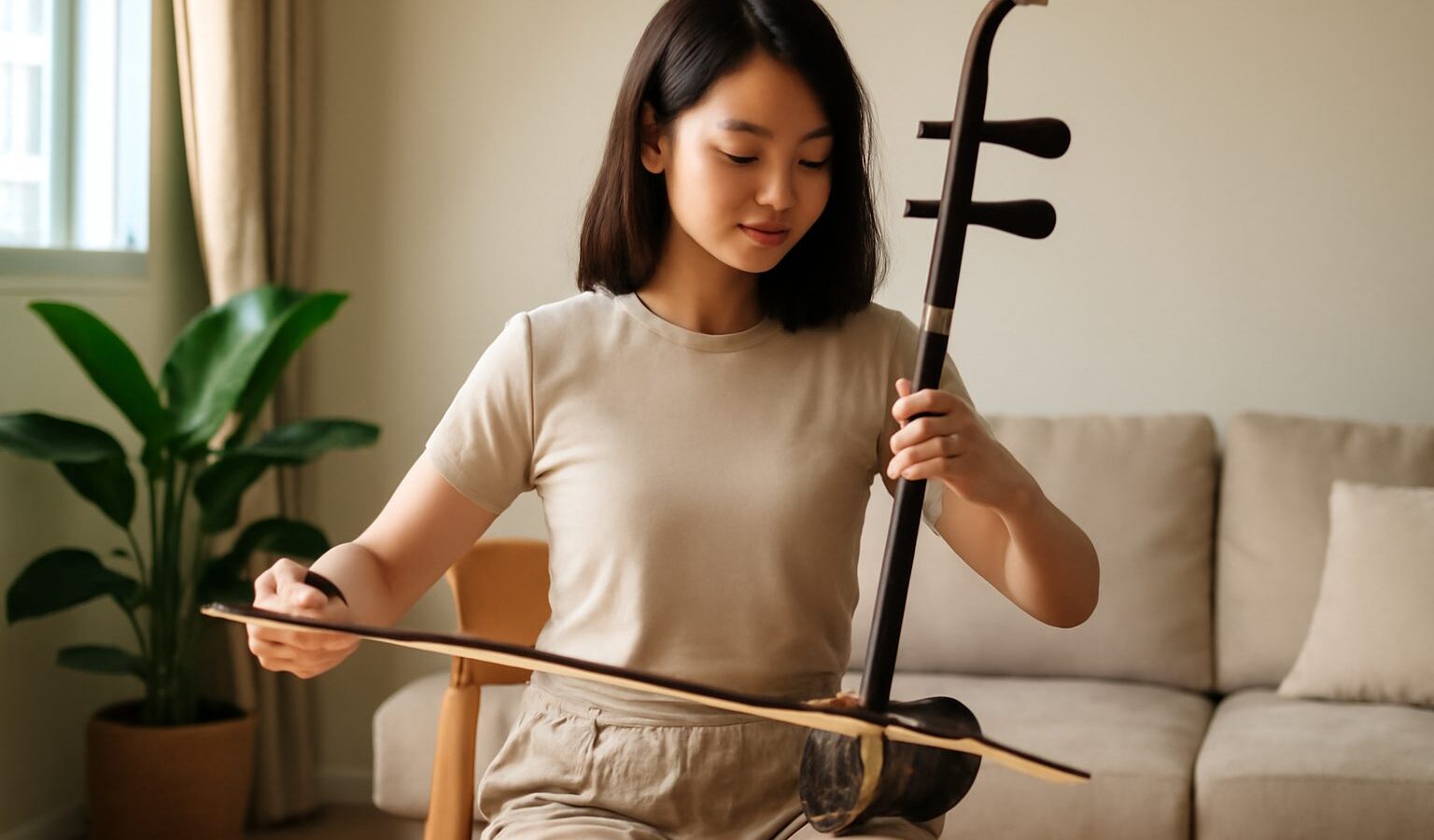
Learning erhu is one of the most rewarding paths into Chinese music, and it is far more approachable than its haunting, voice-like sound might suggest. The erhu is a two-string bowed fiddle with roots going back many centuries in China, and it sits at the heart of Chinese orchestras, opera and folk music. In a bilingual city like Singapore, it also carries real cultural weight, which is part of why so many families, students and hobbyists pick it up. This guide walks you through what the instrument is, what you need to start, and how to practise sensibly in a flat with neighbours close by.
What Makes the Erhu Special
The erhu is deceptively simple to look at and wonderfully expressive to play. A slender neck rises from a small resonating chamber, and two strings run the full length. Traditionally the sound box is covered with python skin, which gives the erhu its distinctive nasal, singing tone; many modern and student instruments use a synthetic membrane instead, which is more consistent and kinder to the humid tropics. The bow is not held separately the way a violin bow is. Its horsehair passes between the two strings, so the bow and instrument are effectively one system, and you draw the hair against one string or the other by changing pressure and angle.
There is no fingerboard. You press the strings in mid air, and your fingertips stop the note by touching string to string rather than string to wood. This is the single biggest surprise for beginners, and it is why intonation, meaning playing in tune, takes patience. The two strings are usually tuned a fifth apart, commonly to D and A, and a small loop called the qianjin binds them to the neck near the top. Once you understand these parts, the instrument stops looking mysterious and starts making sense.
What You Need to Start
You do not need much to begin, and you should resist buying anything expensive until you know you will stick with it.
- An entry-level erhu. A reputable Chinese instrument shop or a music school can point you to a sturdy student model. Synthetic-membrane erhus are a sensible first choice in Singapore because they cope better with humidity swings.
- Rosin for the bow hair, so it grips the strings and produces sound.
- A shoulder cloth or small pad, since the sound box rests on your left thigh and can slide on smooth trousers.
- A clip-on tuner or a tuning app to check your D and A strings.
- A folding stand and a simple notebook for the numbered notation (jianpu) that much Chinese repertoire uses.
Because the erhu has no frets and no fingerboard markings, a teacher is genuinely valuable early on. Even a handful of lessons will save you months of ingraining bad habits in your bow arm and left-hand position. Many community centres, Chinese orchestras and private studios across the island offer beginner erhu classes, and school co-curricular groups are a common entry point for younger players.
Your First Weeks of Practice
Progress on the erhu comes from short, focused, regular sessions rather than long occasional ones. Here is a sensible order to work through.
- Sit and hold correctly. Rest the sound box on your left thigh, keep your back tall, and let the neck lean slightly away from you. Comfort now prevents strain later.
- Learn the bow before the notes. Practise long, even strokes on open strings, aiming for a steady tone with no scratch. The bow arm is where good erhu sound is won or lost.
- Add the left hand. Start with first position and play slow scales, listening hard and adjusting your finger placement until each note sings in tune.
- Combine slowly. Play simple folk tunes at half speed, keeping the bow smooth and the fingers relaxed.
- Record yourself. Even a phone recording reveals intonation and tone problems your ear misses in the moment.
Tune every single time you practise. The erhu drifts easily, and training your ear to a correctly tuned instrument is part of learning erhu well. If you also want to understand why the strings sit a fifth apart and how melodies are built, a primer on understanding scales and keys will make the theory click faster.
Practising Considerately in an HDB Flat
The erhu is not a loud instrument by the standards of, say, a trumpet, but its tone carries and its high register can be piercing through the thin walls common in HDB and condo living. Be a considerate neighbour. Keep to reasonable hours, favouring daytime and early evening over late nights and early mornings, and follow your town council and HDB guidelines on noise. Practising a little away from a shared wall, closing the window during long sessions, and using soft furnishings to dampen reflections all help. There is no true silent erhu in the way there are silent violins, but a practice mute placed on the bridge lowers the volume noticeably for late sessions. Honest communication with immediate neighbours goes a long way too.
Caring for Your Erhu in the Tropics
Singapore’s heat and humidity are hard on wooden instruments, and the erhu’s membrane is especially sensitive.
- Store the instrument in its case with a little silica gel to buffer humidity swings, and keep it out of direct sun and away from air-conditioning vents that blow straight onto it.
- Loosen nothing that does not need loosening, but do wipe rosin dust off the strings and body after playing.
- Watch a natural-skin membrane for changes in tone that signal it is reacting to the weather; a synthetic membrane is far more stable and is one reason many local players choose it.
- Have a shop check the bridge, strings and qianjin periodically, and replace worn strings before they sound dull.
Erhu Versus Other First Instruments
If you are weighing the erhu against another starter instrument, it helps to see the trade-offs side by side.
| Consideration | Erhu | Guzheng | Trumpet |
|---|---|---|---|
| Intonation difficulty | High, no frets or fingerboard | Low, fixed tuned strings | Moderate, needs ear and lips |
| Volume in a flat | Moderate, carries in high register | Moderate to loud, resonant | Loud, needs a mute |
| Portability | Very portable | Bulky and heavy | Very portable |
| Early tone reward | Slow, bowing takes time | Fast, plucking sounds pleasant early | Slow, embouchure takes time |
| Cultural repertoire | Rich Chinese folk and orchestral | Rich Chinese classical | Broad, jazz to classical |
Every choice has trade-offs, and the best instrument is the one you will actually pick up each day. If the erhu’s expressive, vocal quality draws you in, that pull will carry you through the early months when intonation feels frustrating.
Keeping Going
The erhu rewards patience more than almost any beginner instrument, because sound and tuning depend so much on tiny adjustments you can only feel with practice. Set small weekly goals, join a class or ensemble for motivation, and give your ear time to develop. Within a few months of steady work, simple folk melodies will start to sound genuinely beautiful, and that is a wonderful place to be.
Explore more: learning the guzheng, learning the trumpet, and understanding scales and keys.
Learning erhu is a long, satisfying journey rather than a quick win, but it connects you to a living tradition and a sound like no other. Start small, tune often, respect your neighbours and the weather, and enjoy every step.