
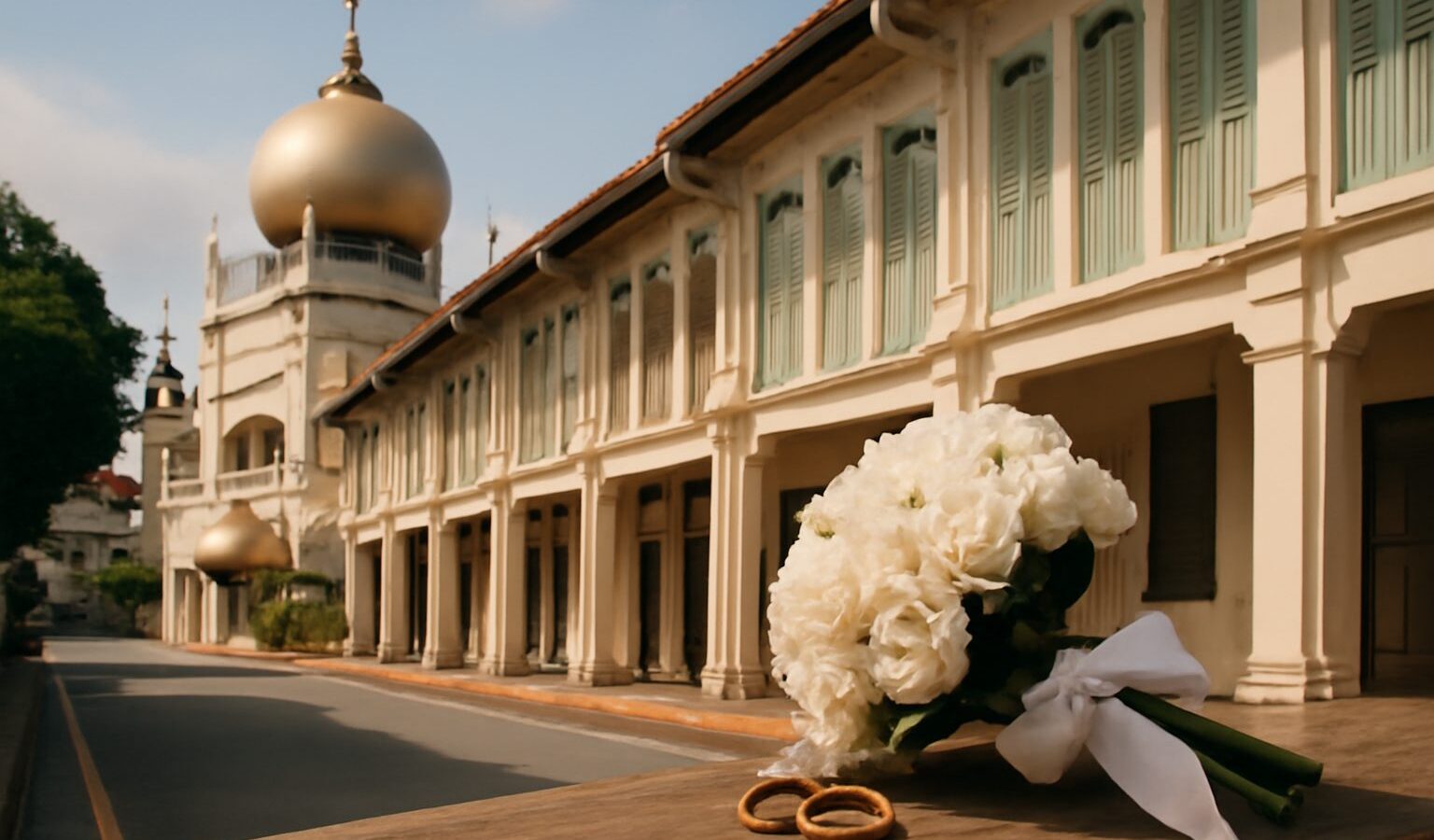
A Eurasian wedding in Singapore is a warm, family-centred celebration where European and Asian roots meet at the same table. The Eurasian community traces its heritage to unions between Europeans, including Portuguese, Dutch and British settlers, and local and regional Asian communities over several centuries. Their weddings tend to blend a Christian church ceremony, usually Catholic, with the food, music and easy hospitality that make Eurasian gatherings so beloved. Customs differ from one family to the next, so treat this as a friendly overview rather than a fixed script, and enjoy the sense of togetherness that runs through it all.
Who the Eurasian Community Is
Eurasians are one of Singapore’s founding communities, recognised as a distinct group with their own heritage, cuisine and, historically, their own creole language, Kristang, which developed from Portuguese and Malay. Many families carry surnames of Portuguese, Dutch or British origin alongside deep local roots.
Because the community is diverse, spanning different faiths, family histories and degrees of tradition, there is no single template for a Eurasian wedding. What ties them together is a strong sense of family, a Christian heart in most households, and a table that speaks of centuries of mixing. This shared spirit, rather than a rigid set of rites, is what gives a Eurasian wedding its character. The community shares this Creole, in-between quality with the Peranakans, and readers may enjoy comparing customs in our guide to Peranakan wedding customs.
The Church Ceremony at the Heart of the Day
For most Eurasian families, the religious ceremony is the anchor of the wedding. A Catholic nuptial Mass, or a service in another Christian denomination, is held in a church, with the couple exchanging vows and rings before a priest and their gathered families. The readings, hymns and blessings follow the church’s own order of service, and the parish is the authority on what a couple must do to marry there.
Preparation often begins months ahead with marriage preparation sessions run by the church, a meaningful part of the journey rather than mere paperwork. On the day, the bride typically wears a white gown and the groom a suit, in keeping with Western Christian custom. Bridesmaids, groomsmen and flower girls are common, and the ceremony carries the quiet dignity of a service that many in the family will have attended for generations.
Couples should remember that the church ceremony and the legal registration of the marriage are separate matters in Singapore, handled through the Registry of Marriages, and current requirements should be confirmed with the relevant authority.
Food, the Sugee Cake and the Family Table
If there is one thing every Eurasian wedding is remembered for, it is the food. Eurasian cuisine is a treasured part of Singapore’s heritage, and a wedding is where it shines. Dishes such as devil’s curry, a robust and tangy curry traditionally served at celebrations, feni or vindaloo-style meats, and an array of home-cooked favourites turn the reception into a feast of shared memory.
The crowning glory is often the sugee cake, a rich, moist almond and semolina cake, semolina being sugee in the community’s usage, that many families guard as a closely held recipe. A well-made sugee cake is a point of quiet family pride, sometimes baked by an aunt or grandmother rather than a bakery, and slices may be boxed for guests to take home.
Beyond the mains, a Eurasian celebration often carries a spread of treasured sweets and snacks. Sugee cake may share the table with kueh, cordials and other festive bakes, and older relatives sometimes bring their own contributions, turning the dessert corner into a small showcase of family recipes. Because so much is home-cooked, the food becomes a way of honouring the generations who kept these dishes alive through the years.
The table is where the community’s hospitality is fully expressed. Long meals, second helpings and lively conversation are all part of the welcome, and guests honour their hosts simply by eating well and joining in the easy, unhurried warmth of the gathering.
How Eurasian Weddings Compare and Adapt
Eurasian weddings blend Western and local elements in ways that vary by family. Some lean strongly towards a classic Western church wedding with a hotel reception; others weave in heritage food, Kristang or Portuguese-influenced music, and community customs. The table below sketches a few common elements and how they tend to appear, as a general picture rather than a rule for any household.
| Element | Common form | Notes |
|---|---|---|
| Ceremony | Catholic or Christian church service | Parish sets the requirements |
| Attire | White gown and suit | Bridal party of maids and groomsmen |
| Signature cake | Sugee almond and semolina cake | Often a family recipe |
| Festive food | Devil’s curry and heritage dishes | Central to the celebration |
| Music | Church hymns, then live or recorded sets | Some add heritage tunes |
Modern Eurasian couples adapt freely. Interfaith and mixed-culture marriages are common, and families blend traditions with care and good humour. Some couples add a Kristang blessing or a nod to Portuguese-Eurasian heritage; others keep things simple and contemporary. None of these choices is more authentic than another, since the community itself is defined by blending.
For couples, a little planning goes a long way. Speak early with your parish about dates and preparation, decide which heritage touches matter most to your family, and give the food the attention it deserves, since guests will remember it. Assembling a home together is part of the joy too, and our guide to preparing a bridal trousseau offers a practical, culture-neutral checklist.
For guests, the etiquette is refreshingly simple. Dress smartly for church, follow the order of service, and come hungry. If you are curious about how Singapore’s other communities marry, our guide to Hindu wedding rituals explores a very different but equally warm tradition. A Eurasian wedding, at its core, is a family folding a new member into its long, well-loved story, and there is no wrong way to share in that welcome.