
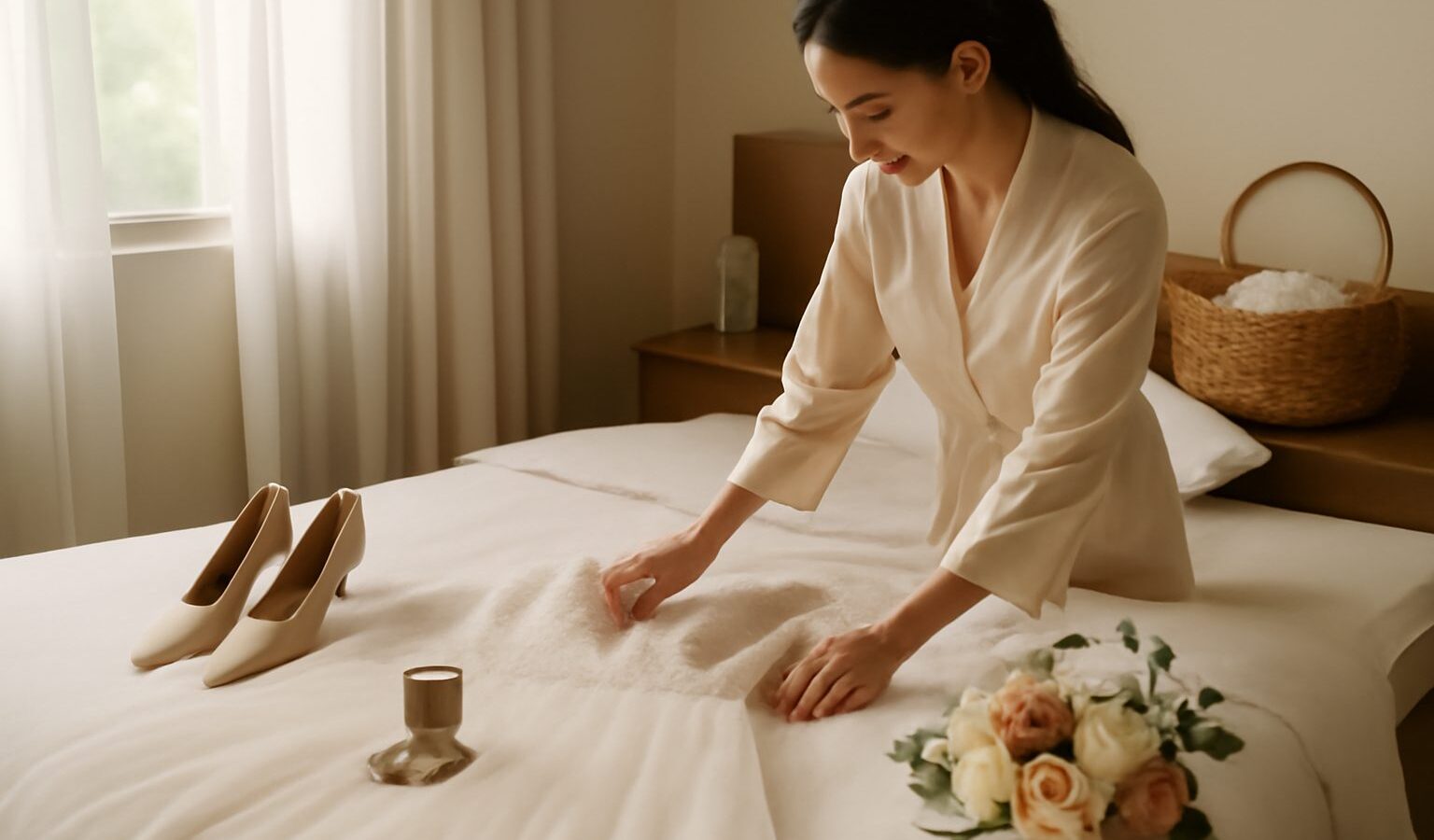
The word trousseau comes from French and once meant the little bundle a bride brought to her new home. Today, preparing a bridal trousseau means gathering the clothes, personal items and symbolic goods a bride sets aside for married life, a tradition that appears, in different forms, across many of Singapore’s communities. For some families it is a heartfelt ritual rich with meaning; for others it is a practical, modern checklist. This guide explains what a trousseau traditionally holds, how the custom varies, and how couples today shape it to suit their own lives.
As with every custom in this series, families observe the trousseau to very different degrees, and there is no single correct version. Read what follows as a friendly starting point rather than a set of rules, and let your own family’s practice and your budget guide you.
What a Bridal Trousseau Traditionally Holds
At its simplest, a trousseau is a curated collection a bride prepares before the wedding, often blessed or presented as part of the celebrations. The exact contents differ by culture, but several categories recur.
- Clothing and attire. New outfits for the wedding and early married life, sometimes including items in auspicious colours or traditional dress.
- Personal care items. Everyday essentials, cosmetics and toiletries, symbolising a fresh start.
- Jewellery and adornments. Pieces gifted by family, which in some Chinese customs overlap with wedding gold; our guide to the si dian jin wedding jewellery explains one such tradition.
- Household and symbolic goods. In dowry-style customs, items for the new home, along with objects chosen for their symbolic wishes for prosperity and children.
- Sentimental keepsakes. Family heirlooms or blessings passed from mother to daughter.
In several traditions the trousseau connects to the dowry, known in Mandarin as jia zhuang, the goods a bride’s family prepares, and in Malay weddings to the hantaran, an exchange of gift trays between the two families. These are related but distinct ideas, and not every community frames the trousseau the same way.
How the Custom Varies Across Communities
Singapore’s diversity means a trousseau can look very different from one household to the next. The comparison below sketches broad tendencies across a few communities. Please treat it as illustrative, since families vary widely, observe customs to different degrees, and increasingly blend traditions.
| Community | Trousseau often associated with | Notes |
|---|---|---|
| Chinese (various dialects) | Dowry goods (jia zhuang), wedding gold, auspicious items | Contents and scale vary by family and dialect group |
| Malay or Muslim | Hantaran gift trays exchanged between families | Cultural custom around the nikah; details vary |
| Indian | Clothing, jewellery and household items by tradition | Practices differ across regions and communities |
| Eurasian or others | A more Western-style collection of personal items | Often practical and individualised |
These are cultural generalisations, not rules about any individual or family. Intermarriage, faith, personal taste and simple practicality all shape what a modern bride actually prepares, so the respectful and sensible move is to ask the family involved rather than assume.
It also helps to remember that a trousseau is not a competition. In earlier generations, when a bride truly moved into another household with everything she owned, the collection had a practical purpose: it set her up for a new home. Today, when many couples already live independently or move into a flat they have furnished together, much of the original function has faded, and the trousseau becomes more symbolic than strictly necessary. Understanding that history makes it easier to keep the parts that carry meaning while quietly letting go of anything that no longer fits modern life in Singapore.
How to Plan a Trousseau Today
For couples who want to honour the tradition without being overwhelmed, a little planning turns the trousseau from a source of stress into an enjoyable part of the run-up.
Some practical steps:
- Talk with family early. Ask your parents and elders what your family traditionally includes, and why. This is often where the most meaningful items come from.
- Decide on scale together. Agree as a couple, and with both families where relevant, on how elaborate or simple the trousseau will be.
- Make a working list. Group items into attire, personal essentials, jewellery, household goods and keepsakes, then add what genuinely suits your life.
- Set a sensible budget. A trousseau should fit comfortably within your means. There is no need to overspend or borrow heavily to impress; a thoughtful, modest collection is entirely proper.
- Time your shopping. Spread purchases over the months before the wedding to avoid a last-minute rush and to catch sales.
- Keep the meaning in view. Choose a few symbolic or sentimental items that genuinely matter to you, rather than filling a list for its own sake.
This is general guidance, not financial advice, and the golden rule is simple: let the trousseau reflect your values and your budget, not social pressure.
Common Mistakes and How to Avoid Them
A few pitfalls come up again and again, and all are easy to sidestep with a little foresight.
- Overspending to keep up. Comparison with elaborate weddings can push couples into unnecessary expense or debt. Set your own comfortable limit and hold to it.
- Leaving it too late. A rushed trousseau in the final weeks adds stress to an already busy season. Start early and pace yourself.
- Assuming instead of asking. Guessing what a family expects, especially in an intercultural marriage, can cause friction. A gentle conversation clears it up.
- Ignoring practicality. Beautiful but unusable items gather dust. Balance the symbolic with things you will genuinely wear and use.
- Overlooking the couple’s own taste. Traditions matter, but so does the bride’s individuality. Blend heritage with what feels authentically yours.
The trousseau often sits alongside other pre-wedding rites, so many couples plan it around the an chuang bed-setting ceremony and the Chinese hair-combing ceremony, and it connects naturally to the wider world of dialect wedding customs in Singapore.
Prepared thoughtfully, a bridal trousseau is far more than a shopping list. It is a warm, tangible way to carry your family’s blessings and your own hopes into a new home. Keep it meaningful, keep it within budget, and let it be a joyful part of beginning married life.
Explore more: the an chuang bed-setting ceremony, the Chinese hair-combing ceremony, dialect wedding customs in Singapore, and the si dian jin wedding jewellery explained.